Mel Robeck: The Azusa Street Mission and Revival

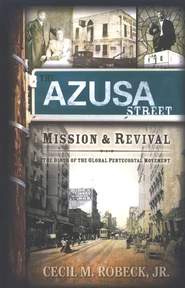
 Cecil M. Robeck, Jr., The Azusa Street Mission And Revival: The Birth Of The Global Pentecostal Movement (Nashville: Thomas Nelson Publishers, 2006), 342 pages.
About ten years ago, I audited a seminary course about the Pentecostal Movement. The course was a cooperative effort between Gordon-Conwell Theological Seminary and Harvard Divinity School. The classes were held at Harvard Divinity School and were team-taught by two professors, one from each of the respective schools. During that course, the Harvard professor, Harvey Cox, said that if Cecil Robeck ever sat down to write about Azusa Street that his book would be the definitive work on the subject. If that is true, we have the first volume now available (Robeck indicates in the book that he expects more volumes to follow). The release of this book is very timely; it coincides with the one hundredth anniversary of the outpouring of the Holy Spirit at the Azusa Street Mission.
Robeck has done extensive research for this book. The book is filled with detailed information about dates, times, places and people. He has gathered this information from a number of sources including interviews with eyewitnesses of the revival and the secular press. The variety of his sources allows him to show the reader how Azusa Street was viewed by both believers and unbelievers alike. Writing about one hundred years after the revival allows Robeck to step back and be fairly objective in interpreting the facts that he has gathered.
The book gives considerable attention to the pastor of the Azusa Street Mission, William J. Seymour. Robeck looks at various factors that contributed to making Seymour the leader that he was, namely his upbringing and spiritual journey. Seymour comes across as a very humble and devout man, who was a team player. One indication of this was that he had a leadership team at the mission that was made up of both men and women and was multi-ethnic. Another evidence of his team spirit was his desire to cooperate, and work with leaders of other Pentecostal ministries. Though Seymour was humble he was also very strong, he had to deal with difficult issues at the mission as well as multiple attempts by leaders, from outside of the mission, who tried to discredit him or steal his ministry.
The book also gives one a good look at the services of the Azusa Street mission. Robeck writes about various aspects of the services including, the worship, preaching and singing that took place at the mission. One very interesting section dealt with singing in the Spirit. The revival had many critics, from both inside and outside the church, but one thing that seems to have especially touched the visitors at Azusa Street was hearing the congregation sing in tongues. When writing about the mission Robeck does not attempt to gloss over, or cover up the shortcomings of the mission, questionable practices and false doctrines are mentioned along with the revival’s positive aspects.
The book also demonstrates that the Azusa Street Mission was not just a “bless me club.†While people came from near and far to receive their baptism in the Holy Spirit at the Azusa Street mission the experience was not seen as an end in itself. The purpose of the baptism was to be a witness. Many people went out from Azusa Street as missionaries, some went to the other parts of the United States and some to other countries. While the missionary emphasis was good and God used many who went out, the book demonstrates that there were some problems as well. Some who went out to the field were ill equipped doctrinally, and in other ways, and as a result, some who went to the field did not stay very long. One factor that had some bearing on this was a misunderstanding about speaking in tongues. Many at that time believed that when God gave them the ability to speak in tongues that He had given them a new tongue so that they could preach the gospel in another land without having to study the language. Some were troubled when they got to the field and this did not prove to be true.
The Azusa Street Mission And Revival chronicles both the rise and decline of the Azusa Street mission. What is amazing about Azusa Street is that this is the story of how God took a prayer meeting of fifteen people and grew it into something that would shake the world. There is much in the book to instruct, encourage, and challenge, as we move into the second century of the contemporary Pentecostal Movement.
Reviewed by John Lathrop
Â