Frank Macchia: Baptized in the Spirit

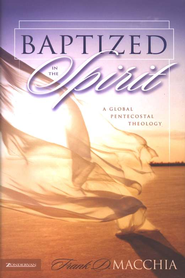
 Frank D. Macchia, Baptized in the Spirit: A Global Pentecostal Theology (Grand Rapids: Zondervan, 2006), 296 pages.
Frank Macchia, (ThD, University of Basel, Switzerland) represents that interesting paradox once thought of as a possible oxymoron: a true Pentecostal scholar. At least no one who reads his Baptized in the Spirit should any longer doubt the evident reality, vitality, and maturity of today’s Pentecostal scholarship. Dr. Macchia, one of the world’s leading Pentecostal theologians, is currently a professor of theology at Vanguard University in Costa Mesa, CA, serves as senior editor of Pneuma: The Journal of the Society for Pentecostal Studies, is a former president of the Society of Pentecostal Studies, and serves on the Faith and Order Commission of the National Council of Churches. Some have yielded to a temptation to paste Pentecostal insights onto an already existing theological paradigm but Macchia proposes a truly all-encompassing theology organized around Spirit baptism that is a profound integration of an authentic Pentecostal ethos with classic and contemporary Christian theology. As such it deserves to be read widely by Pentecostals themselves and by others seeking to understand Pentecostal theology today.
Professor Macchia begins his task by “framing the issue†in a helpful introductory chapter. Here he shares his exciting Pentecostal testimony of being baptized in the Holy Spirit. That Spirit baptism is much more to Macchia than an interesting item for intellectual reflection is readily apparent. Then he outlines the main themes he develops throughout the book: that Spirit baptism “involves experience;†is a “fluid metaphor surrounded by ambiguous imagery†capable of encompassing numerous emphases; is both charismatic (Lukan) and soteriological (Pauline) in nature; and, that it includes “a Pentecost/kingdom of God correlation†in which “the highest description possible of the substance of Spirit baptism is an eschatological gift that functions as an outpouring of divine love.†Significantly, Macchia maintains that the Holy Spirit’s work “cannot be compartmentalized or separated,†chiding Pentecostals for being too narrow and consequently not developing a broader (and deeper?) pneumatology. He declares that “the vision of the whole for which this book reaches†is that purposeful development.
Macchia insists that though many helpful and insightful Pentecostal monographs have been produced, a central focus on Spirit baptism is regrettably missing in more recent scholarship. He therefore calls for a return to Spirit baptism as the central distinctive of Pentecostals. His survey of the historic development and current state of Pentecostal theology and his passionate argument for completing “the unfinished business of Pentecostal theology†is worth the price of the book. Macchia makes plain his wish to expand the boundaries of Spirit baptism to include applications to all of Christian life and even God’s eventual and ultimate cosmic presence. For him, Spirit baptism in the present age points to and partakes of existence with God in the resurrection and the new heavens and new earth. Macchia places Spirit baptism in Trinitarian perspective. He elucidates the Pentecost-Kingdom connection he argues for throughout the book, the Church’s faith in Jesus as Spirit Baptizer, and in an especially stimulating section, the Trinitarian implications of Spirit baptism itself, before unpacking his understanding of how Spirit baptism impacts present and future life in the Kingdom. Macchia confessedly shows his “Pentecostal colors†here. Then he extensively examines ecclesiology in light of Spirit baptism. Among other things, Macchia stresses koinonia in the Spirit as a possible key to Pentecostal progress on understandings of the Church and also argues for a more pneumatological anthropology. Macchia takes a prime opportunity to address the problems of contemporary religious pluralism too. He describes the uniqueness of the Church in terms of “a critical dialectic†of witness and sign of God’s grace in an all-too-graceless world before addressing the more traditional marks of the Church. He confessedly shows his “Barthian colors†here. The capstone of the book argues emphatically for the Spirit baptized life as an expression of the depths of divine love. Macchia suggests an integrative theology of love that relates cardinal Christian virtues and incorporates sanctification and charismatic gifting/empowerment, personal and social transformation, and historical and eschatological concerns and values through the doctrine and experience of Spirit baptism.
Throughout his book Macchia sustains a reverence for sacred Scripture, always giving it the first and last word in any argument. He also interacts expertly and insightfully with a wide range of thinkers and theologians, including other Pentecostal scholars as well as patristic and contemporary ecumenical sources. He often includes opponents of Pentecostalism, frequently offering robust rebuttals. Special affinities with Barth are sometimes apparent. Most importantly, Macchia explores how the doctrine of Spirit baptism may inform an overall Christian worldview rather than limiting it to any single esoteric experience. In this respect he admirably achieves his anticipated “vision of the whole.†He also carefully and faithfully draws on thinkers around the world and is therefore not only ecumenical but truly global in his perspective.

A possible criticism concerning this book could come from those who perhaps fear that Macchia’s enlargement of Spirit baptism risks losing its classical Pentecostal distinctiveness. After all, he basically admits that the Evangelicals (and others) who insist on Spirit baptism in a context of conversion-initiation are at least partially correct. And his emphasis on the eschatological Spirit’s indwelling and infilling of all creation could be construed as a concession to the thought of Moltmann and others regarding God’s ultimate interdependent relationship with the world. Similarly, his connection of Spirit baptism with the Kingdom and with the dynamics and ethics of love implies a certain Wesleyan-Holiness construct often used against Pentecostals. Macchia might reply that the main elements of these emphases are not so much incorrect as incomplete—as is a Pentecostalism stressing Spirit baptism only as speaking in tongues or spiritual gifts! The key for me is that he never emphasizes the above themes in exclusion of charismatic gifting and/or vocational empowerment but always in a context of inclusion and integration. What we have here therefore is not a diminishment of distinctive Pentecostalism but rather an authentic embellishment of its inner reality for a broader perspective. Perhaps imperative for Pentecostals accepting this line of thought will be an intentional effort to balance its both/and elements rather than being thrown into any either/or positions.
Macchia himself is particularly adept at balance (always a challenge for anyone, especially Pentecostals!). An evident example is his rigorous refutation of the philosophy of religious pluralism. He skillfully argues that Christ’s role as Spirit Baptizer indicates the Church is the locus of the Spirit’s work, but also that the Spirit still works in the wider religious world because the Kingdom extends in gracious ways beyond ecclesial borders. Pluralist equalizations of all religions are thereby refuted without falling into the equal and opposite error of exclusivist incriminations. Accordingly, Macchia adds his voice to others assisting Pentecostals in advancing toward a mature, moderate theology of religions.
Macchia’s Baptized in the Spirit promises to provoke much discussion both within and without the Pentecostal movement itself. I predict that any scholar serious about Pentecostalism will have to take his account into careful consideration. Fortunately, though he writes at a profound theological level, Macchia’s readable style makes this work accessible beyond academia’s professional theologians to many “amateur†theologians in the pastorate or in positions of church leadership. I highly recommend it.
Reviewed by Tony Richie
Â
Preview: http://books.google.com/books/about/Baptized_in_the_Spirit.html?id=KtQv435JLx8C
Â