Christians and a Land Called Holy

Â
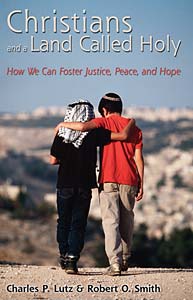
 Charles P. Lutz and Robert O. Smith, Christians and a Land Called Holy: How We Can Foster Justice, Peace, and Hope (Minneapolis: Fortress, 2006), 146 pages, ISBN 9780800637842.
Christians and a Land Called Holy is an appeal for action on the part of the wider Christian community in response to the vexing political situation in the Holy Land. This book was written in response to a visit of the authors to Israel/Palestine in 2002. They came away with a conviction that “Christian from elsewhere in the world have a faith-based interest in seeking a just peace between Israelis and Palestinians, and that they have a key role to play in pursuit of that peace†(ix).
Charles P. Lutz is a retired journalist who serves as Minnesota coordinator for Churches for Middle East Peace, a coalition of national church policy agencies. Robert O. Smith is an ordained pastor in the Evangelical Lutheran Church, who serves as Campus Pastor for the University of Chicago. Both have traveled often to Israel and regard themselves as emissaries for peace in the Holy Land.
The book is composed of two chapters each by the authors, an appendix featuring a short essay on the biblical politics of the Holy Land by Roman Catholic scholar Ronald D. Witherup, and a resource section with an annotated list of books, videos, and websites. The book also includes maps and twelve black and white photos.
The main argument of the book is that Western Christians should advocate for peace between Israelis and Palestinians. The authors state four reasons in support of their argument. First, peace would assure safe passage for Christian pilgrims. Second, the indigenous Christians of Palestine are “begging us to become active in their struggle for a secure and just peace†(ix). Third, Christian ministries in Israel/Palestine are disrupted by outbreaks of violence. And fourth, America Christians should engage in citizen advocacy with their government, which has influence over the conflicting parties.
In chapter 1, Lutz poses the question, “What’s So Special about This Space?†His answer is that the religious meaning of the land called holy is significantly qualified by the universalizing love of Christ, in which “all lands become equally holy†(20). Based on his conviction that the gospel has shattered the privileged geographic significance of Israel/Palestine, Lutz argues that Christians should be primarily preoccupied with securing justice and peace for all of its inhabitants, including Muslims.
In Chapter 3, “Division in the Christian Family,†Smith assesses two opposing Christian views of state of Israel, evangelical Christian Zionism and mainline Christian Palestinianism. The former he denounces as indifferent to human suffering and the latter he upholds as the key to achieving genuine reconciliation and peace. Smith calls for a comprehensive strategy to accomplish “the marginalization of Christian Zionism it richly deserves†(80). He commends a recent appeal of the World Council of Churches for its member bodies to use economic pressures, such as disinvestment in Israel, to lobby against Israeli occupation of Palestinian territories.
In Chapter 4, Lutz issues a four-part “Call to Action,†which provides his readers with many useful tools for gathering accurate news, composing petitions for the corporate prayer of local churches, advocating for changes in American public policy, and planning pilgrimages that show solidarity with the Palestinian Christian community in the Holy Land. Lutz commends the view of the sticking point in the peace process cited in a statement of Churches for Middle East Peace (CMEP), a coalition of twenty-one U.S. Orthodox, Protestant, and Roman Catholic national policy offices: “We believe that one of the primary outcomes of peace negotiations in the Middle East must be a viable Palestinian state living in peace alongside the state of Israel. For a state of Palestine to be viable, all Israeli settlement activity in the Occupied Territories must cease†(105). Lutz urges the leaders of faith communities to play a central role in bringing an end to Israeli settlement construction and securing a Palestinian state.
In the appendix, Witherup addresses the question, “Whose Land Is It?†Based on a minimalist assessment of the evidence of biblical archaeology, he takes a dismissive view of any attempt to utilize the biblical perspective as a blueprint for political action, averring that “the place to begin with the land question is not with the Bible but with the facts of the present situation in the Holy Land†(130). He advances three guidelines: 1. Israelis and Palestinians must share the land in two nations. 2. The construction of Jewish settlements in the West Bank must cease. 3. Jerusalem should be preserved as a holy city and home of diverse religious communities.
There is no question that the authors of A Land Called Holy are committed to the cause of peace in Israel/Palestine, with which the reviewer strongly resonates. However, their strategy for pursuing peace is flawed in three respects. For starters, in jumping on the bandwagon of pressure politics, this book offers a politically biased analysis of the situation in the Holy Land which will only drive a wedge between the supporters and detractors of the state of Israel. Second, the authors downplay the problem of Islamic extremism. For example, they overstate their case when they allege that in the period of Islamic dominance (638-1948 CE), “Jerusalem enjoyed peace, prosperity, and even religious tolerance that was probably unsurpassed anywhere in the world during those thirteen hundred years†(3). Albeit sporadic, Jerusalem suffered its share of egregious Muslim suppression of Christian churches. Third, this book demonizes Christian Zionism. The authors speak in disparaging tones of premillennial dispensationalism, without bothering to provide a fair exposition of its meaning. One of the authors goes so far as to insist that “because of that way of reading the Bible, people are dying†(65). This allegation is a gross oversimplification of the causes of the violence that plagues Israel/Palestine. An approach more conducive to peacemaking would acknowledge the Christocentric core of Christian Zionist eschatology and allow for honest differences of theological and political opinion among Christians.
Despite these objections, A Land Called Holy is worthy of our attention, for the sake of helping us to understand the perspectives of North American Christians who side with the Palestinian opposition to the state of Israel.
Reviewed by Eric N. Newberg
Preview this book online at: http://books.google.com/books?id=v22vBmgMG9MC
Publisher’s page: http://store.augsburgfortress.org/store/product/2729/Christians-and-a-Land-Called-Holy-How-We-Can-Foster-Justice-Peace-and-Hope