
Michael Bird: Jesus Is the Christ

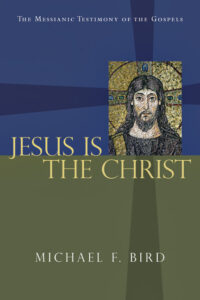 Michael F. Bird, Jesus Is the Christ: The Messianic Testimony of the Gospels (Downers Grove, IL: IVP Academic, 2012), 207 pages, ISBN 9780830828234.
Michael F. Bird, lecturer in Theology at Ridley College in Melbourne, Australia provides the reader a study of how each of the four evangelists present Jesus as the Messiah of early Israel’s expectation. This is the first study that this reviewer has seen to do a comparative study among the gospels as to Jesus’ messiahship. The author begins with Mark and then proceeds to Matthew, Luke (including Acts), and John, and ending with a discussions of common elements as well as what is distinctive to each gospel account.
Embedded within this study is the contention that the declaration of Jesus as Messiah was from the beginning of the gospel message and not a later ascription by the early church looking at the person of Jesus. This is probably the reason Bird begins with Mark which is considered to be the earliest of the gospel messages. Bird, however, goes back to the Old Testament’s understanding of messiahship and shows how Jesus fits within Israel’s expectation of a coming servant-shepherd king that would deliver them from their exile and which deliverance would draw all other nations to worship the one true God. Mark’s gospel, supposedly the earliest of the four gospels, is addressed to a gentile world. Bird takes the pains of careful biblical study to show how the messiah of Israel’s expectations is also the anointed deliverer (Christos = Messia) of all peoples. He does this without making note of the fact that of the four gospels, Mark is the only one who translates from the Aramaic/Syriac language of the Near East for the benefit of his gentile readers.
Though very detailed, Bird’s study is very readable. Aiding this readability is his use of end-notes rather than foot-notes at the bottom of each page. It is a study for the general reader as well as for the more academic reader interested in a comparative study.
After dealing with Mark’s testimony to Jesus as Messiah (Christ), Bird proceeds to a study of Matthew’s testimony which he maintains was directed to a Jewish audience as is evident by his references to Abraham and to David the king. Bird understands Jesus’ ministry as the fulfillment of the ancient prophetic expectation if a promised Davidic descendant who would deliver Israel from exile as a shepherd-king. Bird recalls both Ezekiel’s and Micah’s prophecies of the shepherd who gathers his scattered flock. He also sees a connection between Balaam’s fourth prophecy recorded in Numbers 24:17; “A Star shall come out of Jacob” and the visit of the Magi who followed a star (Matt. 2:1-12) to Bethlehem and gave gifts of gold, frankincense and myrrh to the child Jesus. The Magi represented the goyim (gentiles, Latin) coming to worship the Messiah (Christ) of Israel. Bird went on to substantiate the inter-relatedness between Balaam’s prophecy and the coming of the Magi by indicating the references to a messianic star found in the Jewish extra-biblical targums Levi 1813 and Judah 24:1.
Moving from the discussion of Luke’s treatment of Jesus as Messiah, Bird goes on to provide a study of the Fourth Evangelist’s understanding of Jesus as Messiah. As Bird points out, John’s favorite phrase is “he who is to come” or the “coming one.” To Bird, Jesus is the “elusive” Messiah. He borrowed the adjective “elusive” from Mark Stibbe’s “The Elusive Christ,” an entry in an 1991 issue of the Journal for the Study of the New Testament (4 L, p. 20). Bird explains that when the crowds seek Jesus, he only allows them to find him when he is ready for them (p. 97). He suggests that the fourth evangelist is not fully aware of the Jewish ideas associated with the title “messiah.” This assertion on the part of Dr. Bird strikes as odd since the fourth evangelist is the most Judaean of the other three evangelists. In point of fact, the fourth evangelist gives more attention to Jesus’ ministry in Judaea and Perea than the other three. The author does recognize that John the Baptizer unequivocally recognizes Jesus as the Messiah. Another prominent feature of the Fourth Evangelist is he records more confrontations between Jesus and the Jewish leaders than do the synoptic gospels. This is no critique of an oversight on the author’s part. Bird may be more attuned to a certain elusiveness present in any relationship of familiarity. The author may be acknowledging that the closer a person is to another, as in the case of Nicodemus’ visit with Jesus, the less aware you are of the other’s significance. This is also apparent in the encounter between Jesus and Nathanael recorded in John 1:43-51. Bird comes down frequently on the repetitive phrase “the coming one,” an expected one who, once he had come, was not recognized or was recognized only by a very few (John 4:25; 6:4; 11:27; 12:13; 18:37).
What Bird offers is invaluable in that the reader is compelled to ask, “Who do I say Jesus is?” Every reader of the Gospels must ask this, they cannot merely accept a second-hand declaration without any personal thought or commitment. In a lot of instances there is a confusion of terms: “Messiah” or “Christ” are not nouns nor are they last names. They are adjectives or compound designations and are synonymous. Jesus is the Christ is correct; so is Christ Jesus. He is the “anointed one of God.” In his conclusion Bird raises the issue of what it means to believe in Jesus as “Messiah” or “Christ.” Though the messiahship of Jesus functions differently in each of the four evangelists, there is a pervasive and shared conviction among all four that Jesus is the anointed one of God come into the world for all men.
Bird’s Jesus Is the Christ needs to be thoroughly read and studied as it forces one to deal with Jesus’ question to his immediate disciples: “Who do you say I am?” It needs to be answered with thought and conviction behind it. This reviewer also recommends that Jesus Is the Christ be read in conjunction with his earlier writing Are You the One Who Is to Come? And his more recent one The Gospel of the Lord: How the Early Church Wrote the Story of Jesus (Eerdmans, 2014).
Reviewed by Woodrow E. Walton
Publisher’s page:Â www.ivpress.com/cgi-ivpress/book.pl/code=2823