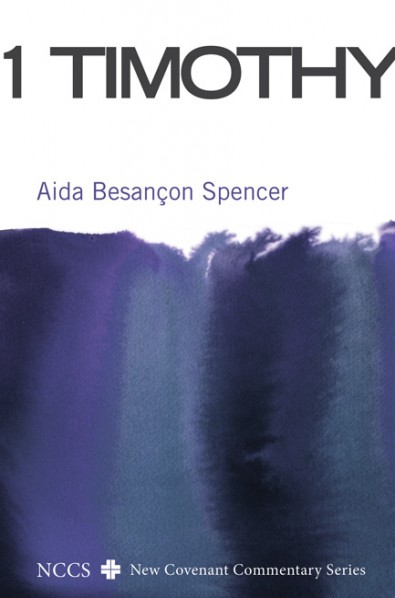
Aida Spencer: 1 Timothy, NCCS

 AÃda Besançon Spencer, 1 Timothy, New Covenant Commentary Series (Cascade, 2013), 192 pages.
Aida Besançon Spencer’s New Covenant Commentary Series on 1 Timothy, is a fresh and powerful look at some of the most challenging texts in the New Testament. Where most commentaries give a lot of external information, Spencer bridges the gap between historical background, culture, and context. Spencer’s extensive research on the historical, social, literary, cultural aspects surrounding 1 Timothy, effortlessly guides the reader toward a deeper comprehension of this epistle.
Beginning with an analytical outline, Spencer believes the overarching purpose of Paul’s first epistle to Timothy is to promote sound doctrine of the gospel by countering a false teaching endangering the church in Ephesus (18). Throughout her work, she categorically rebuilds what this heterodox teaching might look like, how the ancient culture shaped it, and Paul’s response.
Most of all, her love for God and His Word undergird the content of her commentary and is conveyed through five major strengths.
First, the structure she uses in this commentary is simple and direct. Analysis and excurses provide the backstory and give more applicable details to the themes Paul discusses in his epistle to Timothy in Ephesus. One such backstory contains the pertinent information concerning Artemis and her temple, one of the ancient wonders of the world. Associated with ritual murder, Spencer’s research and study points toward the practice of human sacrifice within the first century. She connects the mythological history of an Amazonian community predating Ephesus to this thriving first century idolatrous cult. Revealed for more than a temple, “a hub of commerce, sorcery and witchcraft†becomes the backdrop for Acts 19 (16).
Secondly, the format was appealing, easy to follow and informative. Semantical study charts, word comparisons, extensive footnotes, and summaries of a contemporary application of the texts referred to as “fusing the horizons.†She adeptly does just that: pertinent information is fused together cohesively. Scholars and ministers alike should be able to navigate the information freely.
Third, her work adds value to theological studies. Not only as a woman in the field of theology, but also as a true scholar, her contribution to the literature is invaluable. Throughout the commentary Spencer weaves 2000 years of historical tradition, theology, ancient culture and contemporary contexts into a beautiful, insightful tapestry. Without discounting Pauline authority, readers are given a glimpse into the unyielding yet pastoral heart of Paul. Unlike the misogynistic zealot Paul is often times presented as, Spencer lays the groundwork for an impassioned and devoted Paul. A Paul who exhorts believers on to maturity, instead of a Paul who creates exclusionary lists to satisfy his legalistic nature (16). This Paul affirms and exhorts women as well as men together toward all maturity and spirit-empowered ministry.
Fourth, with over 40 years of practical ministry experience as a clergywoman and scholar, Spencer’s sheds light on the most controversial passage concerning women. 1 Timothy 2:12, “I do not permit a woman to teach or assume authority over a man, she must be quiet.†Her word studies on the obscure Greek word, authentein and usages of “authority†in Paul’s epistles, and throughout the New Testament, illuminate the need for utilizing context and background in deciphering problematic texts. Unabashedly she also admits to the difficulties in interpreting this passage between both egalitarians and “hierarchicalists.†She concludes, “1 Timothy is primarily about Paul’s great themes: right knowledge, salvation, and submission to truth†(67). Though she brings this perspective, she remains unfettered by her experiences as a woman in ministry and is extremely thorough.
Fifth, she defines the core issues surrounding the heterodox teaching and points back to Paul’s rich use of rhetoric, such as military language, extended images, and wordplay to appeal to Timothy and the church (154). Constantly returning to Paul’s word choices, she notes the nuances in Greek and English as well. This enhances and broadens readers’ knowledge on Paul’s significant writing with significant depth of insight.
Throughout her commentary, Spencer exhibits the same gracious presence from the Lord Paul prays for Timothy to experience at the conclusion of 1 Timothy. In her writing, first hand research, careful examination, biblical exegesis, word studies and summaries, God’s grace and an eloquence of thought shines through. A scholar par excellence, her commentary combines both ministry heart and scholarly work for both the academy and minister-in-training.  This work is a great resource or anyone, scholar and preacher alike, who is looking to do work in 1 Timothy.
Reviewed by Debbie Fulthorp
Publisher’s page: http://wipfandstock.com/1-timothy.html
Preview: https://books.google.com/books?id=L6ZbBAAAQBAJ