
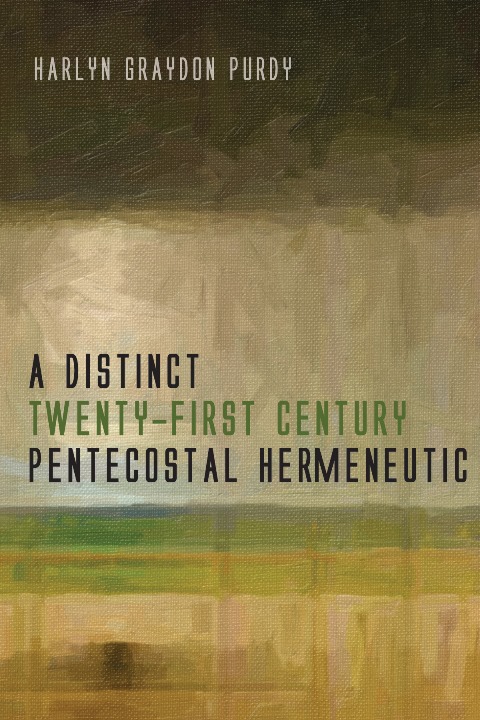
Harlyn Purdy: A Distinct Twenty-First Century Pentecostal Hermeneutic

 Harlyn Graydon Purdy, A Distinct Twenty-First Century Pentecostal Hermeneutic (Eugene, OR: Wipf & Stock, 2015).
In this monograph, Harlyn Graydon Purdy, President of Pentecostal Bible College in Malawi, sets forth to contribute to the ongoing discussions about Pentecostal hermeneutics. The author expresses concerns regarding trends in Pentecostalism, such as allegorization – or what he calls “unrestrained imagination” – that are mistaken for revelation from the Holy Spirit. Purdy acknowledges that such trends are common in the Majority World, including his African context. Therefore he argues that a hermeneutical structure is necessary to avoid heretical interpretations and abuses.
In chapter one, Purdy introduces his thesis and provides a literature review concerning Pentecostal hermeneutic over the last thirty years. According to Purdy, the variety of options demonstrates that the issue of hermeneutics has not been settled among Pentecostals, so developing a distinct Pentecostal hermeneutic is necessary. He writes, “Failing to do so will allow the current chaotic state to worsen and even possibly silence the Pentecostal voice completely” (18). Purdy sees a potential danger that Pentecostals will either default to an Evangelical hermeneutic or be so divided that their unique perspectives for the larger church will be lost.
In the following chapter, the author takes a historical look at Pentecostalism including its origins, Holiness influences, Revivalist impacts, and modern contributions upon it. He gives a very brief glance (about two pages) to Pentecostalism within the African context. Purdy argues that early Pentecostals used the Bible Reading method along with a Lukan lens in order to interpret scripture. He concludes that while Pentecostalism has evolved since its beginnings, many of these early influences continue to impact Pentecostal hermeneutics.
In chapter three, Purdy examines scripture to better understand the hermeneutic employed by the early Church. By studying the second and fifteenth chapters of Acts, he extrapolates that early Christians did not draw meaning from the text exclusively. Rather, meaning was developed through the interplay of scripture, the Spirit, the community, and trained leaders. The author also examines how several New Testament passages used Old Testament passages, and he deduces that “the biblical text is not static but is somewhat fluid” (73). For him, this provides precedence for a similar approach for contemporary Pentecostals.
In chapter five, the author expands upon his proposal to apply various types of interpretive methods. He states, “A legitimate, distinct Pentecostal hermeneutic must also engage methodology that recognizes the interpreter’s involvement in the creation of meaning” (92). Purdy maintains that using a variety of approaches can both create meaning for the contemporary context while also safeguarding against extreme interpretations that are not aligned with the spirit of the text.
In the next chapter, Purdy expands upon a quadratic interpretive process that includes scripture, the Spirit, the community, and trained leadership. He discusses each of these dynamics individually and corporately, proposing how they can contribute to a Pentecostal hermeneutic. For example, Purdy makes clear that the Spirit will not contradict scripture; even though tradition and experience have a place in the interpretive process, scripture will always trump both of them; and experience is also open to critique from the community. Ultimately, the author concludes that this approach can benefit both Western and Majority World Christians. It may open up Western Christians to the role of the Spirit and the interpreter and help Majority World Christians better understand the role of human agency in the development of scripture.
The final part of Purdy’s book is dedicated to a series of lessons that have been designed for use in an Introduction to Hermeneutics course. This includes a course syllabus, lecture outlines, and “lab” activities for thirteen weeks.
This book is helpful in several respects. First, it provides an adequate introduction to Pentecostal hermeneutics. Second, it extends the current conversation concerning this topic. Purdy principally extends the conversation by proposing the role of leadership within the hermeneutical process. While this may be a worthy pursuit, in my opinion his book lacks sustained discussion of this topic. Only ten pages expand upon this idea, and even then his attention is sometimes focused elsewhere. Given his quadratic proposal, I would have welcomed greater focus upon the role of leadership in hermeneutics.
Another primary goal for Purdy is to contribute to hermeneutics in the Majority World, which is not surprising given his context. He writes, “This book intends to expand the discussion to at least include African Pentecostals” (89). My concern is that the author does little to include African Pentecostals in the dialogue, and primarily speaks to these Pentecostals instead of dialoguing with them. I think it would have been beneficial to include the views of African Pentecostals on this topic. Instead the book predominately focuses upon the views of Classical Pentecostals in a North American context.
As the title and the text indicate, Purdy is focused upon developing a distinctive Pentecostal hermeneutic. But it should be noted that his framework is not distinct from other Pentecostal proposals. In fact, it could be argued that his approach largely mirrors that of Kenneth Archer – with the addition of the role of leadership in hermeneutics. Rather, Purdy maintains that his proposal is distinct from non-pentecostal frameworks because it is Pentecostal. This may not be satisfactory to those looking for a more novel alternative.
In conclusion, for those looking to enter the stream of Pentecostal hermeneutics, Purdy’s text provides a readable introduction. He also makes a valid argument to consciously expand the role of leadership in hermeneutics, and this certainly deserves greater attention. But whether or not his view advances the Pentecostal conversation far enough is up for debate.
Reviewed by David Bradnick
Publisher’s page: https://wipfandstock.com/a-distinct-twenty-first-century-pentecostal-hermeneutic.html
Preview A Distinct Twenty-First Century Pentecostal Hermeneutic: https://books.google.com/books?id=LU1gCgAAQBAJ