Joe Maxwell: Martyred for the Message

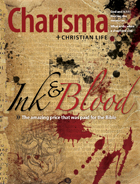
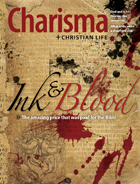 Joe Maxwell, “Martyred for the Message: We’ve forgotten how much blood was spilled so that we could read God’s Word” Charisma (Sept 2006), pages 38-40, 42-47.
A Thriller or Real Life?
Does this sound like an exciting book or movie? “A small group of radical extremists are publishing a book full of dangerous ideas. National governments and international religious groups search desperately for these peddlers of heresy and rebellion. Despite danger and hardship, the fanatics relentlessly push their version of truth on an unsuspecting world.”
It has often been said that the main difference between real life and fiction is that fiction has to be believable. Who would believe that the Christian church would oppose translating and publishing Scripture? Who would think that William Tyndale would be hunted as a heretic and martyred for making the Bible available in English?
The media elite will say you can’t make a movie or book about Tyndale’s life. The story just isn’t believable. No one would believe this as fiction.
Martyred For The Message
Joe Maxwell’s article recounts the life and times of Bible translators and publishers William Tyndale and John Wycliffe. Their work brought reform and revival to a Christian Church and world that practically ignored Jesus Christ. For their efforts, they were prosecuted and persecuted.
Tyndale’s martyrdom, and the desecration of Wycliffe’s grave, proves the disruptive nature of their work. They insisted, centuries apart, that Christian authority rest in unchanging Scripture, rather than fallible men. This radical theology made them the enemy of those who wear a crown or mitre.
As believers read Scripture for themselves the numerous corrupt practices and doctrinal errors in the Church and governments of their era became obvious. Those who profited from the status quo refused or resisted reform. Cheats and crooks called devout men heretics or traitors, then spilled their blood.
All too often, the blood of saints is a key ingredient in the formula for Bible ink. While salvation is free, the freight is costly. Sometimes that “transportation charge” is murder on the Godly man or woman who delivers Scripture to a lost soul.
Plow Boys As Theologians
—William Tyndale
Tyndale, who read and wrote 8 languages, was clearly a scholar. His actions mark him as more than just an intellectual. He relentlessly and boldly worked to bring the Bible to the common English man and woman.
The availability of Tyndale’s translation fueled the drive for literacy in general, and Biblical study in particular. An educated populous is more productive but harder to swindle. It is no surprise that 16th century governments, both secular and ecclesiastical, objected to the availability of inexpensive, easy to read Bibles.
The act of making Scripture available in the language of local readers remains a challenge and opportunity today. Many “governments” in the 21st century discourage local language Bibles. Scripture creates problems for national dictators and the local shaman alike.
Bibles in an “outlaw” dialect foster regional identities and allegiances, perhaps against the policy of a central government. If people are studying their Bibles, their moral and intellectual powers are also increasing. Again, this could lead to conflict with a local “chieftain” or national leader who wants to push a different agenda.
History teaches us that repressive regimes, communist, fascist or cultist, first eliminate the Christian missionaries and teachers in a region. Christian doctrine encourages more moral strength and intellectual capability than tyrants or demons want to face. Once the Bibles and Bible teachers are gone, the darkness falls.
Blood and Ink
Tyndale’s willingness to make sacrifices to publish Scripture cannot be over-emphasized. Modern Christians need to get Bibles and Bible teachers into places of darkness. There is the risk of persecution and perhaps martyrdom. “No Cross, No Crown.”
The words of Jesus are often written in red to emphasize His sacrifice for us. What isn’t always seen is the sacrifice of men like Tyndale and countless other Bible translators. These courageous souls use their enormous intellectual powers and relentless dedication to God, to make Scripture available to everyone.
Maxwell’s call for more Bibles and Bible carriers in the world is just as important today as it was for Tyndale. The world needs men and women who are willing to pour their own sweat and tears into the Bible inkwell. And some saints may give that ultimate ingredient, their own blood, to make Salvation accessible to the lost.
Reviewed by Kirk Hunt