
Effectively Engaging Pluralism and Postmodernism in a So-Called Post-Christian Culture

Editor Introduction: Postmodernism, The Church, and The Future

A Pneuma Review discussion about how the church should respond to postmodernism
A Review Essay of Lesslie Newbigin’s The Gospel in a Pluralist Society.
“Pluralist!” “Postmodern!” Lately these two terms are increasingly, and sometimes carelessly, bandied about as especially descriptive of the present age. They signify such complex concepts that sometimes even defining the terminology can be difficult. To make matters even more intimidating for many of us, pluralism and postmodernism also exist in both religious and secular forms with widely variant philosophical, political, and theological schools of thought and levels of radicality. In fact, they may be descriptive of an even deeper seated condition of being post-Christian. “Post-Christian” describes a personal or societal world view no longer rooted in the language and assumptions of Christianity, though it previously originated and existed in, and thus emerged from, that environment. Importantly, a wide range of continuing attitudes from open embrace to complete exclusion exist toward Christianity itself.1 Yet the basic meaning of pluralism and postmodernism is understood easily enough. “Pluralism” at its most fundamental level simply observes the fact “that there is an actual plurality of religious and other beliefs, practices, and so on in the world.” It proceeds from that point to varying degrees of representation either embracing or eschewing implications of that acknowledgment.2 “Postmodernism” essentially identifies a disposition questioning the Enlightenment/Modernist argument for the sovereignty and ubiquity of reason as being reductionist at best and dismissive of or skewed against other important elements of reality (e.g., imagination, intuition, tradition) at worst. Again, it proceeds from that point to varying degrees of representation either embracing or eschewing implications of that acknowledgment.3 Christians are currently divided about the consequences of these paradigmatic developments. Some are hopeful about possibilities while others are fearful of pitfalls.4 At this point, humbly admitting that I’m not an expert or authority in these matters may be helpful; at least, it will certainly be honest. I’m more or less a typical pastor and preacher struggling to make sense out of today’s world. I suppose that is why I find Newbigin so challenging and stimulating.
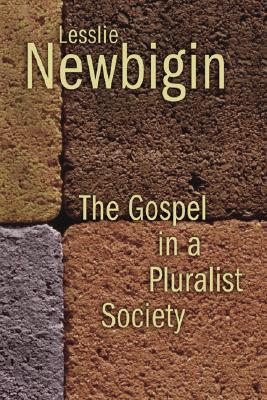
Lesslie Newbigin (1909-98) was truly one of the towering figures of the twentieth century when it comes to the theory and practice of Christian mission. And this book is his now classic contribution to that increasingly complex and controversial endeavor. A native of Great Britain educated at Cambridge, as a young man he was converted from agnosticism to Christianity when he saw a vision of a huge cross touching heaven and earth. A man of boundless energy and profound intellect, Newbigin then spent nearly four decades as a missionary in India, also building a lasting reputation as a great ecumenical leader. Although he himself humbly claims to be only “a pastor and preacher” he is often hailed by others as a scholar and thinker.5 The Gospel in a Pluralist Society is in fact a clear and cogent articulation of how contemporary paradigm shifts such as pluralism and postmodernism may inform and influence Christian identity and ministry in what is now sometimes called a post-Christian society.6 One would be hard pressed to find another book that takes more seriously or navigates more skillfully both commitment to historic Christianity and engagement of contemporary cultural contexts. It is a must read for anyone intending to integrate those same ideas today. At times provocative, always informative, seriously studying it promises to be potentially transformative. Therefore, be warned: one reads at a certain (worthwhile) risk!
Newbigin begins by effectively exposing foundational epistemological presuppositions hidden behind and beneath modernity’s flawed dichotomization of reality into insular and polar realms of “facts and values” which ultimately makes Christianity rationally or scientifically indefensible and untenable. He acidly indicts this “program of systematic skepticism,” rooted in European Enlightenment history, for its arrogance and inconsistence, and forcefully advances that faith is a fact of life. He then argues that not only religious knowledge but also scientific knowledge is impossible without the exercise of imagination and intuition as well as a certain concession to the authority of tradition. Debunking the illusion of absolute objectivity, he defends a carefully qualified subjectivity as an essential element of the quest for truth. He therefore underlines the equal importance of “personal commitment” and “universal intent.” Newbigin analyzes in depth the foundations of Christian belief upon reason, revelation, and experience.
Reason is not a separate source of knowledge over against revelation but the faculty by which we attempt to order and understand all of our experience, whether religious or scientific. Reason, however, usually operates according to society’s underlying but often unconscious “plausibility structure,” that is, our cultural assumptions and practices about what is, or is not, rational—often, especially in the West, heavily influenced by “modernization.” And all experience is interpreted experience. Revelation as the personal disclosure of the divine to knowing subjects requires no less rational effort than to interpret experience of the historical events or story of God’s self-communication. But relativism is rightly avoided as believers fully and mutually indwell their society and their Christianity as internalized living traditions always interacting with one another. Although Newbigin is addressing complex concepts in this section, the upshot of it all is simple: facts, faith, and values are not mutually exclusive categories.
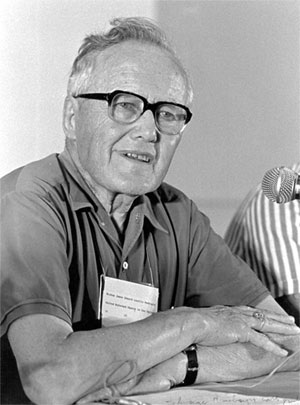
Image: newbigin.net
History is an important category for Newbigin. Christianity stakes its existence on what he calls the “happenedness” of the New Testament story and on the purposefulness of God’s providential acts within human history. There is legitimacy to the so-called “scandal of particularity” because “the history of the Church is to be interpreted not merely as one among the varieties of religious experience but as the fruit of the promised work of the Spirit of God.” The election of a particular people, Israel and the Church, to testify to all of a universally available redemption and salvation flies in the face of modernity’s almost obnoxious individualism but may be better viewed as an expression of human relationality and solidarity. In fact, the Bible really only makes sound sense as the “secret” of the narrative’s divine author’s eschatological agenda is considered and subsequently centered in a universal hope with a definite terminus in God’s ordained goal. Here is the cure for debilitating contemporary despair. The story of the life, death, resurrection, ascension, and coming again of Christ reveals itself to be an alternative plausibility structure for interpreting reality and inspiring hopeful existence and action. Christ is the clue for all of human history!
All of this thus far has been a kind of introduction to Newbigin’s real purpose regarding the project of Christian missions in a postmodern and pluralist society. For him, the Church’s mission is not built on guilt over lost souls so much as an irrepressible “explosion of joy” rooted in and arising out of the gospel itself. Usually this is responsively offered to inquiries when the gospel is observed in practice. Pentecost is a prime example (cf. Acts 2:12). The Church’s mission is a divine initiative in which we are ever learning what Christ’s lordship means. Christian mission is only understood aright in terms of the Trinity in light of the missio dei (mission of God). The Father sent the Son and the Spirit into the world to create a community of faith as a foretaste of the Kingdom of God ultimately available for all. Accordingly, “The Church is not so much the agent as the locus of mission.” It simply rehearses and reenacts “the story which has given it birth”—the story of Jesus Christ. For Newbigin, though obviously important, the salvation or perdition of individual souls is not the solidifying center of New Testament missions. Significantly, more central is that the “the true meaning of the human story has been disclosed” in Christ and “must be shared universally.” Missions become a kind of testing ground for present provisional validation of faith in the gospel. Only eschatologically will it be known and shown that “the real clue to the story of every person” is Jesus Christ. Meanwhile, readiness in sharing the good news of Christ is the test of real belief. Ultimately, however, missionary activity is not pointed toward humans at all, Christian or non-Christian; it is doxological—a joyful act of divine worship. Nevertheless, it proclaims the gospel to humanity and propels humanity toward God’s goal in Christ in the power of the Holy Spirit. Thus New Testament apocalyptic passages are assurances that God will consummate the crisis of human history precipitated in Christ at God’s own divine initiative. Until then, neither evangelism nor social action exclusively exhaust Christian mission. Only when word, deed, and being come together in Christ does mission become an appropriately holistic endeavor. Of course that calls for “true contextualization”—not merely adopting customs and language where one endeavors to minister or identifying with this group or that cause, but “so to proclaim and embody the life of Jesus that his power to sustain and judge every human culture is manifest.” Such contextualization is both local and ecumenical. When we start with the primacy of scriptural witness to the gospel and answer the human question then “the sovereign Spirit of God can do his own surprising work.”
Now Newbigin is ready to tackle difficult topics regarding Christian claims to exclusiveness in a world of diverse religious traditions and cultures. He rejects outright radical religious pluralism, the position that all faiths are more or less equally valid, vigorously defending the uniquely decisive significance of Jesus Christ as the only Lord and Savior (cf. John 14:6; Acts 4:12). He finds pluralists’ arguments circular and self-defeating—not to mention self-serving—as they attempt to erect a façade of human unity on the foundation of an absolute relativism. The “truth by which alone humankind can become one” is found in “the man Jesus Christ in whom God was reconciling the world.” Yet Newbigin encourages dialogue with non-Christian religions and acknowledges the “impossible possibility of salvation.” Graciously and mysteriously salvation is only through Christ but Christ is not only through Christianity. Avoiding equal and opposite errors of universalism (everyone ends up saved) or exclusivism (only a favored few end up saved), he challenges us to live in the tension between “these two poles: the amazing grace of God and the appalling sin of the world.” Accordingly, individual salvation, or what happens to a person after death, is best left in the hands of God while we focus on being faithful to our part in the overall human story God has given us. Again, for Newbigin all these intricacies will be eschatologically resolved. Meanwhile, Christians may see “signs of God’s grace” at work in religious others though other religions are not “vehicles of salvation.” Of course cultural and religious pluralism are not synonymous but they are often almost inseparably intertwined. Culture is a human construct of corporate behavior and is therefore “corrupted by sin.” We should equally avoid demonizing other cultures or idolizing our own. Interestingly, Pentecost points to God’s gracious acceptance of linguistic and therefore cultural diversity. Yet Newbigin suggests that God both accepts and judges culture at appropriate points. Accordingly, a process of discernment and mutual correction in light of the gospel becomes necessary.7
Newbigin is nothing if not thorough. Next he moves to look more closely at societal underpinnings of some of today’s troubling ideological assumptions. He is almost fierce in his denunciation of “individualism” and “privatization.” Basically, he rejects an Enlightenment view of “the absolute autonomy of the individual” in favor of a more communal and relational anthropology rooted in Scripture and also resident in many non-Western societies. Pentecostals (and Charismatics) will be perhaps surprised but possibly pleased too that he finds evidence for societies’ structural benevolence and/or malevolence in a radical reappropriation and reappraisal of biblical teaching on principalities and powers. Newbigin is equally fierce in his demythologization of secularism. Even some Christians erroneously accepted that a secular society would likely allow more religious liberty for all. Unfortunately, devout secularists repeatedly demonstrated that they had in mind an eventual elimination and outright eradication rather than liberation of religion. Fortunately, they were unable to achieve their dark dream. Proclamations that “God is dead,” and predictions that religion is soon to follow have proved to be premature. The idea that the human spirit can survive, much less thrive, without religious belief and experience is fatally flawed and has failed in that most ambitious of secular experiments: the United States. If anything, religion is on the rise. Even the natural sciences are not a haven of atheism. The Church, therefore, should understand itself as an entity outlasting “states, nations, and empires,” and as “that movement launched into the public of the world by its sovereign Lord” to continue his work until he comes again in glory.
Newbigin ends with what has been his insistent emphasis throughout, that “the gospel cannot be accommodated as one element in a society” according to the “reigning ideology” of pluralism. This would entail the domestication and privatization of the gospel. That would involve an illicit expression of the message of the Kingdom of God—which is essentially God’s rule over all things. He argues that the Church must therefore “claim the high ground of public truth.” Here the local Christian congregation is the “hermeneutic of the gospel.” In other words, the public credibility and intelligibility of the gospel is established primarily in “a congregation of men and women who believe it and live by it.” Ministerial leadership for these missionary congregations should, often quite apart from traditional ministerial training, nourish, sustain, and guide them in their priestly work, or lead them in claiming their whole life, public and personal, for God’s rule. In conclusion Newbigin observes that in an age of pluralism the Church’s constituency and ministry often fall into self-defeating attitudes of timidity and anxiety. He recommends confidence in the gospel. Christians must not allow popular opinion to shape their concept of gospel truth. Conversely, their trust in God as the source of their effectiveness and fruitfulness should encourage them in all things.
Newbigin’s climactic conclusion reinforces an impression that has been building throughout the book regarding his response to pluralism, postmodernism, and the overall post-Christian condition. Think of Newbigin as a general in God’s spiritual cavalry. General Newbigin’s strategy is not to have the bugler sound “Retreat!” before the encroaching hordes but rather to blow “Charge!” as he bravely gallops into battle. Newbigin is convinced that Christianity is a victorious faith well able to face all the odds against it. His conviction is often contagious.
As a means of ascertaining whether Newbigin’s approach is amenable to Pentecostalism, let’s briefly explore how it affects his pneumatology. He fairly frequently lifts up the essential significance of the Holy Spirit for contemporary Christian experience, thought, and practice in a number of vital ways. For example, he unstintingly stresses “the active work of the Spirit” in the Christian community in its witness to the world. Also, he affirms that in the present age of vulnerability “signs will be given of the presence of the kingdom, the power of the Spirit” over against the powers of darkness in this world. Again, the Church carries out its mission in the power of the Holy Spirit as it becomes “the place where the Spirit speaks and acts.” That the kingdom is made present in the Church as “its foretaste, firstfruit, and pledge (arrabōn) in the Spirit” seems an especially strong and repeatedly stated emphasis. And Newbigin outlines the Holy Spirit’s role in the Church’s apocalyptic and eschatological hope and in present day mission (“not an achievement of the Church but a work of the Spirit”). The “witness of the Holy Spirit in the hearts of others” is what makes missions possible. The centrality and essentiality of the Spirit for Newbigin shows in his description of full-orbed Christianity: “the total life of a community enabled by the Spirit to live in Christ, sharing in his passion and the power of his resurrection.” He emphatically argues that the event that changed the entire course of early Christianity was not a rationalized step but when “the Holy Spirit was freely given to uncircumcised believers.” In light of Newbigin’s robust pneumatology, there seems to be no noteworthy reason Pentecostals may not benefit positively from his approach to pluralism and postmodernism. In other words, no surreptitious compromise of basic Pentecostal Christian convictions is at stake. Doubtlessly Pentecostals could effectively adapt and apply these deliberations.
The preceding does not propose uncritical acceptance of postmodern approaches, either Newbigin’s or that of others. Pentecostals will undoubtedly wish to critique and qualify at appropriate points. I will just lift up a few more or less arbitrary examples. Think of what I would call Newbigin’s “soteriological agnosticism.” While he is of course accurate to suggest caution in trying to declare on who is saved or lost, especially regarding those beyond the pale of institutional Christianity, pressing that point too far would be a regrettable mistake. The biblical doctrine of assurance ought not to be so easily cast aside (e.g., 1 Th 1:4-5; Heb 10:22; cf. 2 Co 3:4; Eph 3:12; Col 4:12). The Wesleyan-Arminian and Holiness/Pentecostal traditions of soteriological assurance point toward this position also. Also, think of what I would call Newbigin’s “individualism aversion.” He is again quite correct that modern emphasis on the absolute autonomy of the individual has led us seriously astray. As he rightly points out, Scripture presents a much more communal and relational anthropological portrait. Much of contemporary theology apparently agrees.8 Downplaying the importance of individual experience, however, would be another regrettable error. John Wesley’s institution of bands, classes, and societies for developing disciples in a communal context, as well as his social awareness and activism, are matters of record; yet, his intense, transforming individual experience of a “heart strangely warmed” at Aldersgate is also well known. As is so often the case, individual experience and relational existence are not exclusive either-or options. Pentecostals believe the Holy Spirit is poured out on individuals in community (Acts 1:8; 2:4; 8:14-17; 9:17-19; 10:44-48; 19:1-7).
Of special significance for Pentecostals is Newbigin’s consistent insistence that the gospel presents us with a story through which human history is interpreted and addressed with Christ as its clue. This falls right in line with the narrative nature of Pentecostal spirituality and theology. In fact, some suggest the essential Pentecostal hermeneutic of scripture and life may be described in terms of narrative or story/testimony.9 We certainly do seem to resort readily enough to the Acts narrative when wanting to understand or explain who we are and what we are about. Here Pentecostals may benefit greatly from postmodern moves away from purely propositional approaches to Christian life and faith. Moving from rationalist reductionism to appreciation of imagination and intuition resonates well with Pentecostal ethos and identity. Pentecostals frequently testify that their story often defies rational description or expression. Our story is of a people who speak out the unutterable as the Spirit enables and inspires us (Acts 2:4; Rom 8:26-27). This then may be one of the most exciting intersections between Pentecostal experience and postmodern insights.
Some Pentecostals may be surprised at Newbigin’s speculations about the unevangelized and adherents of other religions. We need not be. Researching resources among the earliest Pentecostals clearly suggests similar attitudes among our forefathers and mothers in the movement.10 Before anyone starts crying compromise of Christian mission, remember that the Newbigins committed almost their entire lives to missions. To me, that gives them a right to speak and me a responsibility to at least listen. Christian theology of religions is usually classified as exclusivist, pluralist, or inclusivist. Ever overflowing categorical classifications, Lesslie Newbigin creatively describes himself thus:
The position which I have outlined is exclusive in the sense that it affirms the unique truth of the revelation in Jesus Christ, but it is not exclusivist in the sense of denying the possibility of the salvation of the non-Christian. It is inclusivist in the sense that it refuses to limit the saving grace of God to the members of the Christian Church, but it rejects the inclusivism which regards the non-Christian religions as vehicles of salvation. It is pluralist in the sense of acknowledging the work of God in the lives of all human beings, but it rejects a pluralism which denies the uniqueness and decisiveness of what God has done in Jesus Christ.
That may be just about the most beautifully balanced description of Christian theology of religions ever. It calls for careful inspection and reflection. The Pentecostal Church I grew up in always insisted that God—not the Church—saves people, and that the Spirit of Jesus Christ is able to reach anyone anywhere if they will but respond by believing (cf. Ps 139:7). Do I hear an “Amen!”?
Perhaps potentially problematic might be Newbigin’s heavy reliance on thinkers and theologians such as Michael Polanyi, Alasdair MacIntyre, and George Linbeck. Although these men contribute much constructive and positive input to the postmodern project, philosophically, politically, scientifically, and theologically, no human system is above critique or without possible, perhaps unexpected, undesirable repercussions. The singular strength of Newbigin’s work could also be its weakness: it is a creative conversation between the ancient and enduring scriptural witness to the gospel and cutting-edge contemporary postmodern theory. For Newbigin, the scriptural witness always enjoys primacy. In that sense postmodernism, as well as pluralism and the general post-Christian condition, is always interpreted and addressed biblically. That makes Newbigin a first-rate partner for engaging this discussion. Any time that delicate but decisive biblical balance is lost danger looms on the nearby horizon. So long as it is scrupulously maintained we may safely advance. An important reminder is that Christian theology is not “tameable by a system—any system—modern or premodern or postmodern.”11 Christianity at various stages of its journey through philosophical history has critically utilized the sometimes disparate thought of various ideological constructs. We may perhaps now do so profitably with pluralism and postmodernism in a so-called post-Christian world as well. Yet we should always remember that Christian faith and thought are not reducible to any particular human ideological system. In the words of C. S. Lewis, Christ is “not a tame lion.”12
Probably the most familiar version of postmodern Christianity for average Evangelicals and Pentecostals and Charismatics, especially in North America, Western Europe, Australia, New Zealand, and Africa, is the high profile “emerging church movement.” Although Lesslie Newbigin has certainly been a seminal influence on this movement, it is also heavily influenced by distinctive and diverse thinkers such as, for example, Brian McLaren.13 Characterized by incredible diversity, the movement essentially shares a commitment to engage postmodern people, especially the unchurched and post-churched. Often this engagement involves a deconstruction and reconstruction of Christianity in conversation with postmodernity. Accordingly, the emerging church movement is highly controversial and has been heavily criticized by conservatives as compromising historic Christianity. However, emergent Christians tend to see themselves as building a neo-Evangelical non-fundamentalist bridge between conservatives and liberals.14 Even some of its most caustic opponents have conceded that criticisms leveled against various elements of the emerging church movement do not include all expressions of the movement.15 At least at its best the Christian response to postmodernism via the emerging church movement appears to be an honest attempt to connect authentic first century Christianity with the twenty-first century condition.16 At its worst it may indeed be what some critics claim—a compromised version of Christianity characterized by non-constructive focus on protest, denial of certitude of faith, logical fallacies, theological unorthodoxy, proposition-less evangelism, and syncretistic spirituality.17
A word of warning seems appropriate. As always in these kinds of developments, an all-too-convenient tendency to select the more extreme expressions of a new movement as universally indicative of its internal character in order to discredit the entire group ought to be avoided. With that kind of logic Luther and the Protestant Reformation were condemned because of the ecstatic extremities of a few fanatics such as Thomas Müntzer and his Zwickau “prophets.”18 Furthermore, that same line has been repeatedly used by some to repudiate revivals ever since, ranging from the Wesleys and the Great Awakenings to the rise of Pentecostals. Time has proven it inapplicable and inappropriate. We should guard against repeating the same error regarding Christian attempts to engage pluralism and postmodernism in a post-Christian culture. Oftentimes how members of the movement itself address their own extremists may tell us more about what we need to know to make an accurate assessment of it than the mere fact that it does have obvious extremists in its midst. Again, Pentecostals ought to be especially sensitive to this point.
In closing, I list a few practical guidelines for making sense out of the maze of postmodern meanderings.19 Postmodernism is not so much an era as an attitude, though one becoming more and more prevalent. As we have seen, many in the emerging church movement are abandoning what they consider the stodgy framework of last century’s models, but they are building something they do not yet know what. The rules are still unclear. Postmodernism is more of a recognition that the old (i.e., modernity) is passing away. It is not in and of itself the establishment of something new. But something new is being built. The shape of it is just not known yet. This makes traversing the postmodern landscape at times delightful and at other times dangerous. Along with the thrill of blazing new trails comes real risk. Here are a few hopefully helpful practical recommendations or suggestions for Pentecostal clergy and laity, whether church leaders, missionaries, pastors, or other readers of Pneuma Review:
- Take the word of God at face value and obey it;
- Adopt conditionally the answer science gives;
- Get to know people outside the Christian community;
- Read more broadly—beware just taking the Christian author’s opinions as fact;
- Abandon certitudes and keep your relationship with Christ on a living basis;
- Allow instrumental doubt and don’t try to resolve hard questions with pat answers; and,
- Reason through problems, even when there is no obvious solution.
Perhaps most importantly, we should all prayerfully seek revelation from the Holy Spirit regarding our worldview and the way it’s applied in our life and ministry.
PR
To preview The Gospel in a Pluralist Society by Lesslie Newbigin: http://books.google.com/books/about/The_Gospel_in_a_Pluralist_Society.html?id=q6tEnRYaHI8C
Notes
1 See “Post Christian” at http://en.wikipedia.org/wiki/Postchristian.
2 Ninian Smart, “Pluralism,” A New Handbook of Christian Theology, eds. Donald W. Musser & Joseph L. Price (Nashville: Abingdon, 1992), 360-64 (360).
3 William C. Placher, “Postmodern Theology,” A New Handbook of Christian Theology, 372-75.
4 Cf. Winfield Bevins, “Retro Faith: A Christian Response to Postmodernism,” Pneuma Review 10:2 (Spring 2007), 37-40, and Dony K. Donev, “Postmodern Rebels,” Pneuma Review 10:2 (Spring 2007), 41, with Millard J. Erickson, The Evangelical Left: Encountering Postconservative Evangelical Theology (Grand Rapids: Baker, 1997), 140, 50-51.
5 See Wilbert R. Shenk, “Lesslie Newbigin’s Contribution to the Theology of Mission,” http://www.newbigin.net/general/biography.cfm.
6 Although, as the title suggests, Newbigin is more directly concerned with pluralism, he definitely interacts with postmodern concepts and addresses post-Christian conditions. In this review essay I sometimes address one strand or another of this triad with assumptions of their interrelatedness in mind.
7 Though coming from a different direction heavily utilizing Pentecostal/charismatic spirituality and theology, Amos Yong arrives at a surprisingly similar position. See Amos Yong, Discerning the Spirit(s): A Pentecostal-Charismatic Contribution to Christian Theology of Religions JSup 20 (Sheffield, Eng: Sheffield Academic, 2000).
8 Cf. John D. Zizioulas, Being as Communion: Studies in the Personhood of the Church (Crestwood, NY: St Vladimir’s Seminary Press, 1985).
9 Kenneth J. Archer, A Pentecostal Hermeneutic for the Twenty-First Century: Spirit, Scripture, and Community (London: T & T Clark, 2004).
10 See Tony Richie, “Azusa-era Optimism: Bishop J. H. King’s Pentecostal Theology of Religions as a Possible Paradigm for Today,” Journal of Pentecostal Theology 14:2 (April 2006), 247-60.
11 David Tracy, “The Many Faces of Postmodernity,” Readings in Modern theology: Britain & America, ed. Robin Gill (Nashville: Abingdon, 1995), 225-35 (234-35).
12 See “Christ,” Martin D. Hinten, The C. S. Lewis Readers’ Encyclopedia, editors, Jeffrey D. Shultz and John G. West, Jr. (Grand Rapids: Zondervan, 1998), pp. 113-14.
13 See Brian D. McLaren’s <em>A Generous Orthodoxy: WHY I AM A missional+ evangelical+ post/protestant + liberal/conservative + mystical/poetic + biblical + charismatic/contemplative + fundamentalist/calvinist + anabaptist/anglican + methodist + catholic + green + incarnational + depressed-yet-hopeful + emergent + unfinished CHRISTIAN (Grand Rapids: Zondervan, 2004).
14 Cf. “Emerging church movement” at http://en.wikipedia.org/wiki/Emerging_Church. As I’ve sometimes heard, the problem with being a bridge is that one gets walked on from both ends!
15 E.g., D. A. Carson, author of On Becoming Conversant with the Emerging Church (Grand Rapids: Zondervan, 2005), after a debate with Australian emergent Christians in September of 2006.
16 See Bevins, “Retro Faith,” Pneuma Review (Spring 2007), 37-40.
17 Cf. “Emerging church movement.”
18 See Justo L. González, A History of Christian Thought: From the Reformation to the Twentieth Century vol. III, revised edition (Nashville: Abingdon, 1987), 86-88.
19 This section is based on insights shared with me through a series of email exchanges (May 23, 26, and 28, 2007) with Douglas F. Olena, Adjunct Professor of Philosophy at an Assemblies of God school, Evangel University, in Springfield, MO. Doug recommends another Pentecostal, Earl Creps, Off Road Disciplines: Spiritual Adventures of Missional Leaders (Jossey-Bass/Leadership Network, 2006), for further reading on postmodernism (especially as it intersects with the emerging church movement).