Veli-Matti Karkkainen: Christ and Reconciliation

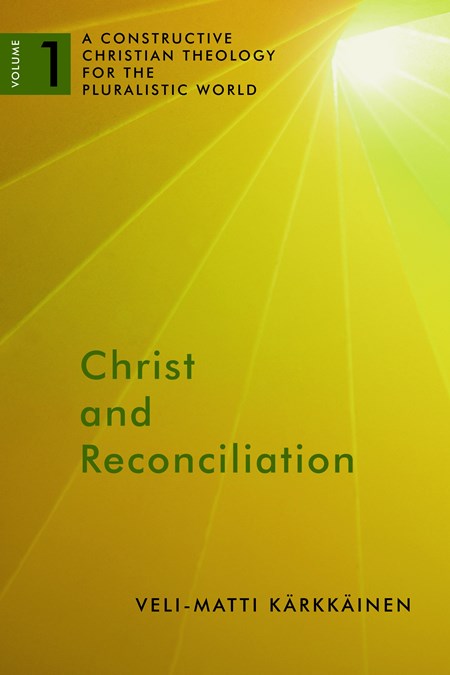
 Veli-Matti Kärkkäinen, Christ and Reconciliation, A Constructive Christian Theology for the Pluralistic World series, Volume 1 (Grand Rapids, MI: Wm. B. Eerdmans Publishing, 2013), 467 pages, ISBN 9780802868534.
Kärkkäinen, professor of systematic theology at Fuller Theological Seminary and a docent of ecumenics at the University of Helsinki, applies both disciplines to great effect in this first volume. While most systematic theologies tend to be a conversation amongst Christians and often a subset of Christians, Kärkkäinen expands the conversation to include Christians around the world as well as the views of non-Christian religions. He believes that Christian theology must willingly, humbly, and cogently engage the challenges presented by a post-modern and pluralistic world. The openness to engage competing (i.e. Western vs non-western Christianity) and even hostile belief systems (Judaism, Islam, Buddhism, and Hinduism) is to Kärkkäinen a form of hospitality. Honest and open dialogue leads to truth because it helps expose our blind spots and opens up new ways to understand our beliefs and engage other faiths.
The book contains two major sections. Part 1, Christ, investigates the person of Jesus. But rather than simply rehashing biblical and historical teaching on the person of Jesus, Kärkkäinen reviews areas that are not as frequently discussed. For example, he focuses on the dynamics of Jesus’ character and mission, paying particular attention to Jesus’ roles as prophet, liberator, and Spirit bearer. Kärkkäinen’s emphasis on the Spirit’s role in Christ’s ministry is, as he contends, to correct this oversight in many theologies on Christ. In addition, he argues that a dynamic Christology that a spirit Christology can provide can be useful in handling difficulties that abound in discussing the dual nature of Christ’s person. After discussing Christian perspectives on Christ, though not always arriving at a complete conclusion, Kärkkäinen engages alternative theologies and religions as lenses to view Christ and evaluate how the traditional views match up to the evidence.
Part 2, Reconciliation, follows the same process as found in Part 1. Kärkkäinen reviews Christian teaching on Christ’s atoning work and then discusses elements of those ideas in conversation with other belief traditions. Kärkkäinen is respectful of traditional ways of understanding Christ’s atoning work (Recapitulation, Ransom, Christus Victor, Satisfaction, and Moral example). But he thinks that they should be balanced with the reconciliation view, which emphasizes Christ’s work to restore relationships between God and individuals, groups, between groups, and creation itself. Interestingly, Kärkkäinen spends a great deal of space on the issue of the relationship between the atonement and violence and the atonement and liberation.
I must confess that my initial reaction to the introductory chapters on methodology was less than charitable. I fully expected this volume to be yet another book written by an evangelical that had gone soft on the faith in order to dialog with non-Christian belief systems. Fortunately, Kärkkäinen quickly proved my initial reaction to be mistaken. He clearly affirms the historic creeds of Christendom as well as the uniqueness of Jesus Christ. But he also thinks that other faiths and perspectives (such as liberation theology) can challenge Christians to think more deeply about our faith and the person and work of Jesus Christ.
I recognize that this sort of self-reflective investigation can be scary not only because self-criticism can be painful but also that it may lead to heresy. But Kärkkäinen masterfully walks the balance beam avoiding both extremes. He is generous to his interlocutors but he does not avoid pointing out where their intellectual systems fail. If for nothing else, readers are provided well-considered insights into different faiths.
The breadth of his reading is astounding. If for nothing less, the book can be a useful guide to finding sources that can be helpful in establishing points for dialogue between Christians and non-Christians.
The book’s negatives are few but important. 1. Too often, Kärkkäinen’s writing was unnecessarily complex. I understand that he was attempting to protect himself from criticism of failing to be nuanced. But his frequent use of disclaimers, exceptions, and alternatives, made for some difficult sentences. 2. Sometimes, he left readers without a firm conclusion. To be fair, Kärkkäinen’s epilogue explained that a more fully developed Christology must wait till other topics are discussed, but I do think he could have given more specifics than he did. 3. Finally, I would have liked to see a bit more exegetical work. At times, he seemed to rely too much on what theologians thought the text said rather than what Kärkkäinen’s exegesis revealed. For example, he claims that Christ came to reconcile the creation to himself. But does Christ’s reconciling work mean that creation was redeemed secondarily following the redemption of the crown of creation (humanity) or does it mean direct redemption as Christ redeeming the plants and animals? A similar problem occurs regarding the notion of liberation. Certainly Christ wants to liberate us from bondage: spiritually, politically, and economically. But how does Christ want to accomplish that? With the bible’s emphasis on suffering, could it be that the church is to model liberation through the process of suffering as a way to show the political/economic rulers that there is a better way? Finally, Kärkkäinen is respectful of Scripture’s reliability but regrettably has adopted deutero-Isaiah language without providing proof that there is a second Isaiah.
Overall, Kärkkäinen’s text makes a good case for showing that classical Christian theology (i.e. Eurocentric/North American theology) is not so much wrong as it is incomplete. His engagement of other traditions and perspectives can only help us define and enrich our understanding of Jesus and his work.
Reviewed by Stephen M. Vantassel
Publisher’s page: http://www.eerdmans.com/Products/6853/christ-amp-reconciliation.aspx
Read Stephen M. Vantassel’s reviews of all five books in Veli-Matti Kärkkäinen’s series A Constructive Christian Theology for the Pluralistic World:
Volume 1: Christ and Reconciliation
Volume 2: Trinity and Revelation
Volume 3: Creation and Humanity
Volume 4: Spirit and Salvation
Volume 5: Hope and Community