Kevin Williams on Kingdom of Heaven and Justification

Kingdom of Heaven, Justification:Â Is There a Conflict? Something Missing?
In this review essay, Kevin Williams responds to Scot McKnight’s article that introduces a conversation among theologians.
 Scot McKnight, “Jesus vs. Paul†Christianity Today (December, 2010), pages 24-29.
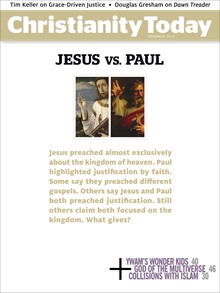
The December 2010 cover encapsulates the discussion:
Jesus preached almost exclusively about the kingdom of heaven. Paul highlighted justification by faith. Some say they preached different gospels. Others say Jesus and Paul both preached justification. Still others claim both focused on the kingdom. What gives?
This was a first for me, to review an article into which a series of videos had been embedded. Congratulations to Christianity Today for creating a format where the interviews do not interfere with the flow or appreciation of the text. I think CT has done an excellent job of allowing readers to access the video content without it being obtrusive to the written content.
I’ll begin with the title: “Jesus vs. Paul.†That is a teaser headline only. As soon as I read it, my mind immediately went to 1 Corinthians 1:11-13, “… that there are quarrels among you. Now I mean this, that each one of you is saying, ‘I am of Paul,’ and ‘I of Apollos,’ and ‘I of Cephas,’ and ‘I of Christ.’ Has Christ been divided? Paul was not crucified for you, was he? Or were you baptized in the name of Paul?â€
Thankfully, the debate is not really pitting Jesus against Paul in McKnight’s article, but whether there can be harmony between the doctrine of Jesus’ “gospel of the kingdom,†and Paul’s doctrine of “justification by faith.â€
The article begins with McKnight’s own doctrinal journey from a Pauline-based theology to his college years, including becoming a professor, where he became enraptured with Jesus, and subsequently, his struggles when he would open up Paul’s epistles. He, like others, often finds more incongruity than harmony between the two.

But McKnight’s concern does not appear to be over the age-old equilibrium between kingdom living and justification as I first suspected. As he puts it, it is “kingdom language on steroids, pushing out justification,†or more to the point, the social-justice teachings of the “unrelenting justice voice of Jim Wallis.†Rev. Wallis, of course, is an advisor to President Barak Obama and an out spoken advocate for social justice and liberation theology, a platform of the Obama administration that has raised considerable debate among the American people.
The church has had its compulsory periods of history, and all of them have been ugly. If this is where McKnight’s heart is, and Jesus’ kingdom gospel is being twisted away from it’s biblical root and into a political one, “the social gospel, which seemed to link ‘kingdom’ with ‘liberal’ and ‘justice,’†then perhaps his warnings should be heeded. Perhaps this is a crisis.
One item worth noting: if McKnight’s supposition is true, then I appreciate his approach. Neither his text nor the video interviews give the impression of anger, annoyance, or of being wounded. His approach is rational, well thought-out, and welcoming. Too often, when the church feels threatened there are Bibles waving, volatile verbiage flying, and flared tempers. That is exactly the kind of controversy to be avoided in a doctrinal “crisis.â€
But as quickly as McKnight brings up the idea of social justice and Jim Wallis he moves back to “the relationship of Jesus to Paul.â€
McKnight then proceeds to discuss “The Gospel Way,†and a deeper foundation where the “disjunction between Jesus and Paul disappears.†Using 1 Corinthians 15:1-8 as his basis, he lets Paul do the work and allows the apostle to explain exactly what “the gospel†is: Christology.
I could go on, but it would be better for you the reader to discover McKnight’s full explanation, a reasoning that satiates most of my curiosity. Why most? Because I think the professor and I would disagree on what Jesus’ is saying in Matthew 5:17 about fulfilling the Law and the Prophets. Even so, when it comes to McKnight’s bigger picture, I find it satisfactorily bridges Jesus and Paul.
Now for a little editorial indulgence: if Paul at any point in his life thought that his theology would preempt the Messiah’s, he would have been bitterly dismayed. It can never be an either/or approach. Otherwise, we risk creating a new dispensation within the New Testament. Has not enough damage already been caused by separating the newer and older testaments?
Even Paul knew that the Torah is good if a man uses it lawfully (1 Timothy 1:8) and through his many epistles to the various communities of the redeemed, we find justification by faith, so that works are kept in a proper perspective, with an emphasis on exactly what the Torah and the Messiah emphasized: here is how to worship God Most High, and here is how to live appropriately in community. There need be no inconsistencies, though if we read the Torah, the Gospels, or Paul’s epistles in any other way, then we dilute them and disassociate their intrinsic and Divine harmony.
If we are to believe Jesus’ words, “Repent, for the kingdom of heaven is at hand†(Matthew 4:17), that our destiny is to reign and rule in that kingdom, if it is the Almighty’s will that this kingdom take precedence as the consummation of centuries of redemptive work, the entirety of the “story of Israel,†of Christology, then the entirety of Scripture had better be in harmony with no preferential treatment given to Paul, Moses, John the Baptist, Rev. Wallis, Apollo, Cephas, or anyone.
My hope and prayer is that we can get away from either/or, versus/but and embrace a well-balanced this/and harmony, which to my estimation is what God desires.
 PR
Editor’s note
This response by Kevin Williams was based on the online version of the article that includes 9 short videos where McKnight responds to related questions about his article. www.christianitytoday.com/ct/2010/december/9.25.html