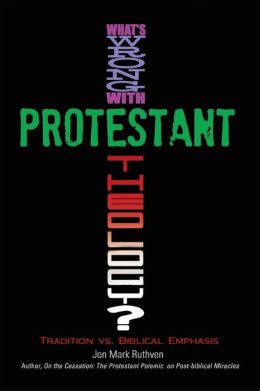
Jon Ruthven: What’s Wrong with Protestant Theology?

 Jon Mark Ruthven, What’s Wrong with Protestant Theology? Tradition vs. Biblical Emphasis (Tulsa: Word and Spirit Press, 2013), 314 pages, ISBN 9780981952642.
Books on Christian theology are often written by academic types: persons of seminary and university training, but with only marginal pastoral experience. This is not true of this work.
Dr. Ruthven is both a scholar and a pastor. He was a pastor for twelve years, and then a professor at Regent University for 18, besides taking numerous missionary trips to the majority world. He wrote the definitive book critiquing cessationism, On the Cessation of the Charismata: The Protestant Polemic on Postbiblical Miracles (Sheffield: Sheffield Academic Press, 1993), which is still in print. He has since written or co-authored a half dozen other works.
Dr. Ruthven’s thesis is that the Bible has an overwhelming emphasis as to what the believer is to do: hear the voice of God and obey. This is not just a command to the religious leaders and elites, but to every believer.
This book establishes this thesis after outlining the key features of Protestant theology, by showing that the central emphasis of scripture involves the process of the prophetic word of God coming to mankind, directly and immediately into individual hearts. This emphasis of scripture is proven by the recurring, central plot line of biblical narratives; the central temptation to mankind (Gen 3; Matt 4 and Luke 4); the essence of the New Covenant (the prophethood of believers); and the central, explicit mission of Jesus: to bestow the prophetic Spirit.
At the end of the work, Ruthven summarizes the answer to his title, “What’s Wrong with Protestant Theology.â€
Christian Epistemology. For all the emphasis the Protestants placed upon scripture as their ultimate doctrinal authority, they tended to use the Bible as a source for proof texts against Rome on the nature of “salvation†rather than allowing it to speak with its own voice and emphasis.
Signs and wonders, the central way God (and his Son) revealed himself in the Bible, were rejected by Protestants as obsolete devices to “prove†doctrine—as “signs†with no value except as they pointed to an accredited Gospel creed. This misconception resulted in …
The loss of the big picture of Jesus’ mission. The Protestant emphasis was on the free gift of Christ’s sacrifice. By contrast, the New Testament portrays Jesus’ kingdom mission as introducing, modeling, ratifying, vindicating, commissioning, and bestowing the New Covenant charismatic Spirit––a synonym for the kingdom of God––a concept traditional theology largely ignored.
By denying Jesus’ central kingdom mission, traditional Protestantism seriously messed up New Testament discipleship, by denying the essential work of the Spirit in the life and mission of the believer. Protestantism generally ignored the significance of the early commissioning accounts, e.g., Mt 10; Mk 6; Lk 9-10, relegating those to the apostles only.
Instead, in traditional theology, the believer’s role is essentially that of a consumer: to receive salvation, meaning a place in heaven, and to “be good†until then.

It is Ruthven’s view that traditional religion avoids the central point of scripture: the ideal of a believer in full communication and communion via the empowering Spirit. Tradition puts the task of hearing God into the hands of the religious leadership. In Judaism this is through the institution of rabbinical commentaries, and in the Christianity it is via the role given priests and preachers of expounding the Word of God––to the exclusion of layperson’s input. For instance, it would be shocking in most churches in Christendom for a layperson to stand up at the end of the sermon and say: “I believe the Spirit of the Lord would add these words to what Pastor Smith has said…â€
Ruthven takes great pains to show the biblical basis of his radical thesis in many scriptures and biblical incidents throughout the Old and New Testaments. Several scriptures anchor his insight. Numbers 11 in the Old Testament and 1 Cor. 14 in the
Numb 11:26-29
However, two men, whose names were Eldad and Medad, had remained in the camp. They were listed among the elders, but did not go out to the tent. Yet the Spirit also rested on them, and they prophesied in the camp. A young man ran and told Moses, “Eldad and Medad are prophesying in the camp.†Joshua son of Nun, who had been Moses’ aide since youth, spoke up and said, “Moses, my lord, stop them!â€Â But Moses replied, “Are you jealous for my sake? I wish that all the Lord’s people were prophets and that the Lord would put his Spirit on them!â€
1 Cor. 14:1-4
Follow the way of love and eagerly desire gifts of the Spirit, especially prophecy. For anyone who speaks in a tongue does not speak to people but to God. Indeed, no one understands them; they utter mysteries by the Spirit. But the one who prophesies speaks to people for their strengthening, encouraging and comfort
We should also note Isaiah 59:21 and Acts 2:39.
By not understanding the continuous hearing and obeying role of every Christian, Protestant theology has instead focused on what Ruthven identifies as the gospel of preparation. That is, to repent and accept the Lord as savior. Thus the common practice of Evangelical churches to repeatedly give alter calls to congregations that have been fully saved for years. The initial call to repentance and salvation is indeed an indispensable first step into the Kingdom of God, but cannot replace what the Bible commands as central: that every disciple develop a life intimacy with God via directly hearing his word, and obeying it. As proof , Ruthven introduces what he describes as the “hermeneutic of emphasis†to show that the major interest of the Bible is for the believer to attain direct, revelatory communication with God.
Ruthven rightly shows that Jesus’ ministry on earth was to introduce and mediate the Kingdom of God, the Holy Spirit, and the New Covenant. It was not just to bring salvation of the soul. This is summarized in Peter’s sermon in Acts 2 (especially vs. 38-39) which alludes to Old Testament scriptures on the Holy Spirit empowering all believers with prophetic giftings, and which in turn is based on Isa 59:21.
What’s Wrong With Protestant Theology has implications far beyond the theological, and indeed impacts the very way Christians worship and interact together. If every Christian is to hear and obey, then the emphasis on public worship will be less on the importance of the sermon, and more on the shared prophecies, dreams and revelations of the whole community. Scandalously, this will mean that the churches will begin operating in the mode mandated by Paul in 1 Cor. 14:26-33 (as well as Col. 3:16-17 and Eph. 5:18-20) where Christians share with each other what they hear from the Lord.[1] This implies that the pastor/minister will no longer be valued or graded principally on the quality of his/her sermons, but on his/her ability to discern, affirm and tactfully correct the prophetic utterances, shared dreams, and personal psalms of the congregation. A minister who operates under Paul’s mandate has to have a radically different balance of necessary giftings than the minister who functions in the typical cessationist church.
An early text of this manuscript was presented and critiqued at the Charismatic Leaders Fellowship meeting in January of 2013, which included many of the luminaries of the Charismatic renewal, such as Dr. Vinson Synan (historian) and Pastor Larry Christensen (leader of the Lutheran renewal). It was greeted with general approval and agreement, save a critique by the Catholic Renewal leader Kevin Reganahan. He objected to Ruthven’s barbed critiques of Catholic theology that were presented as undisputed assumptions (My wife and I read this first manuscript edition, and she mentioned the problem to me––I had not noticed it). Ruthven took note of the critique and has corrected the text, so that the copies the public can now purchase from Amazon, etc. are more carefully worded on this issue.
My only criticism of What’s Wrong With Protestant Theology is that the work is a bit repetitious, and could have been shortened some. On the other hand, due to the radical nature of Ruthven’s thesis, it is perhaps necessary to dig out every scripture that focuses on his argument. In spite of its length, Ruthven writes in a style that makes it accessible to the layman, but has the scholarly documentation in footnotes to satisfy the seminary and university scholar. I believe this work will be a standard for many seminaries and adult education classes for years to come, and will play an important role in transiting the churches from their traditional “cessationist†orthodoxy to a more biblical and Spirit-filled perspective.
Reviewed by William De Arteaga
[1] See my blog posting on this, “Can Church be done as Paul mandated in 1 Cor. 14?†AnglicanPentecostal.blogspot.com (March 25, 2013).








I like this, I think I will try to find the book!
“….the PAIN, the sadness, the former Glory and the emptiness that is caused by the loss once was considered to be “…the CHRISMATIC RENEWAL ??”
Dr. Jon Ruthven has written a piece of work I hope will influence every pastor and college and seminary professor for years to come.
Definitely like to read the book and see how Jon Ruthven addresses changes in evangelical eschatology today…