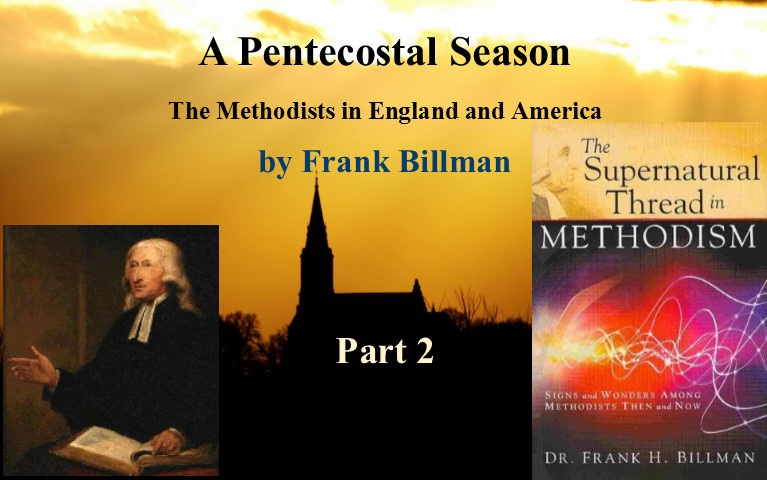
A Pentecostal Season: The Methodists in England and America, Part 2
Author’s Introduction to this Excerpt A Pentecostal Season, Part 1In this excerpt from his book, The Supernatural Thread in Methodism: Signs and Wonders Among Methodists Then and Now, Methodist historian and renewalist Frank Billman reveals how miracles and supernatural interventions were widespread in the ministries of John Wesley and the early Methodists.

George Whitefield
Whitefield first took to preaching in the open air in Hanham Mount, southeast of Bristol, in one of the worst neighborhoods of the day. Approximately 20,000 poor workers came to hear him, their tears cutting white streaks down their dirty faces and “strong men being moved to hysterical convulsions by God’s wondrous power.â€[1]
By the time Whitefield came to America, his preaching was ordinarily accompanied by people toppling over: Dr. John White writes in his book When the Spirit Comes With Power, “Under Mr. Whitefield’s sermon, many of the immense crowd that filled every part of the burial ground, were overcome with fainting. Some sobbed deeply, others wept silently… When the sermon was ended people seemed chained to the ground.â€[2]
At Nottingham, Delaware, on May 14, 1740, 12,000 people gathered. Thousands cried out under conviction, almost drowning Whitefield’s voice. Men and women dropped to the ground as though dead, then revived, then dropped again, as Whitefield continued preaching.[3]
His meetings were wild, though not all his listeners were fans. “I was honored with having stones, dirt, rotten eggs, and pieces of dead cats thrown at me,†writes Whitefield.[4]
In October 1741 Rev. Samuel Johnson, acting dean of Yale College, wrote an anxious letter to a friend in England regarding a revival sweeping New England led by George Whitefield. In the letter he stated: “But this new enthusiasm, in consequence of Whitefield’s preaching through the country and his disciple’, has got great footing in the College [Yale]…Many of the scholars have been possessed of it, and two of this year’s candidates were denied their degrees for their disorderly and restless endeavors to propagate it…Not only the minds of many people are at once struck with prodigious distresses upon their hearing the hideous outcries of our itinerant preachers, but even their bodies are frequently in a moment affected with the strangest convulsions and involuntary agitations and cramps, which also have sometimes happened to those who came as mere spectators. …â€[5]
In the Cambuslang revival outside Glasgow, Scotland in 1742, a large communion celebration was held. It was here that people began falling out in the Spirit by the droves. Whitefield was there and commented: ‘Such a commotion surely was never heard of, especially at eleven at night. It far outdid all that I ever saw in America. For about an hour and a half there was such weeping, so many falling into deep distress, and expressing it in various ways…their cries and agonies were exceedingly affecting.â€[6]
Whitefield, who was serving some of the tables, was “so filled with the love of God as to be in a kind of ecstasy.†At the next revival service, hundreds fell out in the Spirit, along with manifestations of laughter, prophecy, and groaning.[7]
Once when preaching in Yorkshire in 1756, Whitefield stood on a platform erected outside an open window of a church, where he could be heard by those inside as well as the several thousand crowded outside. He read from the text in Hebrews 9:27: “it is appointed for men to die once, but after this the judgment.†Suddenly, a ‘wild, terrifying shriek†came from the audience, as someone suddenly dropped dead. One of the ministers pressed through the crowd, and after a moment of confusion, the body was carried away. After a pause, Whitefield began to loudly read again, And as it is appointed for men to die once, but after this the judgment.†Immediately another screech erupted from a different part of the crowd. A second person had dropped dead after hearing Whitefield’s words on death and judgment.[8]
It seems that George Whitefield took to heart Wesley’s advice to not judge the manifestations so harshly and to “suffer God to carry on His own work in the way that pleaseth him.â€
Whitefield was certain that the low state of the church was principally because of clergy who disguised their spiritual deadness with sound doctrine. He declared that ministers can “preach the gospel of Christ no further than we have experienced the power of it in our own hearts.†[9]
Â
Francis Asbury
Asbury was a very disciplined man who insisted, like Wesley, that camp meetings even on the remotest frontier, be conducted in a seemly fashion. Yet his revivals, too, were characterized by swooning, shouting, weeping and a kind of wild behavior known as the jerks.[10]
In an episcopal directive issued in December 1802, Asbury bestowed his blessing on the (general) camp meetings in the Carolinas and Georgia (in which “hundreds have fallen and have felt the power of Godâ€)….[11]
Asbury said, “The friends of order may allow a guilty mortal to tremble at God’s word…and the saints to cry and shout, when the Holy One of Israel is in the midst of them. To be hasty in plucking up the tares, is to endanger the wheat.â€[12]
Wigger comments: “Asbury recognized that the enthusiasm so endemic to American Methodism was not an unfortunate anomaly, but the very lifeblood of the movement.â€[13] He once urged one of his preachers, “Feel for the power; feel for the power, brother.â€[14]
Francis MacNutt writes in his book Overcome by the Spirit, “In summary, it seems that the preaching in the Protestant Church that has had the most profound and lasting effect in both England and the United States has also been accompanied by listeners being overcome in the Spirit. The greatest preachers in 19th century England all regularly saw people fall over in their services: among Anglicans, John Wesley; among Methodists, George Whitefield and Francis Asbury; among Congregationalists, Jonathan Edwards; among Presbyterians, Charles Finney and Barton Stone; and of course numerous Quakers and Shakers.â€[15]
Â
Thomas Rankin
Sometime after his conversion, Thomas Rankin went to hear Wesley preach for the first time. “When we came within the sound of your voice,†he wrote Wesley, “I was so struck with the power of God, that if I had not held fast by Dr. Watson’s arm, I should have fallen to the ground.â€
Thomas Rankin was converted after a series of dreams and visions. He was sent by Wesley as a missionary to America. He was appointed by Wesley as general superintendent or superintendent of the American Societies and led the first Annual conference in Philadelphia, July 14, 1773, which was the first annual conference ever held in America.
While Rankin preached at one gathering in 1774, “it seemed as if the very house shook with the mighty power and glory of Sinai’s God. Many of the people were so overcome, that they were ready to faint and die under His almighty hand. For about 3 hours the gale of the Spirit thus continued to break upon the dry bones…As for myself, I scarce knew whether I was in the body or not and so it was with all my brethren.â€[16]
Thomas Rankin was not initially comfortable with the emotions demonstrated by the early American Methodists in their meetings. Commenting on the emotional expressions of the American Methodists, Laurence Wood writes: “Some of Wesley’s assistants, such as Thomas Rankin who had gone to America as a Methodist missionary, had considerable difficulty containing the emotional responsiveness of their American hearers. It was normal for his American hearers to weep loudly and cry out with shouts of joy, despite the fact that he made deliberate attempts to keep them quiet. Emotional displays were a prominent feature of early American Methodism, and phenomenal conversions and sanctifications were reported in the tens of thousands which involved considerable emotional expression. These Pentecost-like meetings were regularly described by the early Methodists as “the demonstration and power of the Spirit†and “a great outpouring of the Spirit.†And there is no indication that Wesley ever tried to persuade Asbury or Coke to put a stop to the emotionalism which was typical of early American Methodism.â€[17]
Rankin records in 1776: “Now when the power descended, hundreds fell to the ground, and the house seemed to shake with the presence of God.â€[18]
Â
Manifestations among the Evangelicals and United Brethren
Martin Boehm, one of the founders of the German speaking United Brethren, was removed as a bishop among the Mennonites because of his association with Methodists. He allowed the Methodists to form a class in his house. He invited preachers (including English-speaking Methodists) to preach on his property. Methodist lay preacher, Benjamin Abbott, described a meeting at Martin Boehm’s saying:
“Next morning, I set out with about twenty others for my appointment, where we found a large congregation. When I came to my application the power of the Lord came in such a manner, that the people fell all about the house, and their cries might be heard afar off. This alarmed the wicked, who sprang for the doors in such haste, that they fell one over another in heaps. The cry of mourners was so great, I thought to give out a hymn to drown the noise, and desired one of our English friends to raise it. But as soon as he began to sing, the power of the Lord struck him, and he pitched under the table, and there lay like a dead man. I gave it out again and asked another to raise it. As soon as he attempted, he fell also….Mr. Boehm, the owner of the house, and a preacher among the Germans, cried out, “I never saw God in this way before.†I replied, this is a pentecost, father. “Yes, be sure,†said he, clapping his hands, “a pentecost, be sure!â€[19]
Â
Henry Boehm
Henry Boehm, one of Francis Asbury’s long-time traveling companions and son of Martin Boehm, co-founder of the United Brethren Church, was convinced that informal small group gatherings in rural cabins or in village class meetings did more to advance Methodism than better-known public meetings. “It is not generally known, wrote Boehm, that the greatest displays of divine power and the most numerous conversions were in private houses, in prayer meetings.â€[20]
Henry Boehm wrote about the response to his preaching in his journal for July 5, 1801: “My soul was filled with the powers of the upper work. Many felt the effects of the same: some fell to the floor, others leapt for joy, and mourners [were] crying for mercy….Some were enabled to shout redeeming love.â€[21]
Â
Jacob Albright
Jacob Albright, the founder of the German speaking Evangelical Association, gathered his flock in 1802 for the first of many Great Meetings. Converts expressed their joy in a variety of ways. Outbreaks of shouting, stamping in rhythm, or fainting, often accompanied his passionate and persuasive preaching. To Albright, the emotional outbursts of the frontier camp meeting implied the presence and power of the Holy Spirit and of true religion. To the Lutheran and Reformed church people this display of emotion was offensive and Albright’s followers were regularly mocked as ‘Bush Meeting Dutchâ€, “holy jumpersâ€, knee sliders and foot stampers.[22]
Early Albright meetings were consistently called “Pentecost meetings.†The theme of Pentecost appears in other areas of early Evangelical and United Brethren doctrine and theology. For example, the Evangelicals’ Book of Doctrine and Discipline (1809) described sanctification as experienced in their early “Pentecostal†meetings as a “Baptism of fire,†which produced a “Powerful outpouring of the Holy Spirit.†Although the journal of John Seybert, the Francis Asbury of the Evangelicals, makes reference to different modes of baptism the emphasis clearly falls on the “Baptism in the Spirit.â€[23]
John Seybert always considered it as a mark of success when emotions were aroused and people wept or shouted. Evangelicals agreed that “a child of God needs no further argument that Christ is God than that he feels him in his soul as the living power of God. Jacob Vogelbach, a promising young minister who formed the first missionary society in 1838 and frequently contributed to the church’s German periodical, left the church because of his opposition to boisterous worship.[24]
Jason Vickers notes that “in contrast with the Methodist Articles of Religion …the Evangelical United Brethren appear incapable of writing a single statement in their Confession of Faith without at least some reference to the Holy Spirit.â€[25] Eight out of sixteen articles in the Confession of Faith include references to the Holy Spirit. By contrast, only three out of the twenty-five Articles of Religion do so. The weight given to the person and work of the Holy Spirit in the Confession of Faith by comparison with the Articles of Religion is truly stunning.[26]
Â
Methodist Local Pastors and Lay Preachers
Manifestations of the Spirit were witnessed as part of the ministries of Wesley, Whitefield and Asbury, Boehm and Albright, some of Methodism’s “big guns.†But understand that a belief in and openness toward the supernatural manifestation of the power of God was a characteristic of American Methodism as it spread in our country. Such manifestations were common among the lesser-known American Methodist preachers as well.
While itinerating near Wilmington, DE in the early 1780’s, Benjamin Abbott discovered that some feared to sit too near him having been informed that people on the circuit fell like dead men when he preached. He presided over some of the most explosive Methodist meetings on record. People fainting during his sermons was the hallmark of his career. On one occasion a “young man was struck to the floor, and many said that he was dead.†After three hours even Abbott became alarmed. Eventually the man revived, “praising God for what he had done for his soul.â€[27]
James P. Horton was a sometime shoemaker, sometime preacher, and all-time enthusiast known as “Crazy Horton.†Following his conversion, Horton spent the next 30 years dividing his time between making shoes to support his wife and 13 children and preaching wherever he felt led to go. His meetings were filled with shouting, falling and fervent prayers and his life with supernatural impressions and prophetic dreams. He was a proponent of divine healing, believing that he himself had been miraculously cured on at least two occasions. One woman went so far as to lock herself in her room when she heard that “Crazy Horton†would be attending a meeting in her house.[28]
There was a one-time itinerant preacher and later physician named John A. Granade who was known as the “wild man†during his preaching days. His brief career was so spectacular that crowds began to follow him from place to place. Some claimed that Granade had a secret “powder†that he threw over the people to enchant them, and other believed he worked “some secret trick by which he threw them down.†At one meeting so many people fainted and lay in such heaps that it was feared they would suffocate.[29]
On New Year’s Day, 1801 on the Delmarva Peninsula, a preacher named Thomas Smith was preaching at the home of Thomas Burton and Burton described what happened by saying, “At the very commencement of the meeting the Spirit of the Lord came as a rushing mighty wind—the people fell before it, and lay in heaps all over the floor. The work continued all night, nor did it stop in the morning, but continued for 13 days and nights without interruption.â€[30]
Itinerant preacher William Jessop writes about a prayer meeting he was a part of: “At the end of the meeting the blessed Samaritan passed us by and paid us a glorious visit. The Holy Ghost descended upon us in a mighty rushing wind, and the glory of God filled the house where we were. The shout of a king was in the midst, and many souls rejoiced in the Lord.â€[31]
There were times when Methodists would pray in one place and the power of God would fall in another place, often miles away.
William Keith wrote: Once they all joined in prayer for a revival of religion in the neighborhood, and at the very same hour the people in their own houses and fields were slain by the power of God. I then began to conclude that this could not be the work of imagination for these people a mile off, who knew nothing of the meeting were slain as they were about their work on the very time when those persons prayed for them.[32]
Another example of this can be found in the testimony of Austin Taft in Appendix 2 [Editor’s note: See the full version of The Supernatural Thread in Methodism: Signs and Wonders Among Methodists Then and Now].
In a 1787 Methodist revival, the preachers could not quiet down the congregation enough to speak, amid all the praises and shouting, until finally they gave up. At the height of the noise, eleven rafters broke in the roof, without anyone noticing it amid the commotion.[33]
John Wigger writes about the extent to which a belief in the supernatural power and activity of God permeated early Methodism: “Perhaps no group had a more enduring attachment to militant Methodist supernaturalism than African-American women. …Since most Methodists believed in the reality of divinely inspired impressions, dreams, and visions, it was not so easy to protest when women, be they white or African-American, manifested such experiences in acceptable and apparently authentic forms. Zilpha Elaw, a black female Methodist, testified of an experience where Jesus appeared to her in a barn. She writes: “At the time when this occurrence took place, I was milking in the cow stall. And the manifestation of his presence was so clearly apparent that even the beast of the stall turned her head and bowed herself upon the ground.†Jarena Lee records numerous instances of supernatural impressions, dreams and visions. She believed that God gave her these “uncommon impressions†to make up for her lack of formal education. She not only had frequent prophetic dreams and visions but also claimed to have an extraordinary gift of healing along with other supernatural powers.â€[34]
Valentine Cook, Noah Fidler, Philip Gatch, and Joshua Thomas gained reputations as healers whose prayers sometimes brought miraculous results. James, P Horton’s, Sampson Maynard’s, and Billy Hibbard’s autobiographies are filled with stories of dreams, impressions, shouting and divine healing. Hibbard even includes an account of a woman apparently raised from the dead.[35]
Wigger summarizes: “It may not be an exaggeration to say that this quest for the supernatural in everyday life was the most distinctive characteristic of early American Methodism.â€[36] [That idea was never mentioned in the seminary course in Methodism that I took!]
Methodist historian, Ann Taves says much the same thing as historian John Wigger, “A striking feature of the Methodist accounts was their continual reference to manifestations of the power of God or the outpouring of the Spirit. In his “Brief Narrative of the Revival of Religion in Virginia,†Devereaux Jarratt said that as early as “the year 1765, the power of God was … sensibly felt by a few.†In 1770 and 1771, there was “a more considerable outpouring of the Spirit.†With the arrival of Methodist itinerant Robert Shadford in the winter of 1776, “the Spirit of the Lord was poured out in a manner we had not seen before.†Over and over, Methodists’ accounts of revivals in the 1770s and 1780s refer to the power of God being manifest in their assemblies. Falling to the ground, crying out, and shouting for joy came to be identified by many as specific manifestations of God’s presence in their midst.â€[37]
Lester Ruth also affirms John Wigger’s highlighting the centrality of the supernatural among early American Methodists:
The supernatural realm and the possibility of having an ecstatic experience within it were not on the periphery of their piety. These things occupied the center of their spirituality until well into the nineteenth century. Methodists expected and desired encounters with God and other spiritual beings through visions, dreams, miracles, signs and wonders. This supernatural quality saturated even their regular religious life in times of prayer and worship as Methodists shouted, fell, and danced in overwhelming experiences of God’s wrath, grace, and presence.[38]
Methodists grew faster in Virginia than anywhere else in America. By 1776 half of all the Methodists in America were in Virginia. The Virginia revival of 1773-1776 was the first instance of a Pentecostal-like religious revival in the nation and was a direct antecedent of the frontier Kentucky revivals of 1800. From this stronghold in Virginia, Methodists began their successful growth that eventually spread over the entire continent.[39]
Nathan Bangs described a great revival that swept through Maryland, Delaware, Pennsylvania, Vermont, Connecticut, and New Hampshire, and stated “that most of the preachers had received a new baptism of the Holy Spirit—like that which had been showered upon Calvin Wooster, and others in Canada, the preceding year [1799]; and wherever they went they carried the holy fire with them, and God wrought wonders by their instrumentality.â€[40]
The growth of this “heart religion†as Wesley termed it, was not just part of frontier life, it was part of urban life as well. The message of the Methodists had great appeal to the poor and downtrodden. One Congregational minister commented on the Methodist way that was gaining converts daily: “They are constantly mingling with the people, and enter into all their feelings, wishes and wants; and their discourses are on the level with the capacity of their hearers, and addressed to their understanding and feelings, and produce a thrilling effect, while our discourses shoot over their heads and they remain unaffected. … They reach a large class of people that we do not. The ignorant, the drunken, the profane, listen to their homespun but zealous … discourses.â€[41]
Lester Ruth points out that “Exuberant religious expression has often been too closely linked with the so-called frontier regions of early America (Kentucky and Tennessee) and with the start of the Second Great Awakening.†And he argues that these were widespread phenomena among Methodists before the beginning of the Awakening in the nineteenth century.[42]
Methodists and Healing
John Wesley believed in divine healing, prayed for divine healing on a number of occasions, and testified to some cases of supernatural healings as a result of prayer.
In his Journal, Wesley wrote: “March 31, 1742. In the evening I called upon Ann Calcut. She had been speechless for some time; but almost as soon as we began to pray, God restored her speech: She then witnessed a good confession indeed. I expected to see her no more. But from that hour the fever left her; and in a few days she arose and walked glorifying God.â€[43]
Again, “October 16, 1778. Immediately after, a strange scene occurred. I was desired to visit one who had been eminently pious, but had now been confined to her bed for several months, and was utterly unable to raise herself up. She desired us to pray, that the chain might be broken. A few of us prayed in faith. Presently she rose up, dressed herself, came down stairs, and I believe had not any farther complaint.â€[44]
And again, “May 31, 1785. At eleven I preached in the avenue again. … Afterwards, a decent woman, who I never saw either before or since, desired to speak with me; and said, ‘I met you at Caladon. I had then a violent pain in my head for four weeks; but was fully persuaded I should be well, if you would lay your hand on my cheek; which I begged you to do. From that moment I have been perfectly well.’ If so, give God the glory.†[45]
John Wesley saw his horse healed three times as a result of prayer.
Theologian John Fletcher was the most influential person in Methodism next to John and Charles Wesley. He arrived at the conference for Methodist preachers at Bristol in 1777 near death. John Wesley knelt at his side and all the preachers joined him. Wesley prayed for Fletcher’s restoration to health and a longer ministerial career. Mr. Wesley closed his prayer with this prophecy—“He shall not die, but live, and declare the works of the Lord.†Mr. Fletcher did recover and lived another 8 years.[46]
PR

This excerpt from The Supernatural Thread in Methodism: Signs and Wonders Among Methodists Then and Now (Creation House, 2013) is used with permission.
For Further Reading:
Experiencing Life in the Spirit: an interview with Frank Billman
The Holy River of God: Currents and Contributions of the Wesleyan Holiness Stream of Christianity reviewed by David Belles.
Watch: John Wesley and Pentecostalism: an interview with Frank Macchia
Daniel Jennings, The Supernatural Occurrences of John Wesley reviewed by Tony Richie.
Winfield Bevins, “Wesley and the Pentecostalsâ€
This article will attempt to briefly discuss the historical development of Pentecostalism by making a special application of John Wesley’s contribution.
Watch: Miracles: John Wesley, with Craig S. Keener
Winfield Bevins, “Historical Development of Wesley’s Doctrine of the Spiritâ€
There is no telling what will happen when the church rediscovers Wesley’s doctrine of the Holy Spirit.
Peter Althouse, “Wesleyan and Reformed Impulses in the Keswick and Pentecostal Movementsâ€
Neil Hudson, “You Will Never Know Where You Are Going Until You Know Where You Came From: British Pentecostals’ past development and future challengesâ€
Winfield Bevins, “A Pentecostal Appropriation of the Wesleyan Quadrilateralâ€
From the beginning, Pentecostals have always emphasized the importance of Scripture.
Gary Best, Charles Wesley: A Biography reviewed by David Malcolm Bennett.
Gary Best captures Charles Wesley as a man of courageous action as well as a thoughtful churchman, theologian and poet. He also gives some wonderful insights into early Methodism.
Â
Notes
[Editor’s Note: Please see The Supernatural Thread in Methodism for complete footnotes. Dr. Billman has also graciously provided a Bibliography covering all citations in this excerpt.]
[1] Crowder, Ecstasy, 282.
[2] John White, When the Spirit Comes with Power, (Downers Grove, IL: InterVarsity Press, 1988), 71.
[3] Schmitt, Floods, 133-134.
[4] Crowder, Ecstasy, 284.
[5] Quoted in DeArteaga, Quenching, 28.
[6] As quoted by Dallimore, Whitefield, Vol. 2, 125.
[7] Crowder, Ecstasy, 284-285.
[8] Ibid., 285.
[9] DeArteaga, Quenching, 41.
[10] Francis MacNutt, Overcome By the Spirit, (Grand Rapids: Chosen Books, 1990), 107.
[11] Taves, Fits, 105
[12] Wigger, Heaven, 115.
[13] Ibid., 112.
[14] John Wigger, “Holy, ‘Knock-‘Em-Down’ Preachers,†Christian History, Issue 45 (Vol. XIV, No. 1), 24.
[15] MacNutt, Overcome, 112.
[16] Wigger, Heaven, 113-114.
[17] Wood, Pentecost, 196.
[18] Crowder, Ecstasy, 286.
[19] Quoted by Scott Kisker, “Martin Boehm, Philip William Otterbein, and the United Brethren in Christ†in Methodist and Pietist, J. Steven O’Malley & Jason E. Vickers, eds., (Nashville: Kingswood Books, 2011), 29-30.
[20] Wigger, Heaven, 117.
[21] Lester Ruth, Early Methodist Life and Spirituality, (Nashville: Kingswood Books, 2005), 194-195.
[22] Kenneth E. Rowe, “Jacob Albright and the Evangelical Association,†in Methodist and Pietist, J. Steven O’Malley & Jason E. Vickers, eds., (Nashville: Kingswood Books, 2011), p. 38-39.
[23] J. Steven O’Malley, “The Theological Heritage of Pietism,†in Methodist and Pietist, J. Steven O’Malley & Jason E. Vickers, eds., (Nashville: Kingswood Books, 2011), p. 67-68.
[24] William Naumann, “Doctrine and Theology in the Evangelical Association,†in Methodist and Pietist, J. Steven O’Malley & Jason E. Vickers, eds., (Nashville: Kingswood Books, 2011), p. 94.
[25] Jason E. Vickers, “The Confession of Faith: A Theological Commentary,†in Methodist and Pietist, J. Steven O’Malley & Jason E. Vickers, eds., (Nashville: Kingswood Books, 2011), p. 128.
[26] Ibid., 134-135.
[27] Wigger, Heaven, 108.
[28] Ibid., 115.
[29] Ibid., 109.
[30] Ibid., 117.
[31] Ruth, Early, 195
[32] Ibid., 171.
[33] Crowder, Ecstasy, 286.
[34] Wigger, Heaven, 120-123
[35] Ibid., 108.
[36] Ibid., 110.
[37] Taves, Fits, 86.
[38] Ruth, Early, 161.
[39] Vinson Synan, The Holiness-Pentecostal Movement in the United States, (Grand Rapids: Eerdmans Publishing Company, 1971), 21-22.
[40] Wood, Pentecost. 300.
[41] Synan, Holiness, 22.
[42] Ruth, Early, 165-166.
[43] Wesley, Works, I, 364.
[44] Wesley,Works, IV, 139
[45] Ibid., 311.
[46] David Lloyd, in a letter to Adam Clarke, November 7, 1821, quoted in Wood, Pentecost, 5.