
The Call of the Shofar

Kevin Williams investigates the significance of the ram’s horn trumpet.
In this edition of Messianic Foundations, we’re going to take a look at the ram’s horn trumpet called the shofar in Hebrew. It has played an important role throughout Scripture, and will play a crucial role in the days that lie ahead as we wait for the return of the Messiah. We are going to look at some of the different ways the shofar was used, what symbolic representations it took on as Jewish theology was molded, and how all of these things might apply to us today. We’re going to cover:
- The Akedah (The Binding of Isaac)
- The Call to Repentance
- The Call to Assemble
- The Last Trumpet
Introduction

Artwork by Steve Grier © 1997 RBC Ministries. Used by permission.
Over the last decade there has been a growing trend in churches to incorporate the shofar or ram’s horn into praise and worship. This uniquely stylized trumpet has become one of the few symbols in traditional Judaism which the church has felt comfortable adopting, and rightfully so. It has a meaningful position in our biblical heritage dating all the way back to Abraham, and plays a crucial role in prophetic events as believers in Messiah listen for the “last trump.”[1]
There are two basic types of shofars. The oldest, and still widely accepted type among much of the Orthodoxy (Chassidim), is short with one curve in it. The timbre is usually a “tenor” sound. The shofar gaining wider popularity is the more recent, long, gently curving and twisting Yemenite shofar. These produce a lush baritone sound that carries further and seems to be more desirable. The tone is produced in the same way a person blows a trumpet, by pressing the lips tightly together and making an “elephant” noise into the narrow opening. With a little practice, almost anyone can produce a sound. Some people can produce two or three notes, and one Israeli believer I know can play two at the same time!
The pictures, at least during the Temple period, are vivid. Imagine if you will, the walls of the Temple surrounding the outer most gates, lined shoulder to shoulder by levitical priests. Each has in his hand a shofar. The sun is sinking low in the western sky, casting the Holy City, Jerusalem, in a blazing golden hue against her sandstone buildings. For miles around the sacred mount, the gold topped Temple looks like fire. Your nose twitches with the fresh scent of the ketoret the holy incense now being burned on the altar of incense. “Soon,” you say to yourself, “Very soon now.”
 You cannot see it, but you know that somewhere in the middle of that column of smoke rising into the heavens, is the presence of the Almighty, the God of Israel. And where the Shekinah glory rests, is the Ark of the Covenant also known as the Tree of Life. Images of Moses at the burning bush spring to mind. Just as the tree would burn yet was not consumed, so it was now in Israel. The Tree of Life was burning with God’s holy presence, yet was not consumed. Rather the truth of the God of the Hebrews was spreading throughout the pagan world as gentile “God-fearers” were joining synagogues in ever-increasing numbers.
The sun sets and a quiet expectation rests on the Promised Land. The column of smoke has now become a pillar of fire, and the Temple no longer reflects the sun’s brilliance, but has become its emanating source as the external glory has become internal a foretaste of the coming One who whose light would be seen by all, and then radiate within the living temple.[2]
Glancing toward the sky, first one star can be seen, then two. “Any moment now,” you say to yourself. As soon as the third star is witnessed, the air fills with the sounds of the ram’s horns as the trumpet blasts from the Temple Mount reverberate in the surrounding mountains, falling back on itself in ripples of splendorous waves of multi-tonal sounds. A new day has been declared in Israel.
This is but one picture which if time permitted, we could explore in greater detail of many represented by the ram’s horn. The shofar had a daily commonalty not unlike the noon-day bell in hamlets all around the world. But it also held a place of honor as it signified beginnings, and endings. It summoned men to war. It called the people to assembly to hear the very words of God. It announced the celebratory feast days, Rosh Hashanah, Yom Kippur, Sukkot, and the New Moon, among others. Before we examine each of these roles, let’s take a look at what the shofar has come to symbolized to Jewish men and women in synagogues around the world.
The Akedah
The “Akedah” is a Hebrew term literally translated as “the binding.” For the observant Jew and now for you it brings to mind the binding of Abraham’s son, Isaac. The shofar has become the earthly symbol of Isaac’s ordeal, and when one hears the ram’s horn, he is to remember that “God will provide a lamb.”[3] These are words that should resonate within every believer, as Abraham’s words became the fulfilled proclamation of the most blessed man ever born to woman John, son of Zechariah: “The next day John saw Jesus coming toward him, and said, ‘Behold! The Lamb of God who takes away the sin of the world!'”[4]
But for many the shofar’s relevance in the Akedah is deeper still. In the binding of Isaac, we find many characteristics of the Messiah of Israel. In the chart below, borrowed from the study booklet The Holidays of God: Fall Feasts,[5] we find many Messianic parallels between Isaac and Jesus.
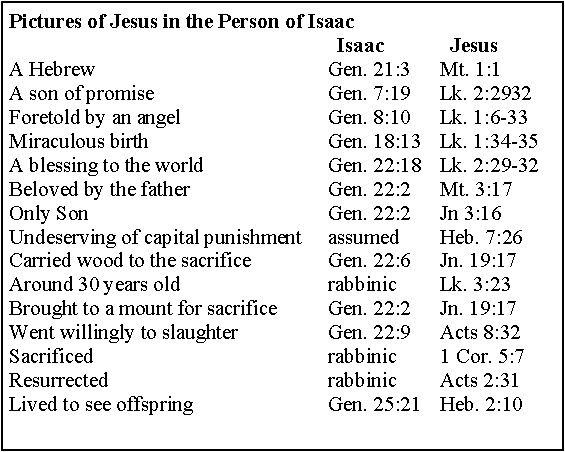
I am sure that if you and I were to pour over the texts, we could find even more parallels than the 15 listed above. But likely, at least two of the comparisons in our chart jumped out at you as new. If you are a born-again, Bible-believing Christian, accepting the accuracy and infallibility of the Word, the concept that Isaac was sacrificed and resurrected comes as a total surprise! Where does it say that in Scripture?
In truth, the Bible does not teach that Isaac was sacrificed. It comes out of an ancient tradition in Orthodox Judaism. Yet what a striking picture of the Messiah, who was sacrificed, dead and raised again to life!
Here is one commentary on the Akedah from Rosh Hashanah: It’s Significance, Laws, & Prayers:
A reading of the Talmudic sources makes clear that God thinks of Isaac as if he had actually been sacrificed and his remains burned on the altar.
Isaac’s ashes are before [God] always a living reminder of Isaac’s covenant because an ascent to such spiritual heights as the Akedah never dies. Therefore too, Isaac’s life after the Akedah was of a different order than any other. He was a living sacrifice, sanctified, and spiritual.[6]
We do not have the time here to dive into all the implications of the rabbis’ teachings, or what a powerful tool they can be in sharing the Good News with your Jewish friends. But the similarities between the person of Isaac and the person of Jesus are undeniable.
All of this is to say, that when the ram’s horn is blown in synagogues, or throughout the streets of Israel (and maybe in your own church as well) it is supposed to bring to mind the Akedah, the binding of Isaac and all that happened there. If this is true in Judaism, then how much more so for us in the community of the redeemed, who see this picture’s grand fulfillment in Jesus the living sacrifice, sanctified, and spiritual?
The Call to Repentance
Given what we now know about the Akedah, we are ready to move into the next attribute of the shofar the call to repentance. When the shofar is blown, a person does not know if God Himself is about to make an appearance.
Then it came to pass on the third day, in the morning, that there were thunderings and lightnings, and a thick cloud on the mountain; and the sound of the trumpet [shofar in the Hebrew] was very loud, so that all the people who were in the camp trembled (Exodus 19:16).
To stand before the Almighty Creator is a fearful thing. Who among us could bear it? Even Isaiah, who by our standards was completely obedient and lawful, full of the Spirit of God, and a prophet among prophets, felt he was undone when He stood before Yaweh.[7] How much more so for us? Therefore, the shofar became the ultimate call to repentance. You may have scarcely a heartbeat to turn from sin before He would stand before you. Who wants to be caught before the Judge of all the earth in sin?
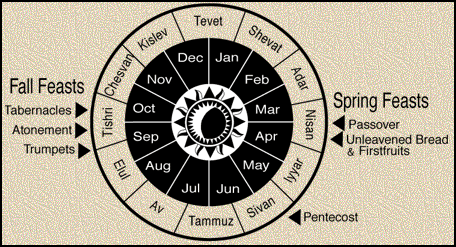
Hence, the Feast of Trumpets (also called Yom Teruah or Rosh Hashanah) in the biblical calendar begins with the shofar blasts, and the call to repentance. In fact, since Trumpets begins on the first day of Tishri, the month prior, Elul, is devoted to turning one’s heart and mind toward repentance. Prayers are offered asking God to call to mind any and all sins which have not been dealt with, all debts to neighbors, friends, family members which have not been put to rest. Promises and vows are critiqued and examined. “Did I live up to my promises?”
One of the other unique properties assigned to the shofar by the rabbis is that when it is blown, it sends Satan and his minions into total confusion. While I cannot attest to this as true, I like to imagine the hordes of evil swirling about in confounded rage with all of that “repenting” going on!
The Call to War
The shofar was commonly used as a battle horn, not unlike the bulls’ horns of medieval Europe, or the trumpet in America’s own Civil War.
“And seven priests shall bear seven trumpets of rams’ horns before the ark. But the seventh day you shall march around the city seven times, and the priests shall blow the trumpets (Joshua 6:4).” From this point on, the shofar became God’s battle call. With the shofar often tucked into your belt, you can see why the smaller, more traditional ram’s horn would prove more battle-ready than the longer, twisted Yemenite shofar.
As mentioned above, according to the rabbis, the shofar sends the demonic realm into confusion. Maybe yes, maybe no. But, when we as the body of Messiah come together to worship and to pray to enter into spiritual warfare I believe blowing the shofar is very appropriate. According to Nehemiah: “Wherever you hear the sound of the trumpet [shofar], rally to us there. Our God will fight for us (4:20).”
The shofars were a very effective communications tool in Israel. Within minutes, from the sound of the first shofar, a network of watchmen set on hills could hear, and sound their shofar off into the next community or mountain. Men would drop their winnowing forks and shepherd’s staffs to pick up their battle gear and gather into the Lord’s army.
What a wonderful picture for us! Would that we, as a community, could be signaled from anyplace in the country to gather together into God’s spiritual army. Would we drop everything to enter into battle against the encroaching enemy of our souls?
The Call to Assemble
Another important attribute of the shofar was to call the people into assembly. When this shofar call went out, it meant that God had something to say to the people. The congregation would gather together into what in Hebrew is called an Adat. The Hebrew word Adat means “assembly or congregation,” but the first two letters in the word, ayin and dalet, form a word meaning “to bear witness.” The congregation not only gathered to hear the Most High’s instructions, but to bear witness of them to others.
“And when the blast of the shofar sounded long and became louder and louder, Moses spoke, and God answered him by voice (Exodus 19:19),” and so was the advent of the 10 Commandments at Mount Sinai.
The other unique principle of this assembly is that they were “one” assembly. The Hebrew used is echad, a composite unity. It is the same “one” applied to man and woman who through marriage come together as one flesh. It is the same “one” used in Deuteronomy 6, that “the Lord our God is One.” If you will, it is a picture of Messiah’s One Body, a singular congregation unified in Him, and as already discussed, bearing witness of His reality.
The Last Trumpet
There are other minor aspects of the shofar we could discuss, but perhaps the one following is of the most significance to the modern-day believer.
Then you shall cause the shofar of the Jubilee to sound on the tenth [day] of the seventh month; on the Day of Atonement you shall make the shofar to sound throughout all your land (Leviticus 25:9).
The Day of Atonement, or Yom Kippur, generally falls in late September or early October. It is also known by Hebrew tradition as the Awesome Day of the Lord. Certainly, it is the day legally set aside by the Almighty for Atonement under the Temple sacrificial system. However, it is also the day when the King of all the earth sits on His Judgment Seat.
Once every 50 years, at the close of Yom Kippur that is to say, at sun down a shofar is blown to announce the beginning of the Yovel, the Jubilee. This particular shofar blast has the unique distinction of being called the last trumpet.
Does that strike a chord in you? Does that title remind you of the words of Rabbi Paul?
… in a moment, in the twinkling of an eye, at the last trumpet. For the trumpet will sound, and the dead will be raised incorruptible, and we shall be changed (1 Corinthians 15:52).
What a moment that will be! And everything we have learned here will be true. Those who recognize the greater Akedah (Binding of Isaac) in Christ Jesus those who have repented will hear the shofar’s call. Those who are raised incorruptible or translated from this life into the next will answer the shofar’s call to war to do battle with the enemies of El Shaddai (God Almighty).8 Those who assemble before the King of kings and Lord or lords will be “one” assembly, bearing witness to the world that Jesus Christ is Lord over all the earth. In the twinkling of an eye, we shall hear the last trumpet and be brought into the full revelation of the Jubilee.
The Spirit of the Lord GOD [is] upon Me, Because the LORD has anointed Me To preach good tidings to the poor; He has sent Me to heal the brokenhearted, To proclaim liberty to the captives, And the opening of the prison to [those who are] bound; To proclaim the acceptable year of the LORD9, And the day of vengeance of our God; To comfort all who mourn, To console those who mourn in Zion, To give them beauty for ashes, The oil of joy for mourning, The garment of praise for the spirit of heaviness; That they may be called trees of righteousness, The planting of the LORD, that He may be glorified (Isaiah 61:1-3).
At the sound of the shofar, the last trumpet, new trees will be planted, and like the burning bush before Moses, like the Tree of Life in the Temple, they shall burn with the fire of the Almighty, but they shall not be consumed.
Summary
This is the eighth article written on Messianic Foundations for the Pneuma Review. I have hesitated at every turn to say, “… and the church should do this,” leaving those choices up to each individual according to the conviction of the Holy Spirit.
Yet at this point, concerning the shofar, it seems only logical that since we as the Body of Christ yearn to hear that last trumpet, we would want to incorporate so mighty a symbol of our faith into our congregational worship. I know churches all around the globe are using them to their great delight. They’ve been heard in popular recordings by Integrity Music’s Paul Wilber. I have witnessed hundreds of thousands of men at the Promise Keepers rally in Washington D.C. in 1997 make a joyful noise after hearing the shofars with a singular shout of praise that had to reach the heavens. No one considered it legalistic or “Jewish.” Rather, they recognized deep down inside the intrinsic call of the shofar, to repentance, to battle, to assembly, and to Jubilee.
PR
Bibliography
- God’s Appointed Times, Barney Kasdan, Lederer Messianic Publications, Baltimore, MD, 1993
- The Holidays of God: Fall Feasts, Kevin Williams, RBC Ministries, Grand Rapids, MI, 2000
- Rosh Hashanah: It’s Significance, Laws, & Prayers, Mesorah Publications, Ltd., Brooklyn, NY, 1983
- The Fall Feasts of Israel, Mitch and Zhava Glaser, Moody Press, Chicago, IL, 1987
Notes:
- [1] 1 Corinthians 15:52.
- [2] 2 Corinthians 6:16.
- [3] Genesis 22:8.
- [4] John 1:29.
- [5] p. 11 (To order a copy without cost or obligation, write RBC Ministries at PO Box 2222, Grand Rapids, MI 49501-2222 and ask for booklet #Q0408. Find them on the web at: www.rbc.org).
- [6] pp. 33, 34; brackets mine.
- [7] Isaiah 6:5.
- [8] If Satan wasn’t thrown into chaos when the shofar was sounded earlier, he certainly will be when the last trumpet is blown.
- [9] The Acceptable Year of the LORD is a euphemism for the Year of Jubilee.
To learn more about the redemptive pictures and messianic promises inherent in the biblical holidays of Leviticus 23, read these on-line study booklets by Kevin Williams (published by RBC Ministries):
Fall Feasts Rosh Hoshanah, Yom Kippur, Tabernacles
Spring Feasts Passover, Unleavened Bread, First Fruits, and Pentecost