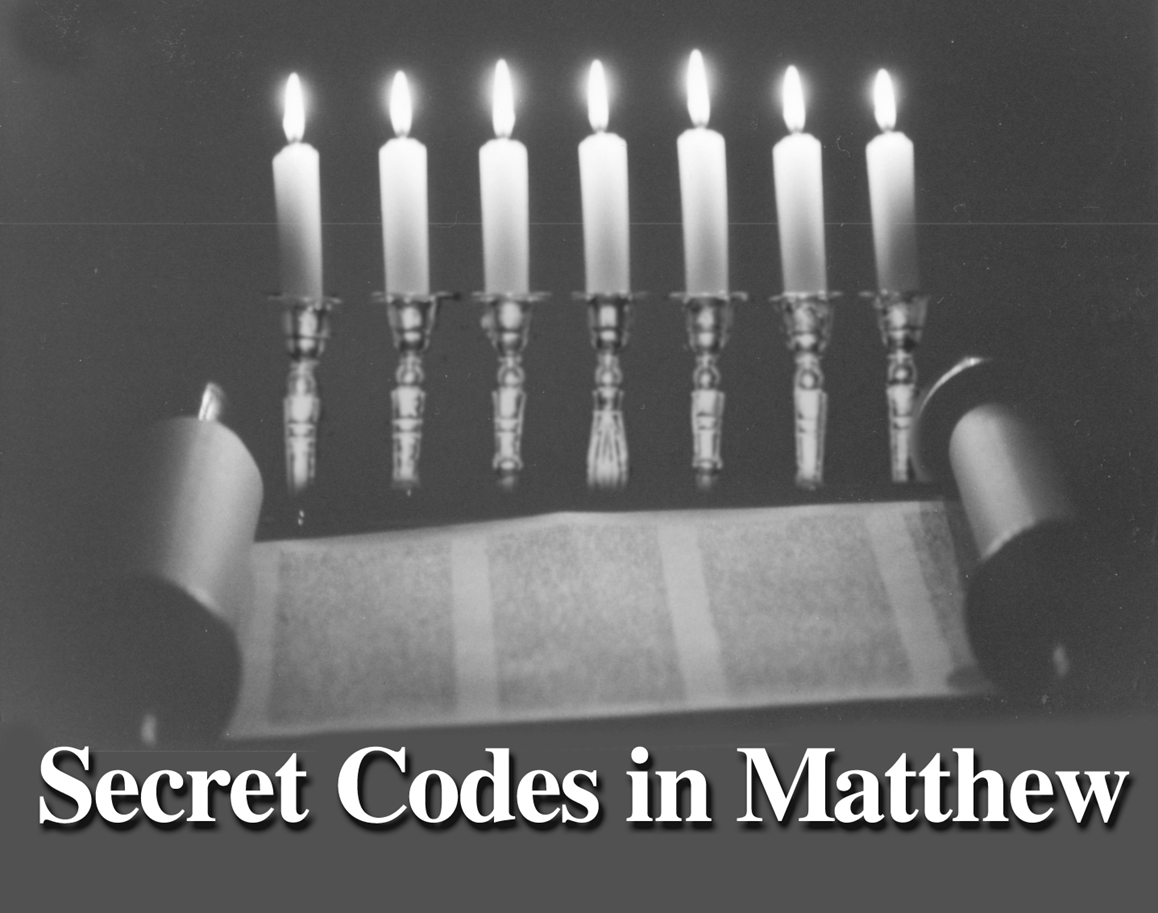
The Secret Codes in Matthew: Examining Israel’s Messiah, Part 4, by Kevin M. Williams

From Pneuma Review Winter 2002
“Now when He heard that John had been taken into custody, He withdrew into Galilee†(Matthew 4:12).
This verse is not, as some might think, God incarnate fleeing danger. Rather, it is possible that this was in fulfillment of John’s words about Jesus, “He must increase, but I must decrease†(John 3:30).
John understood, as each of us eventually must, that the Messiah had to become preeminent. John understood that his own ministry was drawing so much attention that, as we have studied earlier, Jerusalem was coming out to be immersed by him—even Pharisees and Sadducees. We don’t know how many men and women this represents, but enough lives were being transformed that many were wondering if John was the Messiah (Luke 3:15).
But the example we have is that John was servant to the greater good. Jesus claims, “Truly, I say to you, among those born of women there has not arisen [anyone] greater than John the Baptist†(Matthew 11:11), yet John knows, “He [Messiah] must increase, but I [his servant] must decreaseâ€
How many times do leaders become the focus of ministries? How many times do we hear about so-and-so coming to town and wonder what the Holy Spirit is going to do, when in fact, we should know that the Holy Spirit is in town, and wonder what He is going to do through any willing servant?
The tone of much of the Tanakh (the Hebrew Scriptures) is that God does not desire offerings and sacrifices as much as He desires a broken and contrite spirit (Psalm 51:17). This was memorialized and epitomized in John, as it certainly should be in the Messiah’s Bride.
Jesus’ withdrawal into the Galilee was not due to intimidation, but because John’s arrest was a clear and evident signal that the ministry of the Messiah would begin outside Jerusalem.
Natural reasoning, natural man would ask, “Why not in Jerusalem?†After all, “The truth was there: exposition, exegesis, hagiology, eschatology, soteriology, christology, theology, apologetics, doctrine. The books were kept there: here were the oracles, the covenants, the ceremonies, the priesthood, the temple; the schools for the scribes, the colleges of both Pharisee and Sadducee; well, God was there, and there exclusively.â€1
Does this sound like an apt description of our churches, Christian schools, and seminaries? Yet is this really were the ministry of God takes place?
Our answer lies in the Torah. For all of its lists of do’s and don’ts, the Torah is the truth of the Almighty, and it contains many, many valuable pictures for our day.
Why did Jesus begin in the Galilee? Let’s look to Moses for our answer.
Moses took his tent and pitched it outside the camp, far from the camp, and called it the tabernacle of meeting. And it came to pass [that] everyone who sought the Lord went out to the tabernacle of meeting which [was] outside the camp (Exodus 33:7).
What do we know about “outside the camp?†We know that it is where the unclean and rejected of society lived. Some were there only temporarily, perhaps through contact with blood in battle. Others were there indefinitely, resulting from tzaaras (often translated as leprosy), or they were from the mixed multitude that came with Israel out of Egypt—the gentiles.2
Regardless, the Mishkan—or Tabernacle—of God was in the heart of the encampment, where the Shekinah glory of the Lord shone into the night’s sky. The Mishkan and its grounds were ritually clean, and the encampment of Israel was ritually clean. It was were the priesthood dwelt, it was where worship, song, and miracles took place. It was where the altar of the Lord stood, and where repentance was transformed into sanctification. In short, it was where we might think the action was.
Yet Moses, like Jesus, preferred to dwell among the unclean dregs of society. For Moses, it was outside the camp. For Yeshua (Jesus), it was Galilee. Why? Because it was where neither of them needed to be, but where they were most needed.
A lesson for our day? Who is accepted in our congregations? Sure, we say “everyone,†but do we really mean everyone? Are there miracles in our churches? Certainly. Is the Holy Spirit present? Without question. Is the Word of God spoken, taught, and encouraged in our sanctified walls of brick and mortar? Absolutely.
But the transforming power of the Almighty Creator takes place someplace outside those hallowed walls, where we are needed most. We can always retreat to our congregations for ministry, for healing, for corporate worship, prayer, and study, but that is not reality for a majority of non-professing people. If we really want to minister, might we follow the example of John, and allow ourselves to decrease that the Messiah might increase? What would happen if we followed our Messiah, and Moses our teacher, and move into the places of darkness so the Light might shine?
Even Matthew answers our question for us. Why did Jesus move to Galilee? “The people who were sitting in darkness saw a Great Light, and to those who were sitting in the land and shadow of death, upon them a Light dawned†(Matthew 4:16).
___
From that time Jesus began to preach and say, “Repent, for the kingdom of heaven is at hand†(Matthew 4:17).
The Kingdom of Heaven has been discussed before in the Pneuma Review (See “The Kingdom of God As Scripture’s Central Theme: A New Approach to Biblical Theology†by David Burns in Spring-Summer 2001), so we will not spend a great deal of time on it here. But it cannot be stressed enough, that biblically, the gospel and the Kingdom of Heaven/God are not separate theologies, separate messages, or separate doctrines. To separate them is to dilute the wholeness of God’s Word and preach only in part. The two are tightly woven into the same fabric of redemption and sanctified living.
Finding the reality of the gospel of the Kingdom of Heaven—not as separate issues but as the same—may be one of the greatest challenges facing the body of Messiah in these last days.
___
Now as Jesus was walking by the Sea of Galilee, He saw two brothers, Simon who was called Peter, and Andrew his brother, casting a net into the sea; for they were fishermen. And He said to them, “Follow Me, and I will make you fishers of men.†Immediately they left their nets and followed Him. Going on from there He saw two other brothers, James the son of Zebedee, and John his brother, in the boat with Zebedee their father, mending their nets; and He called them. Immediately they left the boat and their father, and followed Him (Matthew 4:18-22).
This, to one degree, parallels our earlier investigation, of Yeshua’s ministry in Galilee and not in Jerusalem. Jesus did not go to the yeshivas (Israel’s seminaries), to the Temple, to the scribes or Torah teachers in holy Jerusalem. He did not recruit from the School of Hillel or the School of Shammai—the two leading academies of the day.
No, Jesus drafted from the school of hard knocks: he pulled from the fishermen among the outlanders, where the unclean dwelt, from the people who lived in the shadowlands.
Men and women today feel inadequate and unqualified to witness their faith to others. Statistically, many Christians do not know how to articulate what they believe. Somewhere along the line, we got it into our heads that we had to be more educated (like the Pharisees?) in order to share our faith.
Yet, the Almighty turned the world upside down with fishermen from the shadowlands. It was the common folk, who didn’t even own a copy of the Scripture, who took the Word out into all nations. To these, He entrusted the ministry. It takes willing people, not wondrous ones.
___
Jesus was going throughout all Galilee, teaching in their synagogues and proclaiming the gospel of the kingdom, and healing every kind of disease and every kind of sickness among the people (Matthew 4:23).
Again, Jesus is teaching the Gospel of the Kingdom. Yet he begins his ministry in their synagogues. This process, this renewal, brought revival not only to the Galilee, but Matthew tells us that news spread throughout Syria (4:24), that people came to Him from Jerusalem (the Holy City comes to the “trash†for renewal?), from Judea and from beyond the Jordan (4:25) where non-Jews and Jews lived.
How did news of this man travel so fast?
Perhaps we might find some of our answer by gaining an understanding of how the synagogue functioned at this time. Beware: this is territory where preconceived notions might get torn down.
First, for there to be a synagogue in the first place, there had to be at least ten learned men—known in later centuries as a minyan. “Not that any ten of Israel made a synagogue; but wheresoever were ten learned men, and studious of the law.â€3
As you may remember, Abraham asked God to spare Sodom if there were only ten righteous men. In the Jewish mind, therefore, these ten became something of an “insurance policy†against God’s wrath.
A second reason for ten men, comes from Numbers 14:27, “How long shall I bear with this evil congregation who are grumbling against Me?†In its context, the twelve spies have returned, and ten have given a bad report. Even though evil, the sages derived that the spies, less Joshua and Caleb, made ten, and the Almighty referred to them as a congregation.
The important message is, there was not one individual chosen as the leader. There was no consolidation of authority into one person or personality. Rather, the synagogue—or beit hamikdash (house of study)—functions on the co-operated effort of ten.
Among the ten, three were assigned to what was called “the bench of three.†They served as congregational judges, using the Scripture as their guide, to deal with issues in the community. Even to this day, a beit din (house of judgment) exists in the synagogue to handle matters of biblical law and due process.
These three came to be known not as rabbis, as some might suppose, but rather, and attested to in the New Testament, as “rulers†(Mark 5:22, John 12:42, Acts 13:15).
Rabbis were men who taught in yeshivas (academies), such as the School of Hillel, or the School of Shammai. They had disciples and often traveled about teaching object lessons gleaned from the world around them. The rabbi as a teacher attached to a synagogue would not occur until after the destruction of the Temple in 70 CE and even then, they had little to do with running the synagogue. Their positions as teachers, the literal meaning of “rabbi†have been kept rather pure to this day.
That is not, however, true in church history, as we shall now see.
After the three “rulers†came the chazzan (literally, “he saysâ€), another position still maintained in modern synagogues. Chazzan is Hebrew, but the Greek approximation is overseer or bishop. However, the bishop of today is nothing at all like the bishop Jesus and Paul knew.
He stood by him that read, with great care observing that he read nothing falsely or improperly; and calling him back and correcting him if he had failed in anything.4
In other words, the bishop called those who read from the sacred scrolls and oversaw their reading, to ensure that God’s Word was not corrupted either intentionally or accidentally. My, how that office has changed!
Within this structure of ten, there were three deacons or almoners who had the responsibility of seeing to the needs of the poor. In the Hebrew, they were called parnasin, which approximates into—of all words—pastors. The earliest role of the pastor was not as a teacher, a counselor, a hospital visitor, a carpet color chooser, or a religious authority at all. Pastors saw to the needs of the poor—particularly for the Sabbath. Again, how that role has changed!
Why three? Whether discussing the rulers or the pastors, why were there three? So that there was no consolidation of authority, so that cooperative wisdom and unity might be maintained in all circumstances. As the wise King Solomon wrote, “A cord of three strands is not quickly torn apart†(Ecclesiastes 4:12).
These seven so far, the rulers, the bishop, and the pastors, were referred to as “the seven good men of the cityâ€â€”a phrase one encounters in the Talmud.
When Paul writes in 1 Timothy 3:13, “For those who have served well as deacons obtain for themselves a high standing and great confidence in the faith that is in Christ Jesus,†he is addressing offices far different from contemporary experience. If Paul—or even the Messiah—were to visit our congregations, how might they feel?
The eighth person in our ten, is the targumin, or interpreter. His duty was to read the Hebrew texts and interpret them into the local language. Even when the scrolls were read in Hebrew, the interpreter would recite in the common tongue. If Greek, then Greek. If Aramaic, then Aramaic. If Latin, then Latin. It was crucial for the local Jewish community and God-fearers (gentiles) to be able to adequately understand the words of the Bible.
One of the most famous, is the Targum Jonathan—written in Aramaic by Jonathan ben Uzziel, and dating back to the time of the apostles. The interpreter’s job was not as strict as the bishop, to oversee an exact recitation of the Hebrew words. The interpreter added commentary as an aid to understanding. The Targum Jonathan, therefore, gives scholars insight into Hebraic understandings of the second temple period, and therefore, insight into New Testament context.
Isaiah 52:13-14 reads this way in the New American Standard: “Behold, My servant will prosper, He will be high and lifted up and greatly exalted. Just as many were astonished at you, My people, So His appearance was marred more than any man, and His form more than the sons of men.â€
Here is a sampling of the same versus from the Targum Isaiah. Notice the subtle nuances in commentative interpretation: “Behold, my servant, the Messiah shall prosper; he shall be exalted, and increase, and be very strong. As the house of Israel hoped for him many days, for his appearance was wretched among the nations, and his countenance beyond that of the sons of men.â€5
Whatever office or duties the ninth and tenth men fulfilled, the information, regretfully, appears to have been lost to antiquity.
As we study Matthew, or any of the New Testament, and we encounter words like “synagogue,†“ruler,†or “overseer,†we may now have a clearer understanding of the biblical context.
We asked the question earlier, how did news of Yeshua travel so fast? The Roman Empire had its system of communication—one of the finest the world had known up to that time. But so did the Hebrews. There were synagogues throughout the Empire, in almost every commercial area. A Jewish traveler or merchant would likely, if he were even moderately religious, stop for the Sabbath and enjoy the local synagogue. Likewise, there were daily prayer services held in synagogues, and at least two other worship services during the week that attracted the locals and the non-locals.
This is where news of the Empire and the Holy Land was shared. If you had a bit of “juicy gossip†about a man the people were calling the Messiah, you would likely pass it along. If you had witnessed a miracle, if you thought the release from Rome was in sight, you would pass it along to your fellow Hebrews.
For news of Yeshua to spread so quickly should surprise no one.
___
And when He saw the multitudes, He went up on the mountain; and after He sat down, His disciples came to Him. And opening His mouth He [began] to teach them … (Matthew 5:1-2)
Here we see a typical example of The rabbi and his talmidim (disciples). It was very common for a rabbi to travel to a locale, sit his disciples down at his feet, and begin teaching them.
Regarding talmidim, Dr. David Stern writes: “The English word ‘disciple’ fails to convey the richness of the relationship between a rabbi and his talmidim in the first century. Teachers, both itinerant like Yeshua and settled ones, attracted followers who wholeheartedly gave themselves over to their teachers (though not in a mindless way, as happens today in some cults). The essence of the relationship was one of trust in every area of living, and its goal was to make the talmid like his rabbi in knowledge, wisdom and ethical behavior.â€
The relationship the disciples of Christ experience then, should be the same experience we are to have today, to have ourselves molded into the image of our rabbi, the Messiah.
It likely that biblical archeologists have determined which “mountain†Yeshua sat on to preach the beatitudes. The parallel we should find interesting is found Deuteronomy 11:29:
And it shall come about, when the Lord your God brings you into the land where you are entering to possess it, that you shall place the blessing on Mount Gerizim and the curse on Mount Ebal.
The beatitudes are “blessings†pronounced by Jesus. Yet almost two millennia earlier, another set of biblical blessings (and curses) were spoken over the Israelites. In each case, if you will, there was a crossing over. The first a spiritual metaphor, a literal crossing over into the Promised Land with its community’s blessings and curses for following (or not following) the Lord of Hosts.
The second “crossing over†was for the talmidim of the Messiah of Israel. To follow Yeshua would also have certain requirements, with rewards and consequences.
If we believe the axiom that for every action there is an equal and opposite reaction, then the Beatitudes also speak of curses. For instance, we read, “Blessed are the poor in spirit, for theirs is the kingdom of heaven.†The opposite reaction—or curse—might be written, “Cursed are the haughty in spirit, for they have nothing in the kingdom of heaven.â€
An excellent test of one’s own attitudes is to look at this reversal of the Beatitudes to see where you land. It might be surprising.
___
Blessed are the poor in spirit, for theirs is the kingdom of heaven. Blessed are those who mourn, for they shall be comforted. Blessed are the gentle, for they shall inherit the earth. Blessed are those who hunger and thirst for righteousness, for they shall be satisfied. Blessed are the merciful, for they shall receive mercy. Blessed are the pure in heart, for they shall see God. Blessed are the peacemakers, for they shall be called sons of God. Blessed are those who have been persecuted for the sake of righteousness, for theirs is the kingdom of heaven. Blessed are you when [men] cast insults at you, and persecute you, and say all kinds of evil against you falsely, on account of Me (Matthew 5:3-11).
In the book, Understanding the Difficult Words of Jesus, the authors write, “Without really understanding why, [Christians] tend to just “read over†the Synoptic Gospels. Phrases such as ‘Blessed are the poor in spirit, for theirs is the kingdom of heaven’ (Matthew 5:3) sound so beautiful and poetic, but the for English speaker, do they convey any real depth of meaning?â€6
The authors David Bivin and Roy Blizzard Jr., explain the Beatitudes from one Hebraic Perspective:
In the opening beatitude Jesus couples “poor in spirit†with “kingdom of heaven.†“Poor in spirit†is an abbreviation of “poor and crippled in spirit†in Isaiah 66:2. The Kingdom of Heaven is what Jesus calls the body of his followers, his movement. In Hebrew, “kingdom†can mean “rule†or “those who are ruled,†but it is never a territorial designation. “Heaven†is an evasive synonym for “God.†“theirs†is a classic mistranslation, still preserved in all modern English versions. The Greek word translated “theirs†should be translated “of these†or “of such as these.†We cannot possess the Kingdom. It does not belong to us; rather, Jesus is describing in these beatitudes the kind of people who make up the Kingdom. It is the “poor in spirit,†the spiritually “down and outers†who have no righteousness of their own; “the mourners,†the brokenhearted who have reached the end of their strength and cry out to God in despair and hopelessness; “the meek,†those who have thrown away their pride. It is people such as these who get into the Kingdom and find salvation.7
To paraphrase their translation, they feel Matthew 5:3 might read better, “Blessed are the poor and crippled in spirit, for those so ruled as these, belong in the Kingdom of God.†Their syntax reads very differently from traditional interpretations. It sounds, if you will, very similar to the enslaved Hebrews of Egypt, bitterly crying out to God for deliverance. Certainly they could be defined as the “down and outersâ€, the “mourners,†the “brokenhearted who have reached the end of their strength and cry out to God in despair and hopelessness.â€
This is one Hebraic interpretation, yet, from the outset of our investigation into this gospel, the claim was made that Matthew was announcing to the people of Israel the arrival of her Messiah. If one will scratch beneath the surface, it appears that the Beatitudes are not merely a code for biblical living or a “philosophy of life.†The Beatitudes may also have been revelational to the talmidim as well as the multitude there on the mountain, that Yeshua was in fact, the Promised One.
A Messianic Jewish rabbi, now an Israeli citizen, opened my eyes to the possibility that each of theses “Blessed are†statements, may be a secret key unlocking the identity of the Messiah. Why would this idea, that Jesus is the Messiah, need to be kept a secret?
First, to come out and publicly proclaim himself as the Messiah was the quickest way to be discounted as a fraud. Better to let others reach that conclusion from a personal conviction. It was as true then as it is now, that the best form or advertising is word of mouth. People convicted in their hearts that Yeshua was the Messiah would talk about it, and word would spread from synagogue to synagogue.
Second, a public announcement that “I am the Messiah, the King of the Jews,†would mean a much quicker trip to a Roman crucifixion. Yeshua had a timetable, and being sent to the cross too early was not a part of that agenda.
Third, the Jewish people had in their minds what the Messiah was supposed to be—a conquering hero throwing off the yoke of evil Roman oppression and establishing Israel as the world’s political and spiritual capital. Yeshua, on the other hand, had a different set of priorities for His first visit, and he needed people to mentally re-evaluate their expectations in light of biblical prophecy.
As we proceed through Matthew’s account, we will find that time and again, Yeshua is either indirect in his announcement, allowing men and women to reach their own conclusions, or what he says could be taken one of two ways; Messianic or natural. When the first approach is applied, we have people reaching true conviction and repentance, not merely rallying around a potential hero for the sake of national independence, but coming into a right relationship with God. Where the latter approach is used, it disallows Yeshua’s detractors from bringing any incriminating evidence against Him in court. A prosecutor might say, “this man thinks he’s the messiah!†But in the Sanhedrin, the Temple Court, there would have to be witnesses who actually heard Jesus say these words. No witnesses, no trial—or at least, no honest trial.8
Fourth, it was a common tool of the rabbis to quote a section of Scripture while intending the entire context. For instance, if I should say, “Our Father who art in heaven,†your mind immediately fills in the rest of the sentence (in theory any way). You instantly recognize that I am referring to what is commonly called The Lord’s Prayer. I do not have to fill in every detail because you already have the passages committed to memory. This was commonly done, and is still commonly done, among the Jewish people. Speak a few words, let the disciples fill in the context.
Let’s begin with the first of the beatitudes: “Blessed are the poor in spirit, for theirs is the kingdom of heaven.†If this was a hint to a messianic prophecy, what might that prophecy be?
Examine Isaiah 66:1-2 (emphasis mine throughout). “Thus says the Lord, “Heaven is My throne, and the earth is My footstool. Where then is a house you could build for Me? And where is a place that I may rest? For My hand made all these things, Thus all these things came into being,” declares the Lord. “But to this one I will look, to him who is humble and contrite of spirit, and who trembles at My word.â€
The King James Version renders “contrite of spirit†as “poor in spirit,†the same verbiage as our Beatitude verse. But it goes on to discuss the haughty in spirit, and their destruction at the hands of the Lord, but the peace of God flowing out like a river to those with pure hearts. Being “poor in spirit†does not mean to be spiritually bankrupt, but to be humble, particularly before God. The context of Isaiah 66 is the redemption of those whose with a poor spirit, Jewish and gentile alike! Only God can redeem and only God can promise life in the Kingdom of Heaven. Jesus promises the hearers the Kingdom of Heaven. Only God can do that. Who, then, is this Jesus?
Matthew 5:4 reads, “Blessed are those who mourn, for they shall be comforted.†Now read what the prophet Isaiah says in 61:1-2. “The Spirit of the Lord God [is] upon me; because the Lord hath anointed me to preach good tidings unto the meek; he hath sent me to bind up the brokenhearted, to proclaim liberty to the captives, and the opening of the prison to [them that are] bound; To proclaim the acceptable year of the Lord, and the day of vengeance of our God; to comfort all that mourn.â€
Who will offer comfort? The Almighty God. Who is Jesus? The one who read in the synagogue, “The Spirit of the Lord is upon me†(Luke 4:18), and who said, “Today this Scripture has been fulfilled in your hearing†(v. 21). The Jewish people look at entire sections of Scripture, within its context. Yeshua’s Beatitude could very easily imply messianic overtones that could be lost on non-Jewish ears.
The third Beatitude in verse 5 reads, “Blessed are the gentle, for they shall inherit the earth.†Remember that Yeshua claims that even the Psalms reveal Him (Luke 24:44).
For evildoers shall be cut off: but those that wait upon the Lord, they shall inherit the earth. For yet a little while, and the wicked [shall] not [be]: yea, thou shalt diligently consider his place, and it [shall] not [be]. But the meek shall inherit the earth; and shall delight themselves in the abundance of peace (Psalm 37:9-11).
Again, a passage about redemption, of God’s judgment on wicked man, and His redemptive arm being stretched out for those whose faith rests on Him.
Verse 6 of the Beatitudes says, “Blessed are those who hunger and thirst for righteousness, for they shall be satisfied.†Compare this with Isaiah 49:8-10. “Thus says the Lord, ‘In a favorable time I have answered You, and in a day of salvation I have helped You; and I will keep You and give You for a covenant of the people, To restore the land, to make [them] inherit the desolate heritages; saying to those who are bound, “Go forth,†to those who are in darkness, “Show yourselves.†Along the roads they will feed, And their pasture will be on all bare heights. They will not hunger or thirst, Neither will the scorching heat or sun strike them down; For He who has compassion on them will lead them, And will guide them to springs of water.’â€
Was Yeshua, the Messiah of Israel, indirectly telling the people “And I will keep You and give You for a covenant of the people,� The capital “Y†is not my idea. It is embedded in the English translation as an interpretive form. If this was an indirect proclamation, those who had ears would hear.
Verse 7: “Blessed are the merciful, for they shall receive mercy.†Contrast this with Psalm 37: 21-24 (KJV), “The wicked borroweth, and payeth not again: but the righteous sheweth mercy, and giveth. For [such as be] blessed of him shall inherit the earth; and [they that be] cursed of him shall be cut off.†Another Psalm of promised, eternal redemption. Who can bestow everlasting mercy and an eternal inheritance? Only the Redeemer.
“Blessed are the pure in heart, for they shall see God,†is our eighth verse. Psalm 24:3-5 promises, “Who may ascend into the hill of the Lord? Or who may stand in His holy place? He that hath clean hands, and a pure heart; who hath not lifted up his soul unto vanity, nor sworn deceitfully. He shall receive the blessing from the Lord, and righteousness†Here is a direct blessing from on high, being promised by a man standing in front of them.
Beatitude number seven says, “Blessed are the peacemakers, for they shall be called sons of God.†Yet look at Psalm 34:8-22, “Oh, taste and see that the Lord is good; Blessed is the man who trusts in Him! … Come, you children, listen to me: I will teach you the fear of the Lord… Depart from evil and do good; Seek peace and pursue it. …The Lord redeems the soul of His servants, and none of those who trust in Him shall be condemned.†Another promise of salvation from the one whose name means “salvation.â€
Nearing the end of the beatitudes, in verse 10-12 we find, “Blessed are those who have been persecuted for the sake of righteousness, for theirs is the kingdom of heaven. Blessed are you when [men] cast insults at you, and persecute you, and say all kinds of evil against you falsely, on account of Me. Rejoice, and be glad, for your reward in heaven is great, for so they persecuted the prophets who were before you.â€
Once again, David, the king of Israel, and archetype for Jesus, wrote, “For the enemy hath persecuted my soul; he hath smitten my life down to the ground; he hath made me to dwell in darkness, as those that have been long dead … In You I take shelter. Teach me to do Your will, for You are my God; your Spirit is good. Lead me in the land of uprightness. Revive me, O Lord, for Your name’s sake! For Your righteousness’ sake bring my soul out of trouble. In Your mercy cut off my enemies†(Psalm 143:3-11). And Psalm 58:11 “Surely there is a reward for the righteous; Surely He is God who judges in the earth.â€
Yeshua says these blessing come upon those who believe in who? “On account of Me [Yeshua].†Jesus identifies Himself directly with the one who gives heavenly rewards, a provision of God and God alone.
The Beatitudes are, without question, a moral code for the life of a disciple. But, as we have clearly demonstrated from the Scriptures, Jesus was teaching no new thing. He was making no new promises. They were already recorded in the book of Isaiah and Psalms by the Great Prophet and the Great King. In that regard, the Beatitudes, this portion of the Sermon on the Mount, are not at all remarkable, except that Yeshua directly identifies himself “on account of Me†into the biblical interpretation. Now that is remarkable! No mere man in Israel would dream of making such a statement. But was Yeshua a mere man?
PR
In the Next Issue: Part 5 of “Secret Codes in Matthew†will discuss the important and often confused subject of the Messiah and the Law as our study of the Gospel to the Hebrews continues.
Endnotes
1 The Messiah, Volume 3, by John Metcalfe, John Metcalfe Publishing Trust, Penn, Buckinghamshire, England, 1980p. 117.
2 “And a mixed multitude also went up with them, along with flocks and herds, a very large number of livestock†(Exodus 12:38).
3Â Commentary on the New Testament form the Talmud and Hebraica, John Lightfoot, 1997, p. 89.
4 Ibid. p. 90.
5 What the Rabbis Know About the Messiah, by Rachmiel Frydland, Messianic Publishing Co., Columbus, Ohio, 1985, p. 97.
6 Understanding the Difficult Words of Jesus, by David Bivin and Roy Blizzard, Jr., Destiny Image Publishers, Shippensburg, PA, 1994, p. 1.
7 Understanding the Difficult Words of Jesus, by David Bivin and Roy Blizzard, Jr., Destiny Image Publishers, Shippensburg, PA, 1994, p. 81-82.
8 The “due process†of Yeshua’s trial will be covered at length as we near the end of the book of Matthew.