
The City of Darkness, an excerpt from The Mind of a Missionary

Read the review by John Lathrop
The Kowloon Walled City in Hong Kong is one of history’s great anomalies. It was, in fact, a world unto its own.[i] Two governments claimed jurisdiction, but neither actively administered it; anarchy reigned while secret societies presided over the no-man’s land. High-rise apartments situated atop a labyrinth of dark, filthy corridors. A mere six acres sheltered the estimated 33,000 people who resided within the Walled City, swelling the population density to 3.25 million people per square mile.[ii] It was the most densely populated spot in the world. (In contrast, Manhattan has the highest population density of any city in the United States at 27,000 people per square mile.)[iii] Crazy-angled apartment blocks obstructed water pipes; without proper sanitation, excrement had to be emptied into the stinking alleys below. At street level, two toilets served all 33,000 residents. The “toilets†consisted of two overflowing cesspools—one for men and one for women. Damp, narrow alleyways with open drains harbored drug peddlers, addicts, pimps, and prostitutes. Triad gangs operated openly in the favored secret hideout; criminal activity ran rampant. Newcomers were immediately recognized and suspiciously monitored; few outsiders dared venture into the heart of the city of anarchy.
The history of the Walled City traced its roots back to the Song dynasty (960-1279) when the Chinese established an outpost to manage the salt trade. For hundreds of years afterward, little took place at the lonely fort, until 1842, when China ceded Hong Kong Island to Britain by the Treaty of Nanjing. As a result, the Qing Dynasty authorities felt it necessary to bolster the fort, check British influence, and maintain a stronghold opposite the harbor. In 1847, the construction of a formidable defensive wall finalized.

Image: Wikimedia Common
The Convention for the Extension of Hong Kong Territory of 1898 leased additional portions of Hong Kong (the New Territories) to Britain for ninety-nine years.[iv] The lease excluded the Walled City, which at the time had a population of roughly seven-hundred people. The British government allowed Chinese officials to continue there, given they did not interfere with the defense of British Hong Kong. The Qing dynasty ended its rule in 1912, leaving the Walled City to the British.
In 1945, at the end of the Second World War, refugees fled mainland China, seeking protection in the Chinese territory surrounded by British land. By 1947, two-thousand squatters occupied the Walled City. After a failed attempt to drive them out in 1948, the British adopted a “hands-off†policy in most matters concerning the Walled City. The city was left to its own devices, and to develop, as Governor Sir Alexander Grantham described it, into “a cesspool of iniquity, with heroin divans, brothels, and everything unsavoury.â€[v] The Kowloon Walled City began its transformation into the squalid enclave of vice for which it later became notorious.

Image: Wikimedia Common
Locals called the place by its alternate name: the City of Darkness. “As I began to know it better,†Jackie Pullinger said, “I learned how true this name was. The Walled City was a place of terrible darkness, both physical and spiritual.â€[vi] Jackie’s first visit brought her through a narrow gap between outside shops where she started down “a slime-covered passageway.â€

Image: Ian Lambot / Wikimedia Common
“I will never forget the darkness and the smell—a fetid smell of rotten foodstuffs, excrement, offal, and general rubbish. The darkness was startling after the glaring sunlight outside,â€[vii] she later reported.
In 1966, Jackie arrived in Hong Kong by boat. Her heart brimmed with great aspirations, for the British missionary had come to make a difference in the world. Jesus called her, and the young woman responded. Thus, she expected to witness great breakthrough, changed lives, and ministry “success.†Little did she understand the extent of the pervading darkness of her new mission field; her naiveté would be challenged on every level.
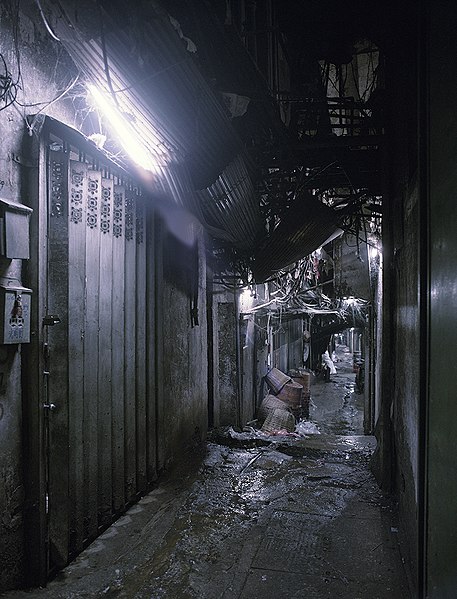
Image: Ian Lambot / Wikimedia Common
She strode gingerly through the dank, labyrinthine corridors so as not to puncture her foot on the shattered glass or one of the many discarded needles. Splatters of blood lined the damp floor and mingled with human feces. She continued through the maze of walkways. She passed a plastic flower factory on her right; on her left, an old prostitute huddled at the threshold of a darkened doorway. Aged, ugly, and no longer able to turn tricks, she employed several child prostitutes, one of whom Jackie deter- mined to be mentally handicapped. She walked on, head down, in case someone chose to empty their chamber pot from an overhead window. Her eyes grew wide at each appalling sight in the multi-storied slum: an illegal dog restaurant, pornographic film-show house, gambling dens, and dingy corners crowded with heroin addicts.
The Walled City filled with residents who lived to “chase the dragon.†This Chinese method of drug-taking had a sort of magic ritual all its own. Addicts placed the small, sand-colored grains of heroin on a piece of silver tinfoil, heated the foil with a slow-burning spill of screwed up toilet paper, and melted the drug into a dark brown treacle. The addicts then placed the outer casing of a matchbox in their mouth to act as a funnel through which to inhale the fumes. They followed the pool of treacle with their mouth as it moved from one end of the silver foil to the other. This is called “chasing the dragon.â€[viii]

Image: Ian Lambot / Wikimedia Common
How can such a place exist inside the British Crown Colony of Hong Kong? Jackie wondered.[ix] Why did Christian outreach remain so scarce in one of the most desperate spots on the earth? The hopeless poor would not come searching for the truth of the Gospel; she must go to them.
The second time Jackie returned to the Walled City, her heart thrilled with joy, and the sensation continued over the next dozen years. “I hated what was happening,†she said of the drug abuse, violence, and prostitution,
but I wanted to be nowhere else. It was almost as if I could already see another city in its place and that city was ablaze with light. It was my dream. There was no more crying, no more death or pain… I had no idea how to bring this about but with ‘visionary zeal’ imagined introducing the Walled City people to the One who could change it all: Jesus.[x]
Local churches in Hong Kong did not share Jackie’s missional enthusiasm, thinking that the triad members, drug addicts, and prostitutes were beyond salvation. Decades of anarchy reinforced vice and violence in the City of Darkness, cementing Christian indifference. Mesmerized and caught up in the unique internal logic of their group dynamics, many believers did not believe for transformation. Pervasive groupthink permeated the Christian landscape, leaving the Walled City’s lost in the dragon’s clutches. But though group behavior is powerful, so too is individual choice.

Image: Ian Lambot / Wikimedia Common
Jackie did not fit the classic mold. She began passing out Gospel tracts and telling people about Jesus. Her early evangelistic efforts incited opposition both from triad members and disapproving Christians. The former threatened her life; the latter warned Jackie about “rice Christiansâ€â€”a pejorative term used to describe someone who professes Christ for material benefits rather than altruistic reasons. Her good-intentioned service made little impact.
Jackie realized she needed to demonstrate Jesus rather than talk about Him. Young people understood nothing about the Kingdom of God. Their horizons [were] limited to the brothel next door, the gambling dens down the road, and the opium dens beyond. “There was nowhere in the Walled City where you could go and do anything neutral,†Jackie said, “let alone take part in constructive activity.â€[xi]
She decided to start a youth club to reach out to the thousands of young men whose only future lay with the triads and young women fated to prostitution. The birth of a counter-cultural ministry formed in the heart of the Walled City.
The Vox Populi is Not the Voice of GodÂ
God fashioned you for eternity. You are a spiritual being having an earthly experience.[xii] Thus, He desires that you set your mind, not on tangible things, but on His Kingdom.[xiii] This is no easy task when your spirit resides in your temporal frame. And the sway from an eternal perspective increases as you situate within the confines of your cultural context.
Day by day, the world seeks to usher you deeper along the currents of pop culture; it attempts to skew your perspective of Kingdom values and merge them with an earthly modus operandi. But the vox populi is not the voice of God; the opinions of the majority do not necessarily reflect the values of the Kingdom. As a Christian in the state of “not of, but sent into†the world, you confront this culture clash round-the-clock. Thankfully, God enables you to overcome the world’s influence by the power of His Spirit. He gives you the mind of Christ and sends you into the earth to shine the light of His glory.
Could this be one of the reasons why over fifty-percent of professing Christians do not know what the Great Commission is,[xiv] why evangelism is going out of style,[xv] or why so few believers thrive on mission today? Or more broadly, why so few answer the call of Christ to cross cultural, geographic, and/or linguistic boundaries to publicize the name of Jesus in foreign lands? After all, the collective social codes of behavior pay little respect to such radical expressions of love for Christ.
The effects of social influence, conformity, and groupthink in the Church often leave little wiggle room in understanding the decision to go abroad. Most believers are comfortable to remain on the home front. That is fine and well as long as every believer recognizes that Christ sent them into their cities and neighborhoods to display the glory of His Kingdom. But when we downplay God’s mission, our sight grows myopic, and our worldview becomes ethnocentric. We no longer see the expansive fields that are ripe and ready for harvest—either at home or abroad.
Most of Jackie Pullinger’s church friends and family discouraged her aspirations for missionary work. Her story is not uncommon. A while back, one of my relatives asked me why I don’t “get a real job.†Given the obscurity and negative connotations surrounding the “missionary†label, I gave them the benefit of the doubt. Perhaps they meant well or did not realize the toil that missionary work requires. Still, it hurt. I wondered why they thought that responding to Jesus’ last commands to “go into all the earth†did not seem like “real job†status. “A family member recently said something similar to me,†Todd Tillinghast, a missionary friend in Panama told me. “They asked why I left a great job to become a missionary. After years on the field, I was surprised how much statements like that still bothered me.â€[xvi]

Image: Wikimedia Common
In 1922, at the height of his spiritual yield in Africa, renowned British cricketer, C. T. Studd, received great pressure to return home. “The apostle to that region†faced illness and summons back to Britain. Even after a lifetime of Kingdom service in China, India, and now Central Africa, looming social expectations from his country of origin weighed heavily on him. But by then, he was a well-known witness in Ibambi (a city in the present-day Democratic Republic of the Congo.) The sixty-one-year-old “gaunt figure with the thick beard, aquiline nose, burning words, and yet merry laugh†blazed new Gospel trails in the heart of the African continent toward the end of his missionary career. “How could I spend the best years of my life in living for the honors of this world, when thousands of souls are perishing every day?†he challenged. The missionary stood his ground against the supposed well-intentioned expectations of others. “Had I cared for the comments of people,†he said, “I should never have been a missionary.â€[xvii]
A wide array of subtler expectations marks the stories of missionaries serving abroad. In Mission Smart, David Frazier says,
Today, workers often feel pressure from within themselves or from their churches to do something in ministry. Such expectations may stem from the focus of their Bible and missions training, from the pace of their lives before they arrived, or from Western success standards.[xviii]
Jesus plainly called us to bear fruit that lasts; but He also stated that all fruitfulness flows from intimacy with Him.[xix] God is not looking for mindless gears in the missionary machine, but passionate lovers who seek first His Kingdom and His righteousness.[xx] He is not looking for “payback†from His people in the form of reluctant obedience. God is relational above all else; His love propels and sustains His followers. His mission does not hinge upon our begrudging compliance; He cares for the well-being of His sons and daughters. But such pressure to perform on the field often results in fatigue, broken relationships, or missionary attrition (which we will explore in chapter seven).
“In my years of missionary service, I have come across many pastors and church leaders who cared more about a return on investment than the missionaries themselves.†Steve Schirmer is the president of Silk Road Catalyst and a former full-time missionary in China. He feels that many sending churches convey harmful expectations to their missionaries. “I personally experienced this phenomenon,†he said.
One of our supposed ‘partner churches’ communicated only in regards to numbers. They wanted to know our five-year plan, how many churches we planted, and how many converts we made. But their interactions were never relational; not once did they ask about the spiritual, emotional, or physical health of our family.[xxi]
“It is imperative that missionaries and churches protect the physical, emotional, and spiritual health of those going out,†missionary coach Sarita Hartz confirmed; “that they don’t unwittingly send the message that the missionary is worth less than the mission.â€[xxii]

Image: Ian Lambot / Wikimedia Common
The ultimate goal of missions is the glorification of God. A high value for His honor drives missional living both at home and abroad—in our “Jerusalems,†“Judeas,†“Samarias,†and to “the ends of the earth.†The extravagant grace of our great King includes His people in His glory; thus, every believer in the body of Christ matters. God gifted each of His children with their unique faculties to make a difference in the world. Our roles are different, but our goal is the same: love God and love others. “Let me give you a new command: Love one another,†Jesus said. His words revealed His high regard for counter-cultural Kingdom living. “In the same way I loved you, you love one another. This is how everyone will recognize that you are My disciples—when they see the love you have for each other.â€[xxiii] If Jesus’ words seem too simple, you may be overcomplicating your missional calling.
The more you yield to the influence of God’s Kingdom, the easier it is to deviate from the adverse currents of popular culture. The naysayers may remain, and your negative internal monologue will endure. But as you set your mind on Heavenly thoughts, the power of social influence wanes. Jackie Pullinger was about to prove this truth to the pimps, prostitutes, gang members, and drug addicts in the Kowloon Walled City. Her ministry of love ran counter to the expected social norms; the City of Darkness was no place for this young British woman, many thought. But Jackie was not deterred. Into the dragon’s lair she went, shining the light of God’s Kingdom in Hong Kong’s darkened alleys.
PR 
“The City of Darkness†is an excerpt from chapter 5 of The Mind of a Missionary, pages 89-96. Used with permission. All rights reserved.
Notes
[i] Elizabeth Sinn, “Kowloon Walled City: Its Origin and Early History,†Journal of the Royal Asiatic Society Hong Kong Branch, vol. 27 (1987).
[ii] Charles Goddard, “The Clearance†in City of Darkness: Life in Kowloon Walled City (Watermark, 1999), 208– 11.
[iii] Dan Nosowitz, “Life Inside The Most Densely Populated Place On Earth [Infographic],†Popular Science, April 19, 2013, https://www.popsci.com/technology/article/2013-04/life-inside-most-densely-populated-place-earth-infographic.
[iv] Diana Preston, The Boxer Rebellion (Bloomsbury Publishing, USA, 2000), 370; Claude MacDonald, the British representative during the convention, picked a ninety-nine-year lease because he thought it was “as good as forever.â€
[v] Peter Wesley Smith, Unequal Treaty 1898-1997: China, Great Britain, and Hong Kong’s New Territories (Oxford University Press, 1998), 12.
[vi] Jackie Pullinger, Chasing the Dragon: One Woman’s Struggle Against the Darkness of Hong Kong’s Drug Dens (Hodder and Stoughton, 1980), 38.
[vii] Jackie Pullinger, Chasing the Dragon: One Woman’s Struggle Against the Darkness of Hong Kong’s Drug Dens (Hodder and Stoughton, 1980), 39.
[viii] Jackie Pullinger, Chasing the Dragon: One Woman’s Struggle Against the Darkness of Hong Kong’s Drug Dens (Hodder and Stoughton, 1980), 44.
[ix] Jackie Pullinger, Chasing the Dragon: One Woman’s Struggle Against the Darkness of Hong Kong’s Drug Dens (Hodder and Stoughton, 1980), 40.
[x] Jackie Pullinger, Crack In the Wall: Life and Death in Kowloon Walled City (London: Hodder & Stoughton, 1989), 16.
[xi] Jackie Pullinger, Chasing the Dragon: One Woman’s Struggle Against the Darkness of Hong Kong’s Drug Dens (Hodder and Stoughton, 1980), 48.
[xii] This is attributed to Pierre Teilhard de Chardin in The Joy of Kindness (1993), by Robert J. Furey, 138; but it is attributed to G. I. Gurdjieff in Beyond Prophecies and Predictions: Everyone’s Guide To The Coming Changes (1993) by Moira Timms, 62; neither cite a source. It was widely popularized by Wayne Dyer, who often quotes it in his presentations, crediting it to Chardin, as does Stephen Covey in Living the 7 Habits: Stories of Courage and Inspiration (2000), 47.
[xiii] Colossians 3: 2.
[xiv] Barna Group. “51% of Churchgoers Don’t Know of the Great Commission.†Barna, March 27, 2018. https://www.barna.com/research/half-churchgoers-not-heard-great-commission.
[xv] “Is Evangelism Going Out of Style?†Barna Group, December 17, 2013, https://www.barna.com/research/is-evangelism-going-out-of-style/.
[xvi] The author’s interview with Todd Tillinghast, June 7, 2018.
[xvii] Norman P. Grubb, C. T. Studd: Athlete and Pioneer (1933), 196.
[xviii] David Frazier, Mission Smart: 15 Critical Questions to Ask Before Launching Overseas (2014), 130.
[xix] John 15: 5.
[xx] Matthew 6: 33.
[xxi] The author’s interview with Steve Schirmer, April 15, 2018.
[xxii] Sarita Hartz, “The Need for a New Missions Paradigm,†Sarita Hartz, September 29, 2015, http://www.saritahartz.com/the-need-for-a-new-missions-paradigm/.
[xxiii] John 13: 35 (The Message Translation).