Estrelda Alexander: Black Fire, reviewed by Wolfgang Vondey

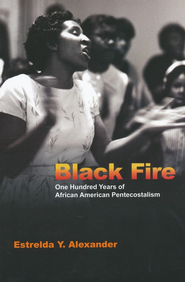
 Estrelda Y. Alexander, Black Fire: One Hundred Years of African American Pentecostalism (Downers Grove, IL: IVP Academic, 2011), 406 pages, ISBN 9780830825858.
At a time where books on the first one hundred years of modern-day Pentecostalism are published with frequency, Alexander reminds us of the important heritage of African American Pentecostals. African and African American origins of classical Pentecostalism remain a neglected topic of study, and even African American Pentecostals often know little of their own heritage. Despite the influence of the black preacher William J. Seymour and other African American leaders on the origins and development of Pentecostalism in North America, few scholars have traced the story of African American Pentecostal origins or developed a comprehensive account of the racial landscape of Pentecostals. The recovery of African American contributions was hindered for many decades by the dominance of two competing theories of Pentecostal beginnings that identified either white or black origins. Interracial origins and the diversity of influences within different racial traditions are only recently becoming a topic of study, and the much larger questions of the relationship of particular racial theories of Pentecostal origins to the racial composition of global Pentecostalism are only in their infancy. Black Fire closes this gap with a rich account of the untold story of African American Pentecostalism.
In ten lucid chapters, Alexander recounts Pentecostal retentions from African Spirituality, the legacy of the nineteenth-century Black Holiness Movement, the impact of William J. Seymour and the Azusa Street revival, the rise of African American trinitarian Pentecostal denominations, development of Black Oneness Pentecostalism, the presence of Black Pentecostals in predominantly white denominations, women’s leadership in African American churches, African American Neo-Pentecostals and Charismatic Movements, and the theological challenges of African American Pentecostalism. Two bibliographies of historical and contemporary sources complete the work.
While first impression might suggest that Black Fire is a historical work, Alexander’s study blends historical presentation with theological arguments. Never dispassionate in her writings, she has recently produced a number of works on African American Pentecostals, including a focus on Afro-Pentecostalism, in general, and women leaders in African American Pentecostalism, in particular, that confront the lack of attention given to African American Pentecostalism. At the core of Black Fire are the twin concerns of gender and race that characterize North American Pentecostal denominations. Interrogating the racial divide and gender paradox that affected the formation and ongoing development of African American Pentecostalism, Alexander explores the racist attitudes of black and white Pentecostals and attempts to repair the damaged relations. Similarly, the challenges of sexism and the suppression of women in positions of leadership are confronted in various accounts of black, Holiness, women evangelists, women as denominational leaders and organizational innovators woven throughout the historical and theological discussions. The black Pentecostal consciousness Alexander endeavors to instill is egalitarian and ecumenical, not without self-criticism, and always protecting the genuine validity of the variety of voices emerging from Pentecostals.
The book does not offer a continuous story, as one might expect, of one hundred years of African American Pentecostalism. Each chapter stands on its own, with some inevitable connections emerging from the historical and theological voices. This choice has its advantages, since the reader can follow the development selectively and with emphasis on the key themes of the century. Each chapter carries its own inherent argument, connected by the interwoven theme of African spirituality, Africanisms, and African American characteristics that influenced theological, practical, political, organizational, and denominational choices. The disadvantage of this approach is mostly evident on the macro-level historiography and felt most likely by those who look for a standard account of a century of Pentecostal history. Here, the reader will not be able to find quick references to events and figures or other historical markers without engaging the text itself. The name and subject indexes are surprisingly short and offer less direction than most historians desire. Alexander’s strengths are in the thematic presentation and analysis as well as the theological observations throughout the book.
Alexander’s overarching concern is perhaps best characterized as identifying the legacy of African American Pentecostalism and the individual movements that can be considered under the larger umbrella of black Pentecostalism. Racial inclusion, equality of gender, spiritual vitality, and socio-political consciousness belong clearly to this legacy, with a wide range of responses that are also typical for the Pentecostal movement as a whole. Easily lost in the shuffle are the variegated theology, the unique worship forms, and the prophetic social activism that also characterize African American Pentecostals in Alexander’s account. The result is an invaluable resource that belongs on the shelf next to the select group of works on Black Pentecostalism in Britain, Africa, Latin America, and the Caribbean. This growing genre of Pentecostal studies is destined to catch up with the standards of predominantly white and western accounts of the movement. Together, a racially and ethnically diverse Pentecostal scholarship can shed new light on the true state of affairs of the Pentecostal movement worldwide.
Black Fire adds a loud voice to the cadre of writers who suggest that the story of global Pentecostalism cannot be told without the story of African American Pentecostals. More precisely: the story of white Pentecostalism cannot be told without the story of black Pentecostalism. Much work remains to be done until both accounts can fully merge. Some of this work must happen in the scholarly academy, in which Pentecostals are still a minority and which knows few African American Pentecostals. However, the black fire burns most brightly in the churches, homes, and schools, in the ordinary and pedestrian dimensions of the Pentecostal movement. Most of the labor to shape a joint account of Pentecostal beliefs and practices, past and contemporary, will have to happen in these realms. Perhaps then we can one day expect to read a book on the “pentecostal fire†that distinguishes neither black nor white but lets the flame shine in all its colors.
Reviewed by Wolfgang Vondey
Publisher’s page: http://www.ivpress.com/cgi-ivpress/book.pl/code=2586
Preview Black Fire: books.google.com/books?id=QsT7z0Y6GGEC