
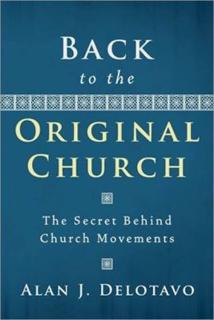
Alan Delotavo’s Back to the Original Church, reviewed by Jim Williams

From Pneuma Review Fall 2013.
 Alan J. Delotavo, Back to the Original Church: The Secret Behind Church Movements (Eugene, OR: Resource Publications, 2010), 100 pages, 9781556355660.
Regular and careful Bible readers inevitably piece the Bible story together until they have a sense of the grand sweep of things. We do the same with the history of the church. Sometimes unconsciously, we jump from the Book of Acts directly to Martin Luther, then to Azusa Street, and finally to the present day. Delotavo fills in some of the blanks to draw out a valuable lesson that can only be seen from an overview.
Back to the Original Church is Delotavo’s University of Pretoria ThD thesis in popular form. This conversation about the flow and progress of church history calls us to see church movements as gifts to the wider church restoring something neglected and not stopping points or ends in themselves.
Delotavo provides examples of church movements that attempted to restore an essential part of church life or faith, but which became bogged down to the point of needing their own renewal. The Reformation era focused on the recovery of the gospel in view of accumulated abuses and theological “defects.†This gospel recovery included the teaching of “the priesthood of the believer,†that each Christian had direct access to God without the need of clergy. Delotavo points out that this set up a division between laity and Protestant clergy and also spawned a divisive spirit throughout the Reformation. Further splits occurred till today denominations around the world number into the thousands. The Lutheran church became State church (protected by law and supported by taxes) and fell into the sorry state of doctrinal correctness with experiential coldness. The Reformation had become an end in itself. To recover what was needed, Pietism arose about a century later. This was an attempt to bring vital Christian experience, including conversion, assurance and holiness back into the Lutheran state church. Once more the renewal movement, although truly helping many, lost its way. Splitting many ways, some parts impacted world missions and future movements, other parts become theologically liberal, and still other parts become radical or revolutionary.
Delotavo’s excellent point bogs down, however, in historical omissions and stretches. He jumps directly from the early church to the Reformation period. The era of the main church councils (AD 325—787) he considered a breakdown of Christianity due to political connections to the Roman Empire. The “Dark Ages†or better, the medieval church, is thought to have no value. He sees the church largely pursuing the expansion of Christian civilization at the expense of “genuine experience of salvation.†Delotavo seems to ignore that in the West, the church was living through the crushing of the Roman Empire under “barbarian†invasions; that in the East, Constantinople was rising to power as the new center of the Roman Empire; and that Islam was racing across North Africa, into Spain and southern France. He could have pulled examples of church movements from these periods that prove his point, but he did not. Does he not recognize the value of that period of the church’s life?
The way forward for Delotavo is found in American Evangelicalism. He noted that several awakenings or revivals had occurred in American history from colonial times, each a church movement in itself. By the end of the nineteenth century, modern Liberalism rapidly set in resulting in the backlash of Fundamentalism in the early twentieth century. In its original form, Fundamentalism was truly a church movement to recover much that was being lost; however, it degenerated into anti-intellectualism and a belligerent separatism. In the 1940s, a corrective movement, Evangelicalism, arose to call the church back to theological basics, to academic engagement, and to a loving spirit. Here, Delotavo believes, is the apex of church movements, breaking down all barriers, and penetrating all denominations and traditions. Here is what the church was meant to be at last! Delotavo forgets his own warning: church movements are means to an end (renewal for the entire church) not ends in themselves (the final best expression of the church). Is this the climax of church history?
Pentecostalism is a renewal movement meant to recover something for the entire church. Delotavo gives it much to ponder. How is the movement doing? Delotavo reads church history through the lens of American Evangelicalism. In American church history, how does Pentecostalism fit in the Evangelical reading? Pentecostalism has changed since Azusa Street. It has strong denominations and educational institutions; it is prosperous and at peace in the world. It is no longer largely pacifist, and the proportion of women senior pastors and denominational officials is a far cry from what it once was. Some argue that Pentecostalism’s desire for recognition led to throwing itself into the Evangelical mainstream resulting in the loss of some of its distinctive witness. Perhaps the Evangelical historical lens is not entirely useful: is there a better one? When does Pentecostalism cease being a church movement and start becoming a sect, then a museum? Delotavo’s vision of the church begs us to think bigger, historically and purposefully.
Reviewed by James Williams








E.E. writes: "James Williams wrote: 'This gospel recovery [the Great Reformation] included the teaching of ‘the priesthood of the believer,’ that each Christian had direct access to God without the need of clergy. Delotavo points out that this set up a division between laity and Protestant clergy and also spawned a divisive spirit throughout the Reformation.' An argument can certainly be made for the Reformation bringing a divisive spirit to the Church, even if this started as a necessary separation over truth. But wasn't it Roman Catholicism that created the division, perhaps starting with Cyprian, between the clergy and the laity? It seems like the reviewer is saying the opposite of what he means."
Thank you for your careful reading and follow-up question. Actually, it is Delotavo saying this, not me. I point out that he skips much of Church history in his presentation (including Cyprian) and overlooks renewal movements that might have made his case for him. To read him in context, he is not focusing on the origin and development of laity—clergy division, but only on its Reformation manifestation arising from the doctrine of the priesthood of believers as evidence of his main theme. In view of this, I respond that both Delotavo and I are saying exactly what we mean.
E.E. writes: “James Williams wrote: ‘This gospel recovery [the Great Reformation] included the teaching of ‘the priesthood of the believer,’ that each Christian had direct access to God without the need of clergy. Delotavo points out that this set up a division between laity and Protestant clergy and also spawned a divisive spirit throughout the Reformation.’ An argument can certainly be made for the Reformation bringing a divisive spirit to the Church, even if this started as a necessary separation over truth. But wasn’t it Roman Catholicism that created the division, perhaps starting with Cyprian, between the clergy and the laity? It seems like the reviewer is saying the opposite of what he means.”