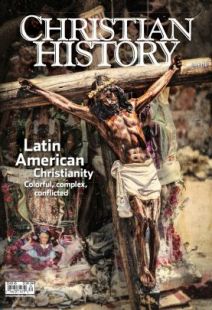
Latin American Christianity: Colorful, complex and conflicted

Historian William De Arteaga invites Pneuma Review readers to journey with him into Latin American Christianity as presented in Issue 130 of Christian History magazine.
Â
 Christian History 130, “Latin American Christianity: Colorful, complex and conflictedâ€
Christian History magazine is a wonderful journal. I recommend a copy of it be at the coffee table of every Christina household so that friends and neighbors would be influenced by it.
Have you noticed how many books of the Bible are historical? No accident. This is different for the scriptures of other religions, which are mostly texts of moral do’s and don’t’s or meditation practices, such as in Buddhism. Without a sense of history, a Christian will have difficulty forming a mature biblical worldview. Without this grounding, Christians fall into errors like conspiracy theories—where one believes another group is especially evil—or so-called pedestal history—where one believes the present generation is the wisest and best. ().[1]
Many Christian writes still fall into modern forms of “hagiography.†That is, writing only the positive about Christians and their ministries, and skip any sinful or negative aspects. Note that the Biblical history books are not written in that way. We learn, for instance, of David’s murder-adultery, Paul had and ugly donnybrook with Barnabus, and the “heroes†of the book of Judges all had serious faults that were not over looked.[2]
In this issue, the editor and writers did a wonderful job of balancing the achievements of the Spanish and Brazilian evangelization of Latin America and some of the saints they produced as well as looking in on the dark sins of genocide of the indigenous people of the Caribbean, the mass importation of African slaves, and the imposition of serfdom on most of the indigenous peoples. The editor, Jennifer Woodruff Trait, an Evangelical Christian, could have accepted the Evangelical suspicion that Catholics are not really Christian, but she did not.[4]
The “Latin American Christianity†issue is divided into ten articles that cover wide panorama of issues about Christianity in Latin America plus its usual and useful sections, “Did You Know†factoids, and “Recommended Resources“ of books, web sites and videos.
Cardoza-Orlandi shows three ways in which Pentecostalism spread and flourished in Latin America. The first was what he labels as “split and grow†whereby a missionary arrives in Latin America, tries to fit into a traditional denomination, but that does not work out. He or she then leaves and forms a new and indigenous church that often flourishes beyond the original denomination. In another pattern called “goodbye missionaries,†a nondenominational and independent missionary comes to Latin America, founds various churches, and quickly leaves them in the hands of local pastors. Lastly, the “nation to nation†is a model in which missionaries arrive at their destination with only prayer support from the originating church and establish churches which, by necessity, are immediately staffed with local people. All of these patterns make a lie out of the anti-Pentecostal conspiracy theory, popular in some Catholic and Left-wing circles, that Pentecostalism was a CIA invention to ruin the advance of Liberation Theology.
The next article I would like to comment on is, in fact, on Liberation theology. This is Edgardo Colón-Emeric’s piece entitled, “A new Pentecost: The Story of MedellÃn.†It is a positive interpretation of Liberation Theology, an opinion that would be echoed in most mainline and liberal seminaries.[5] The article affirms that Liberation Theology shifted attention to the poor in Latin America, something both Catholicism and Protestantism did not do well.
My own take is that Liberation Theology was a disaster. It advocated that “Capitalism†was the evil, which doomed governments influenced by it to anti-free market policies. The destructiveness of disdaining free markets can be seen in the present crisis in Venezuela and in the fact that China and other ex-Communist countries have rejected this dogma.
More seriously, Liberation Theology created a justification for armed revolt. This inspired a whole generation of Catholic youth to become anti-government guerrillas. This, in turn, bred counter repression among the middle classes who feared that any revolution would eventually be captured by some variety of radical Marxism. I can think of the Cuban revolution of the 1950s which was an alliance of several groups, but which the Communists captured. Other Marxist groups arose in Latin America, such as the murderous Sender Luminosa of Peru that became a Maoist tyranny in the areas they controlled. In this, the conservatives were historically informed, whereas the sincere advocates of Liberation Theology were ideologically hopeful. The resultant civil wars in Central America and Columbia were especially savage and a win-win for Satan.
All in all, Liberation Theology made it very difficult for the political center to form realistic programs of economic growth, social justice and alleviation of poverty. Significantly, the most effective anti-poverty program in all of Latin America was the program designed by the Brazilian Government under President Lula da Silva. The poor in Brazil were given a base income which greatly reduced poverty without threatening the middle classes. The Brazilian economy was allowed to grow and prosper in a free market environment. This had nothing to do with Liberation Theology, but it liberated a large section of Brazil’s poor from poverty and despair.
PR
Notes
[1] I am writing a book on this topic, but you will have to wait a while. In the meantime, you may check out my article, “The Sinfulness and Destructiveness of Conspiracy Theories,†Pneuma Review (Spring 2015).
[2] Lee R. Martin, “Judging the Judges: Searching for Value in these Problematic Characters†Pneuma Review (Fall 2010).
[3] Peter Hoken, The Glory and the Shame: Reflections on the 20th Century Outpouring of the Holy Spirit (Gilford, UK: Eagle, 1994). [Editor’s note: See William De Arteaga’s review]
[4] I was raised Roman Catholic and yes, some of their beliefs are unbiblical, as in Marian devotion, but that does not cancel Romans 10:9.
[5] This is new research, gleaned from evidence from ex-Communists spies in Eastern Europe, that Liberation Theology was developed, or at least financed and encouraged by communist theoreticians in Rumania and East Germany. See Articles: J.D. Flynn, “Former Soviet Spy: We Created Liberation Theology,’ interview article with Ion Mihai Pacepa, CAN, Posted, n.d. https://www.catholicnewsagency.com/news/former-soviet-spy-we-created-liberation-theology-83634