

A Time of Weakness, A Time of Strength: AD 315-450

Constantine’s Edict of Milan brought an end to the persecution of Christians, but that did not mean the Church was granted favor throughout the Roman Empire. What are the lessons for us today?
The impression is often left that with the Edict of Milan that Constantine issued in A.D. 313-314 which brought an end to the persecution of Christians, the Church was granted favor throughout the Roman Empire. Such was not the case. Constantine’s policy was only one of toleration. In A.D. 314, the coins that were issued throughout the empire during Constantine’s reign not only carried the image of the cross but also an emblem of Sol Invictus and Mars Conservator. These coins were issued year after year.

The state of affairs was therefore of toleration and not of favoritism for a number of years. Persecution of Christians came to an end but there were still problems to be faced. The years between A.D. 313-4 and A.D. 475 were a period of stress and weakness but also a time of strengthening. The Roman pantheon remained and was honored chiefly by those in the military. There were military units that were also religious orders. Sol, the sun, was considered to be the God who brought about important victories. Other military units honored Mars. Various cavalries and infantries had their favorites.
Not only was there still the continuing presence of the Roman pantheon of Gods and heroes, but returning soldiers from the Eastern defense brought with them the cult of Mithra and its initiation rites. Because Rome had its eastern border along the Euphrates river with its main fortress, Dura Europas, facing the Persian city of Ctesiphon on the opposite bank, there was an opening for eastern ways to seep into the Roman empire. Gnosticism, a dualistic spirituality which considered the material world as evil and the spiritual world as good or divine, seeped through to the West as early as the late second century but gained ground through the third and fourth centuries. Gnosticism had a leech-like character and attached itself to anything that looked attractive. The Christian faith was one. As early as A.D. 185, Irenaeus, The bishop of Lyons in Gaul, attacked the Gnostics in his writing, Against Heresies. It was not enough though it helped to retard Gnostic spirituality.
Gnosticism and Mithraism were not the only ones to cross over into the Roman Empire. So did Manichaeism which was perpetrated by a Persian mystic named Mani who itinerated throughout the Persian realms and into parts of Roman East Africa, North Africa, and eastward to the Indus river valley. The man who saw through the errors of Mani was once attracted to his teachings, none other than Augustine. Soon after his conversion to Christ Jesus from a garden experience and the mentorship of Ambrose in Milan, Augustine attacked the teachings of Mani.
Augustine was important for the Church in more ways than his apologetic and polemic writings. One other contribution was the account of his way to Jesus, The Confessions, which had a wide reading within his own lifetime and which has been widely disseminated throughout the subsequent seventeen hundred years. Beyond the inspiration of the dramatic impact of the power of the grace of God in Christ Jesus, Augustine was the first to develop an understanding of the church as a counter-culture. This was done in his later writing De Civitate Deo (The City of God) composed at the time of the weakening of Rome in the West and when the Vandals and Visigoths invaded the western European sector of the empire. This is critical for the next issue of this writing.
When Constantine converted and came over into the Christian Church, it was the beginning of a relationship which proved to be both blessing and curse. The Christians were favored by not having to pay the taxes imposed upon other members of the empire. Church buildings came into existence for the first time in history, with the congregation at Dura Europas on the Euphrates and one in Caesarea in Palestine being the first two known to exist. After Constantine’s conversion to Christianity, he became interested in the affairs of the Church. He paid close attention to what was happening among the Christians both with regard to what bonded them together and with regard to where they disagreed with each other. This served to create a situation which evolved into the issue of church-state relationships.
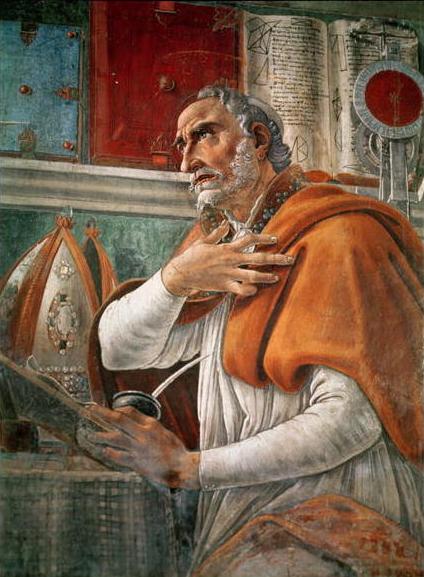
Augustine’s contribution through his massive City of God is that the life of the church is separate from the life of the body politic. This has taken the church down three divergent paths in the west: triumphalism, as practiced in the Middle Ages by the Catholic Church as superior to the state; church and state as separate partners as practiced by the Protestant-Reformed churches; and complete separatism as proposed by the Anabaptist Brethren-Mennonite-Amish reformers. All derive from Augustine’s City of God.
The Church in the East developed differently on church-state issues. It suffered unduly from the impact of believing rulers in the affairs of the Church. The Church did have men in the pulpit who challenged the rulers. The most vocal of these men was John of Antioch, later the archbishop of Constantinople, and better known through the succeeding centuries as John Chrysostom. St. John Chrysostom’s most famous and eloquent sermon, The Foolishness of the Cross Conquering, at some date between A.D. 398 and 402. He rattled the nerves of the Empress Eudoxia, wife of the emperor Arcadius. He was exiled twice: once in 403 but was recalled and then again in 404, this time sent to Armenia. But by extensive correspondence, he exerted such influence that Arcadius had him banished still further away. It did no good. Though he died in A.D. 407, just a few years before Augustine in Hippo and Patrick in Ireland, the power of his eloquence and influence after death marked him as the most articulate opponent of what is known in politics as caesaro-papism: the emperor; or we may say, the government is pope.
Caesaro-papism has been a thorn to the Orthodox Church and in early modern Russia. John Chrysostom also opposed the idea of any bishop having primacy of position within the body of the church. He once conceded to the bishop of Rome “the primacy of honor, but not the primacy of jurisdiction.
What is the point to this discussion? The issue of the relationship between the life of the church and the life of the state is an ongoing problem. Sometimes this gives rise to the problem of a “civic appeal to Christian belief and faith†which only has a facial quality and is not the real thing.
As for Augustine, he retains a position in Western Christianity, third in influence only to Jesus and Paul. He greatly influenced the reformers of the 16th century both in their doctrine of irresistible grace and the relationship between church and state.
Chrysostom is loved by both Eastern and Western Churches. He left to posterity not only his sermons but also commentaries on the Scriptures and the example of an unyielding allegiance to the truth of the gospel even under the pressure of a ruling elite.
Another strength emanating from these men came from the fact that they were both monks. The men of the monasteries were the regular ministers of the gospel. They were ministers under a regula (Latin, rule.) The Monastery has as its origin in the desert of Egypt when two men, Antony and Pachomius forsook their ordinary lives and retired into the fastness of the Egyptian desert to maintain a pure Christian life. Antony gained his fame after his death in a biography written of him by Athanasius, the bishop of Alexandria. He can be considered the first of the Desert Fathers of the Church and the originator of the hermitage and laura concepts of “retreat.†It was Pachomius who conceived of a community of men who withdrew from the urban centers. Each had his own house and a cell where he slept and where he prayed. In the middle or center was a main building having a sanctuary, a common eating-place, and a scriptorium where one studied, copied the scriptures of the Old and New Testament into Latin, Armenian, Georgian, Amharic, Coptic, and other indigenous languages. This cenobitic concept was what made the monastery. All lived under a regula established by a ruling monk.
Pachomius’ sister had the same idea for women. She is considered the originator of the nunnery. She borrowed the concepts of her brother. The importance of these monasteries in the desert of Egypt were that they were the school houses of evangelists, later pastors, bishops, and leaders. Pastors at that time were referred to as secular ministers. Secular comes from the Latin word secula, meaning world. They walked with their congregants in this world to make it through this world as believers in Jesus.
In these monasteries the four gospels were gathered together with the letters of Paul, James, John, Peter, the unknown author of to the Hebrews, and the Revelation. In short, the monasteries gathered all together into what became known as the Kaine Diatheke, more popularly known today as the New Testament.
It was in Athanasius’ Paschal letter of A.D. 365, that all 27 books of the New Testament as we have them were enumerated. It was at the Council of Carthage in A.D. 389, which Augustine attended, along with Chrysostom and many more from East and West, that the 27 segments of the New Testament as we have them were officially declared Novum Testamentum, whence we gain from the Latin, New Testament, or Kaine Diatheke, the Greek form of New Testament.
Out of the monasteries came the copiers and then the evangelists who then spread the gospel of Jesus Christ, east and west, north and south. They went into Gaul under Martin of Tours and John Cassian; into the north of Ireland by Patrick where he established a monastery at Armagh where the gospel was preached and taught to a group of new believers in Christ who later gained fame as the Irish pedestrians or peregrini who walked all over Europe between between A.D. 389 and A.D. 450.
What Pachomius started became a powerhouse of the Holy Spirit and raised up such men as Athanasius, Basil the Great, Gregory of Nyssa, Gregory Nazianzen, John Chrysostom, Theodoret, Augustine, and others too many to enumerate. Under Basil the Great, the monastery took on a theological rationale for outreach, the kenosis of Christ Jesus who emptied himself and took the form of a servant. Servanthood meant creating hospitals for the infirm and the ill, and homes for widows and orphans. This was derived from the second chapter of Paul’s letter to the Philippians (2:7).
The western monastery took as its rationale for outreach not only Philippians 2 but also Matthew 28, the letter of James, and I John. They developed schools for children, hostels for travelers, havens for the homeless, homes for widows, orphans, and hospitals. Through succeeding years many became the first universities.
In the unlikely time of 312-450, when the church was under duress, the gospel took hold from Ireland in the west to the Ural Mountains and the Caspian Sea in the east. When the Romans lost the battle of Adrianople (AD 378), the way was open for evangelists to begin mission outposts and establish congregations in Germanic and Asian cultures. What was a time of weakness became a time of outreach and strength.
PR
More Christian History from Woodrow Walton
 The Ghost Of Alexander Severus: Third Century Religious Pluralism as a Foretaste of Postmodernity
Has Christianity ever found itself in a world full of competing religions and cultures? What can we learn from how those followers of Jesus acted in their times? Should we hope for the same kinds of outcomes?