The Falls Church Anglican: The Long March to Healing Ministry Excellence


This article is a chapter from the Rev. William De Arteaga’s forthcoming book, Saints, Heroes and Villains of the Anglican Healing Awakening.
To my knowledge no other Anglican church, or any other church, has such an effective and robust ministry of healing and deliverance as The Falls Church Anglican of Falls Church, Virginia (Ok, just a bit confusing, “Falls Church†is the name of the town, and “The Falls Church Anglican†refers to the church in the town of Falls Church).[1] At this church the healing, deliverance, and intercessory prayer ministries are woven into the core of church life.
Its clergy and members understand their calling as a “three streams†congregation. That is, a church where the different aspects of liturgical and sacramental worship, evangelical preaching and Christian good works, and the gifts of the Spirit operate and interact among various groups and ministries, according to their preferences and needs. To be specific, the gifts of the Spirit operate mostly among the healing and intercessory prayer ministries, and a few home groups, but not in the main liturgical services.
The town of Falls Church, Virginia, is a suburb of Washington DC., and many of the parishioners are executives, government employees, and current or former military personnel. Its parishioners and its excellent staff make it one of the most prominent churches in the greater D.C. area.

Image: Wikimedia Commons
The historic Falls Church was established during the colonial period. Its first building arose in 1732. Later, George Washington was a warden of the church in the 1760s and oversaw the construction of the brick church building to replace the original wooden structure. The Falls Church served as both a church and recruiting station for the American Army during the War of Independence. Later, the church served as a Union hospital during the Civil War, as Northern forces quickly took over the territory around Washington, D.C.
After that terrible conflict, The Falls Church was restored to its original status, but did not really thrive, and Sunday attendance dropped to less than a hundred. But in 1935 the Rev. Watkins was called as rector, and by the time his tenure ended (1945) church attendance was in the 300s.[2] The Falls Church grew steadily from that time as the population of Washington D.C. continued to grow as World War II morphed into the Cold War with the Soviet Union.
However, The Falls Church did not become the prominent church it is today until the pastorship of the Rev. John Yates, who came in 1979. He and his wife were both from devoted Christian homes.[3] The Rev. Yates’ mother was prominent in CFO circles in the 1950s and 1960s, and her son John accompanied her at those CFOs on several occasions.[4]
John Yates graduated from Princeton Theological Seminary in 1971, and then served at an evangelical Episcopal church as a youth minister. After he was called to be rector at The Falls Church he earned a Doctor of Ministry from Fuller Theological Seminary.
Yates led The Falls Church into a strongly evangelical and orthodox position. This was not easy, as there was opposition to that focus from parishioners who were content with the less demanding “broad church†mode of Episcopal life that enjoyed a good liturgy but rocked few theological boats. Yates tactfully handled the situation while he continued to preach the evangelical Gospel. For help, he invited such Anglican evangelicals as John Stott to preach and confirm the evangelical persuasion. The fruit of this was that, while some left, the numbers of truly committed parishioners grew steadily, reaching a thousand, then over two thousand.[5]
Under the Rev. Yates important programs were initiated, including the Second Chance ministry which gave counsel and assistance to abused women and their children. He also set up a program for college graduates—the Fellows Program—to teach apologetics and how to encounter America’s increasingly secular culture. Another ministry focused on helping the poor in the Washington D.C. area with legal issues. These ministries were run by qualified lay volunteers, and given that many of the parishioners were experienced government or military personnel, there was no lack of qualified and experienced persons to staff and lead the various ministries.
Thankfully, among the ministries that the Rev. Yates wanted for The Falls Church was the healing ministry. In 1992, with Yates’ blessing, the assistant rector assembled a group of people to begin praying about starting a healing ministry. There were some connections made with the Order of St. Luke,[6] but it never really got off the ground. However, before we delve further into how the healing ministry ultimately succeeded, we need to mention the struggle that The Falls Church had with the national Episcopal hierarchy which led them to ultimately separate from the Episcopal Church and lose their buildings and property.
During the 1980s the argument about orthodoxy and Biblical authority within the Episcopal Church (and other mainline churches) continued unabated. All through this decade the liberal “demythologizing†campaign continued, made infamous by the writings of Bishop John Shelby Spong of New Jersey.[7] The argument became focused in the popular press on the homosexual issue, specifically wither a practicing homosexual could be ordained into the priesthood. That was debated and rejected by the Archbishops of the world-wide Anglican Church, but the Episcopal hierarchy in the US defied various directives on this issue and went ahead and began ordaining openly gay persons to the priesthood. When Jean Robinson was elevated to the Bishopric (2003), many orthodox and Bible affirming Episcopalians felt this was the last straw and decided to separate from the Episcopal Church. They left either individually or collectively to form new congregations, and eventually new denominations.
The situation for the Rev. Yates and his congregation was perplexing in the extreme. Yates did not want to separate from the Episcopal Church and did everything his conscience permitted to remain Episcopalian. Yet he, his staff and the congregation saw the continued slide of the national Episcopal Church into un-biblical spirituality and into a sexual ethics that made human desire the ultimate authority. It became clear that separation was the only option for them. The congregation eventually voted overwhelmingly to separate from the Episcopal Church. Yates sent a letter to Bishop Lee, Bishop of the Virginia Diocese, notifying him of this decision (September, 2005). Negotiations for a separation settlement began, and indeed an amicable agreement was reached, in which the congregation retained its buildings.
But as the agreement was being completed, a new presiding bishop was elected, Katharine Jefferts Schori. Among her first actions was to mandate that all negotiations between separating congregations and their dioceses be terminated. She insisted that every exiting congregation vacate its property and lose its assets. Her policy led to long and costly litigation throughout the United States which drained much of the cash reserves of the Episcopal Church. This litigation of course violated the clear Biblical injunction that Christians should avoid legal fights among themselves (1 Cor 6:5-7). This was to be expected of a leader who believed so little in the mandates of the Bible. Eventually the national Episcopal Church won, and orthodox congregations all over the United States were evicted from their properties.
When all the litigation was over in 2012 for The Falls Church, Yates and three thousand or so orthodox members left its buildings and its other assets, including almost $2,000,000 in cash. They arranged to worship and continue their multiple ministries at other venues. But there was real joy felt by the majority of those leaving, as they knew they were obedient to God’s word and direction.[8] About sixty members remained as a rump congregation to keep the lights on and the original The Falls Church going. The Falls Church Episcopal grew very little in the following years.[9]
The separating church, The Falls Church Anglican, found temporary episcopal oversight from the Anglican Church in Nigeria. Before long, however, it joined with other key withdrawing congregations in the U.S. and Canada to form the new Anglican Church in North America (ACNA). Pastor Yates had good relations with many of the other churches in the local area, and many allowed The Falls Church Anglican to worship or conduct ministry activities at their facilities. Most often used was the gym of Bishop O’Connor Catholic High School for its Sunday services. Staff worked out of their homes until affordable offices could be leased. In this situation spiritual community grew out of discomfort and trial, as relations between the host churches and the people and ministers of The Falls Church Anglican became even stronger.

Soon a building fund was begun, and by 2015 a large office building with sufficient property to build a sanctuary next to it was purchased. To this day the church itself occupies the entire third floor and most of the lower level; the remainder of the office space is leased. Finally, in 2019 a new and beautiful sanctuary was completed.[10] To the Rev. Yates must go much of the credit for leading his congregation through this difficult period. Just before the new sanctuary was completed, Yates began his long-postponed retirement following forty years of service, and handed over the reins to the Rev. Sam Ferguson.
Sam Ferguson came to The Falls Church under the Timothy program as a new seminary graduate in 2011. He went to Gordon–Conwell Theological Seminary and then Cambridge University. Previous to attending seminary, he had begun in ministry working with the Fellowship of Christian Athletes in inner-city Philadelphia. During his time at The Falls Church, Ferguson was ordained to the diaconate and then to the priesthood. At the completion of the three-year Timothy program, he felt called to pursue a doctorate but remained connected with The Falls Church Anglican on an official basis, returning periodically to teach and preach. Throughout that time, he impressed the congregation with his abilities and learning. In 2018, he earned a Ph.D. in New Testament at Southeastern Seminary in North Carolina, with a dissertation in the area of biblical anthropology. In fact, the Rev. Ferguson has proven to be a brilliant preacher and scholar, and he fully supports the church’s healing and deliverance ministry.
Let me go back to retrace Yates’ achievements in the area of healing ministry. As we mentioned above, an attempt to start a viable healing ministry petered out in the early 1990s. In 1999, Yates went on retreat and there the Lord spoke to him with the prophetic message that The Falls Church had a healing ministry. When he returned he preached on healing and expressed his frustration that a healing ministry had never gotten off the ground at The Falls Church. He ended by saying that he believed the Lord had a healing ministry for the church but that it would come out of the laity. The response was positive, and several persons, including Chuck and Nancy Cook, stepped forward to bring this ministry to reality.
A Lay Couple and a Priest
Chuck and Nancy Cook had experienced the Baptism of the Holy Spirit back in the 1960s. They had attended many retreats and Order of St. Luke meetings and were regulars at the Shrine Mount CFOs[11] and had been on its governing council ring. Before they came to The Falls Church they were attending a Presbyterian church, but were frustrated there by its lack of the Holy Spirit’s activity and healing power. A friend invited them to attend The Falls Church, and they accepted as a trial. They both appreciated its faith-filled atmosphere, its fine preaching and liturgy and they stayed. Yates’ call for the laity to lead the creation of a healing ministry was, literally, an answer to their prayers.
In 2000, the Rev. Rick Wright was called to be Director of Pastoral Care ministry at The Falls Church. As a teen, Rick Wright entered the Charismatic Renewal at its height in 1973, and naturally absorbed its multiple teachings for healing and deliverance that were at the heart of the Renewal.[12] Wright felt a call to the ministry and went to Trinity School of Ministry, near Pittsburgh. This was and is one of the few orthodox (and Charismatic affirming) seminaries in the Episcopal Church. After ordination, he served in several Episcopal parishes for sixteen years before coming to The Falls Church.
When he came to The Falls Church Anglican, the pastoral care ministry included such things as counseling, hospital visitations and other services besides the healing ministry. The Rev. Wright came with the experience, knowledge, and desire to grow the healing ministry and quickly connected with the lay volunteers, including Chuck and Nancy Cook. Not long after he had arrived, Wright informed the prayer ministers that the Cooks would take the lead in doing what was necessary to establish a growing healing ministry at The Falls Church Anglican. He had not told them before the announcement, but they graciously accepted the charge. With Wright’s mandate, they took initial actions to organize healing teams and prayers for the church, and began “Prayer at the Rail†where parishioners who needed healing and intercessory prayers were prayed for right at the end of the main services.
In the fall of 2001, Wright started a new healing class for lay persons. This featured the early videos put out by the MacNutt’s Christian Healing Ministries,[13] out of Jacksonville, Florida. The first class had about twenty members, about half of whom had gone to various healing conferences and camps. From this group, and the yearly classes that followed, a strong and well trained core of healing volunteers arose.
The first several years of the healing ministry were largely low-key, as many in the congregation were not used to the idea of healing prayer. Some in the congregation came from cessationist churches and others from Episcopal churches where the healing ministry was not active. Thankfully, the ministry enjoyed the full support of the Rev. Yates and the rest of the clergy, and the multiple lay ministers always felt their support. As healings began occurring regularly, growth and acceptability followed.
The Rev. Wright had been influenced by the literature of the English Church Missionary Society and its principals of ministry growth. These were: start small, listen to the Holy Spirit for direction, make sure money is only of secondary importance, and attract quality people under God’s providential guidance. He kept these principles in mind as the healing ministry grew under his guidance. These principals were a perfect match for the situation at The Falls Church. The healing ministry under a flourishing and wealthy congregation which The Falls Church had become, could sustain itself with little additional income. Being part of the regular functioning of the church, the healing ministry at The Falls Church had a ready infrastructure of clergy, staff, and volunteers, along with ministry space and required office equipment. Standalone ministries do not have that luxury, and often the need for sustaining funds sneaks into high priority regardless of good intentions.[14]
In 2002, the Rev. Wright invited the McNutts to The Falls Church for a healing conference. Several hundred parishioners and members of nearby churches attended. This was a major energy producing event which fired up many in The Falls Church about the healing ministry. After the conference, Wright and several of the ministry leaders went down to Jacksonville to see just how the MacNutts had organized their ministry. They were impressed, but one thing particularly struck Wright: how CHM had created an “open door†in which a person with a healing need could come and be ministered to immediately, and not wait for a specific mid-week or Sunday service. The Rev. Wright determined that The Falls Church healing ministry would strive to do likewise, and managed to make that a fact.
By 2006, another step forward in training was taken. The Rev. Wright, together with the Cooks, organized an eight-month long course given every Wednesday night to train new volunteers and interested persons in healing prayer. This was a very through series of instructions and exercises. These classes ran (and still run) between seventy-five and a hundred participants, about two thirds from Falls Church and the rest from nearby churches in Virginia, Maryland, and D.C.

In 2007, Fr. Wright brought in the Rev. Kathleen Christopher as an assistant in the pastoral care ministry. She had both the experience and the credentials for that ministry and had a special love for the healing and deliverance ministry. Soon after arriving, The Rev. Christopher met with Chuck and Nancy Cook to talk about the healing prayer ministry and found that they all shared the same passion. When the three of them asked Wright if the Rev. Christopher could work closely with that volunteer ministry, he readily agreed, assigning her oversight over the healing and intercessory prayer aspects of the pastoral care ministry.
Kathleen Christopher’s Story
Kathleen Christopher was born into an Irish Catholic family and attended Catholic schools through college, earning a BA in Classical Languages from St. Louis University.[15] She had a deep love for Jesus since childhood and recalls that in her childhood she was in church “six days a week.â€[16] But in her teen years she was drawn into the occult. At first naively playing with the Ouija board, she became progressively more involved in Eastern and metaphysical beliefs and practices, i.e. “New Age†spirituality. For her, Jesus faded into the background as one of the “ascended masters†who had reincarnated sufficiently to achieve perfection.
Upon graduating college, Christopher married and had two children, going on to acquire an M.A. in Classical Archeology from the University of Pennsylvania. With that background, she got a job at the Smithsonian Institution as an archivist and for ten years served as the reference archivist for the National Anthropological Archives where she worked especially with Native Americans and their cultural records.
Unfortunately, Christopher was also struggling with severe depression, primarily related to trauma that she had experienced as a child. She began psychiatric counseling which did some good, but still entertained thoughts of suicide, and her sleep was plagued with terrible nightmares.
At the retreat, the priest, the Rev. Jane, sensed Christopher’s depression and suggested she talk about it. Late that night, the two sat on a bench by the beach where Kathleen Christopher began to tell her story, including a description of the persistent and vivid nightmares which were filled with horrifying creatures. Listening a while, the Rev. Jane said, “I think those are demons—would you let me pray for you?†Christopher argued about that as foolish “medieval superstition,†but finally agreed to have the Rev. Jane pray over her. In a conversational voice, with no drama or manifestation that sometimes occurs in deliverance ministry, Jane prayed, commanding the demons to leave. After the deliverance prayers Christopher asked, “Is that all?†Jane answered, “Yes,†she made a sign of the cross on her forehead and spoke the baptismal promise found in the Book of Common Prayer, “Kathleen, you are sealed by the Holy Spirit in Baptism and marked as Christ’s own forever.â€[18] The Rev. Jane later commented that this was her first experience with deliverance ministry, but that she had obeyed a prompting from the Holy Spirit.
They both returned to the retreat house and went to bed. When Christopher awoke the next morning, she discovered that she had had no nightmares and had a wonderful sense of peace. The depression was completely lifted! This began her renewed walk with Jesus. She renounced her metaphysical and occult past. Over the next few years, she would be introduced to teachings and publications on Christian healing and deliverance, and attended conferences and workshops by the MacNutts’ and others.
Christopher felt a call to ministry which was confirmed and supported by her new church and the Episcopal Diocese. She entered Virginia Theological Seminary (Episcopal) where she received a Master’s in Divinity in 2000. Due to her experiences in the metaphysical and occult movements, Christopher discovered that she had special wisdom and gifting in the area of spiritual warfare and deliverance. She went on both domestic and foreign missions, including to the Pine Ridge Reservation in South Dakota, and in Uganda and Kenya were she ministered healing and deliverance prayer. Ordained to the priesthood in 2002 by the Episcopal Diocese of Virginia, Kathleen Christopher served in various parishes between 2002 and 2007, primarily as an assistant pastor, but did not find much interest in healing prayer among the churches she served.
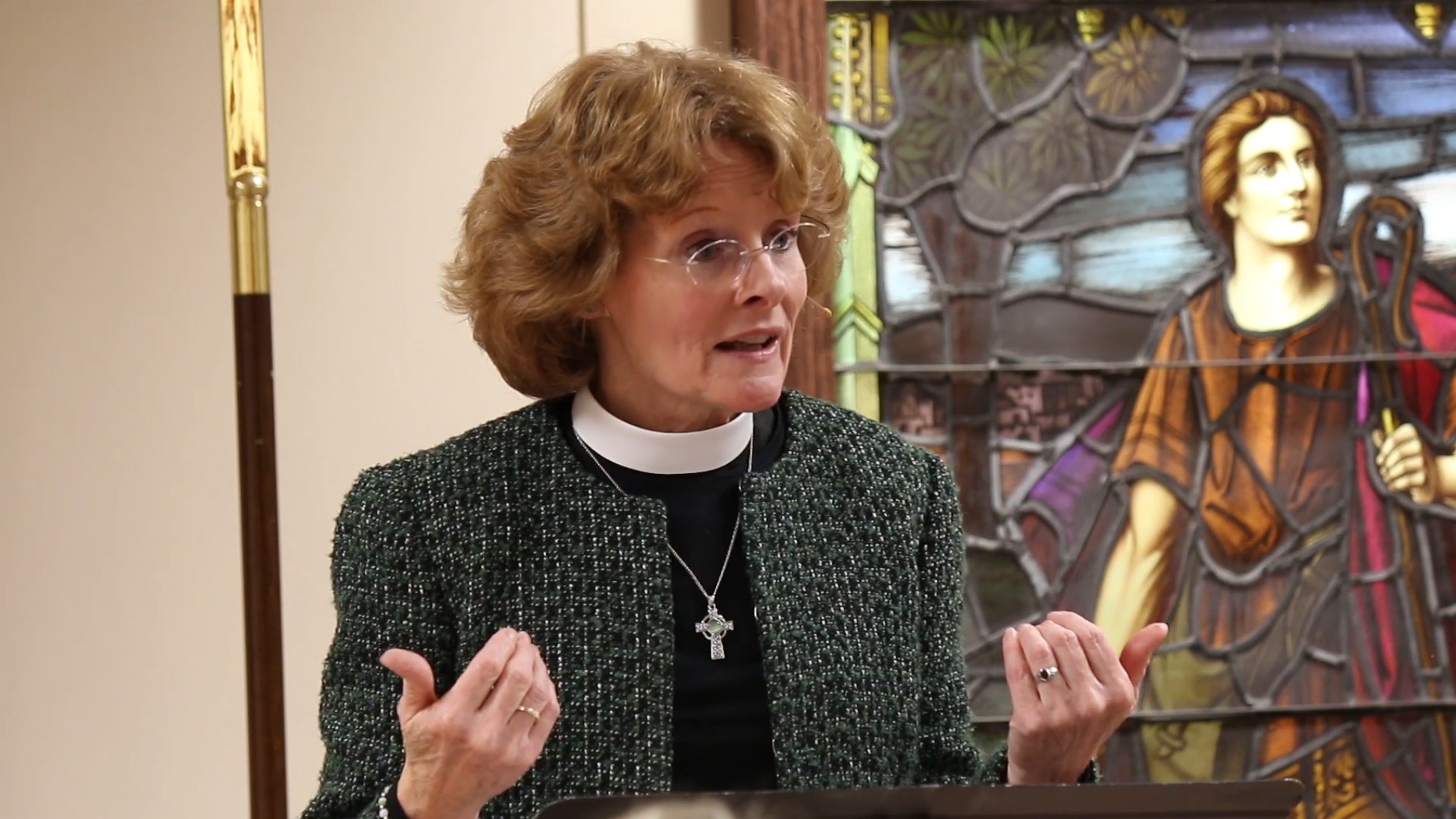
The Rev. Christopher came to The Falls Church in April of 2007 for a part time position, assisting in general pastoral care under the Rev. Rick Wright. Already knowing that the healing ministry was her passion, Wright readily approved her meeting regularly with the Cooks and serving as clergy oversight for that ministry. It was a providential decision. The healing ministry grew steadily stronger and more expansive. She was shortly given a full time position on The Falls Church Anglican staff. By January 2013, the healing and intercessory prayer ministry had grown to the point where it came out from under the pastoral care department and became a separate department with the Rev. Christopher as its director. As the ministry continued to grow, so did interest from other churches, many of whom would contact The Falls Church asking for help in developing a prayer ministry and in training lay participants. In response to that need, Christopher and her principal volunteers began planning for the creation of a separate more outwardly-focused healing ministry. This culminated in the formation of the Christian Healing Institute (CHI) in the Fall of 2014. Today, the Rev. Christopher serves as both the Director of the Healing and Prayer Ministries at The Falls Church Anglican and the Executive Director of CHI. The Falls Church Anglican supports CHI by allowing Christopher to wear both hats and by providing the infrastructure, teaching and ministry space, office resources, and so forth. This is the advantage of having a healing ministry intertwined with a church.
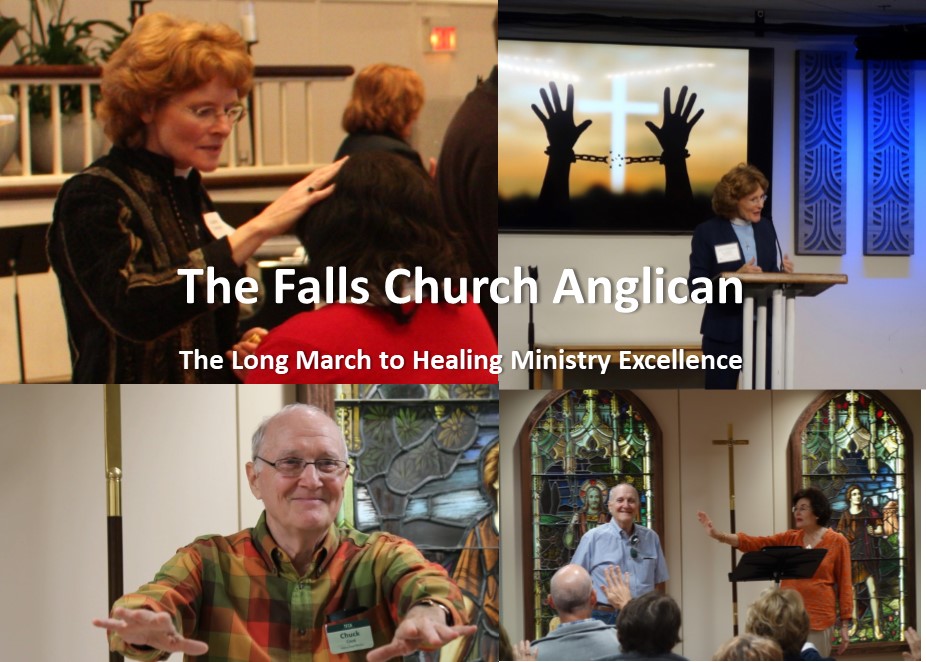
We need to describe the astounding multiplicity of healing prayer opportunities available to the Falls Church Anglican parishioners and visitors. Most common are the healing prayers available at practically every worship service. Trained prayer ministers are invariably present at the altar rail or at the side of the altar to offer “prayer at the rail.â€
Every Tuesday afternoon, from 1:30 to 4 p.m., various prayer ministers pray personally for those in need of healing or other personal needs. On Wednesdays, there is a noonday Communion service at the Crammer chapel which includes prayers for healing.
There is an Evening of Healing Prayer every third Tuesday of the month, 7 to 9 p.m. Also, on the first Tuesdays of every month there is a period of “Abiding Prayer,†7 to 9 p.m., also called “soaking prayer,†where persons rest in the Lord’s presence and prayer ministers lay hands on them as they do so, silently praying for them.
On the second Sunday of every month there is an evening healing service in the sanctuary, at 7:00 p.m. This becomes a Generational Healing Eucharist four times a year. Rev. Christopher, the Cooks, and other well-trained prayer ministers also regularly meet with individuals for “intensive†one and a half to two-hour prayer sessions by appointment at various times during the week.
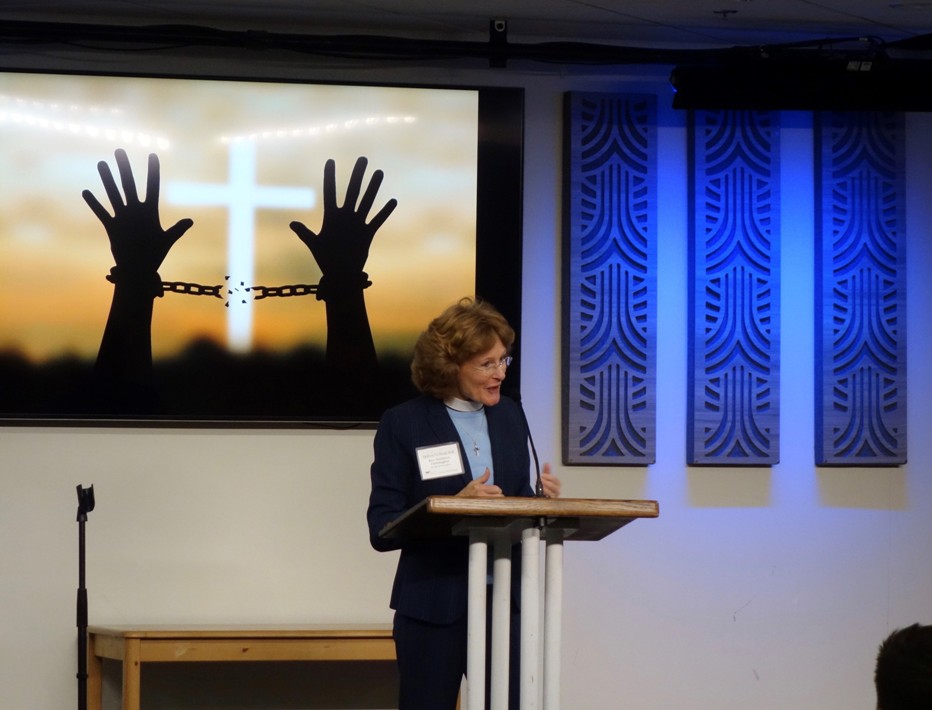
The Rev. Kathleen Christopher, through both the church prayer ministries and CHI, also organizes conferences on healing, deliverance, and intercessory prayer. There are normally two large conferences per year at The Falls Church Anglican. One is open to all and deals with general topics of healing and intercessory prayer. Another is more specialized, aimed at providing training for those in lay or ordained ministry and those in the mental health professions. For instance, in the Fall of 2019 a specialized conference focused on deliverance ministry. The presenters were both from the Falls Church Anglican and CHI but included others from the outside, including a psychiatrist from the West Coast who does exorcism and deliverance ministry within his practice.
Every year, The Falls Church Anglican hosts a twenty-five week Healing Prayer Class from September thru March. The fall semester runs thirteen weeks and covers Biblical aspects of healing and the basics of healing prayer, including listening to the Holy Spirit, the Biblical basis for healing prayer, and praying for physical and inner healing. In the spring semester, twelve weeks are used to cover more nuanced topics such as spiritual warfare, generational healing and other particular modes of healing prayer. It is in these sessions of instruction that the gifts of the Spirit and their practice within the healing ministry are taught.
The Rev. Kathleen Christopher is fully charismatic with strong gifting in discernment of spirits. I am a strong believer in the manifestations of the gifts of the Spirit even during liturgical services,[19] and I asked Christopher how she felt, being a staff member, about the church limiting expressions of the gifts of the Spirit to less visible situations such home groups and healing and intercessory prayer ministries. She responded by saying that she was thrilled and totally content to be at The Falls Church Anglican. The mix of Anglican liturgy, excellent teaching and preaching by the Rev. Ferguson and others, and other opportunities for the gifts of the Holy Spirit to operate suited her well. She added that the reputation of The Falls Church Anglican as a church rooted in God’s Word and well-reasoned theology provided an opportunity for people who would never attend a “full-blown†charismatic church or ministry to experience the movement of the Holy Spirit in a safe environment.
Testimonies of God’s Healing
The Rev. Christopher was kind enough to supply this author with various cases of healing that have occurred at Falls Church Anglican over the years. Here are a few, all of which are anonymous:
At church Sunday, a woman slipped and fell on the wet floor at Bishop O’Connell [This was back when The Falls Church Anglican rented Bp. O’Connell High School auditorium for Sunday worship.] just before the 9am service. She hurt her knee, managed to rise, then fell again, damaging her lower leg and ankle. Three healing prayer ministers came quickly, found her splayed across the floor just outside the auditorium doors, and prayed hands on for her, and she claimed healing for the swelling knee. PTL! Someone apparently helped her inside the auditorium for the service. Then another prayer minister found her sitting in the back. She said her knee was better but the lower leg and ankle were still bad and hurting. Later, during a prayer time in the service, the prayer minister prayed hands on for the damaged lower leg and ankle. After the service, she was beaming with a big smile and walking around completely well over by the cafeteria. She said she had been completely healed! Praise God!
A couple months ago a large growth was discovered on my mother’s pancreas. Knowing the severity of pancreatic cancer, my family was devastated. My mom was rushed in for emergency surgery to have the area tested. We were praying the fluid within the growth would be clear, but instead we received the dreaded news that it was full of a “mucous†material, indicating that it was either cancerous or pre-cancerous with the likelihood of becoming cancerous quickly. While we waited for another two weeks to find out the exact details of the cells, her doctor explained the process of the planned upcoming surgery to try to remove it. Due to the fact the growth was communicating with her pancreatic duct, the surgery would require the partial removal of 5 organs and had an extremely high mortality rate. This was definitely the hardest week for my family. Although we all knew firsthand that God not only can but does heal, fear had a way of sneaking in on many days. It was during these long two weeks that my family went to meet for individual prayer one Tuesday afternoon with two wonderful women on the prayer team. A few days after our prayer together, the test results of the cells finally came in. The doctor began by sharing that in the 30+ years he’s been a pancreatic specialist, he has only once before seen a growth contain mucous fluid and yet not contain cancerous/pre-cancerous cells—my mom was now his second occurrence. [smile] He had no medical way of explaining the miraculous results. Thank you so much again for your prayers—they meant so much to me and my family!

I just wanted to let you know that my neurosurgeon said, “It’s a miracle—no surgery needed!†when he last saw me. Four days after running up a flight of stairs, tripping and hitting my right temple on the edge of a door (with full force!), passing out and ending up in the hospital—I was told I would need spinal surgery and possibly brain surgery to correct all of the damage that had taken place. I was given steroids to reduce the swelling in my brain but was making very slow progress in my recovery due to several factors (severe concussion, spinal damage and an unknown pre-existing chiari malformation in my brain). After coming to a night of healing prayer my recovery took a very rapid turn for the better. At each week since, I have become so much better, stronger and “clearer†that even the nurses in the office were literally clapping their hands to their face saying, “We don’t believe it!â€
My wife was instantly cured from late stage 3/early stage 4 breast cancer. After fighting the cancer with surgery and chemotherapy the cancer was still spreading. It had moved into her lymphatic system and was quickly spreading throughout her entire body. A friend invited my wife to your healing service where she received prayer. The next day we got a new scan and the cancer was totally gone. That was 5 years ago.
Our son has a rare, serious colon disorder for which he has had a number of major surgeries and procedures since he was a newborn. The surgeries did not resolve his problems. Eventually it appeared that no surgical options were left except to give him one final colostomy. That would not be desirable, given how little colon he had left. Our now four-year-old son has not been able to have bowel movements on his own—he was dependent on a thrice daily medical procedure performed at home, which was not ideal for various reasons. Last month, our son received healing prayer. Exactly one week later, our son had his first self-controlled bowel movement on his own. And for the first time in years, we do not need to perform any daily medical procedures for our son. This is truly a miracle. The Lord giveth, the Lord taketh away. Blessed be the name of the Lord.
[The Rev. Kathleen Christopher, “We continued to follow this family, and their son was completely healed—able to go off medication for what was an ‘incurable’ condition.â€]
My husband and I attended a Tuesday night session of soaking prayer in October 2009. We had struggled with two years of infertility, including two miscarriages. That night we felt so covered in prayer by the various healing ministers at the Falls Church. It provided great emotional relief. Also, God used it to work a miracle in my body. That month, after eighteen years of irregularity, my reproductive cycle was healed and became regular. I had never experienced this before. This was not accompanied by any medication or medical intervention, it happened because of God’s healing. We were so encouraged and walked onward in hope of having a child someday. The following May, on Mother’s Day, a visiting minister from Swaziland was staying with my parents in Southern California. He heard our story and called us to pray for healing over the phone. He had us lay hands on my body and prayed powerfully, in Jesus’ name, casting out the spirit of miscarriage and asking for a child. He said, “Next Mother’s Day, we’ll be celebrating.†A few weeks later, I got pregnant, and now I am six and a half months along with a baby boy, due on Valentine’s Day 2011. I found out about the pregnancy exactly one year, to the day, of learning that our second baby [miscarriage] had passed away. We are thankful beyond words, not that God has given us what we hoped for, but because God has showed himself powerfully in our lives and worked through healing ministers to do His will in us. It is impossible for me to think about this baby, or feel him kick, without remembering what God has done through healing prayer. [Follow-up: she gave birth to a healthy baby boy.]
The Rev. Christopher added: “We have lots of cases of prayer over infertility resulting in healthy pregnancies/births; also a few cases where a pregnant woman has come to us because doctors have determined with ‘absolute’ certainty that the unborn child has a severe deformity and will not live much past birth, and is trying to convince her to have an abortion. After healing prayer, they give birth to completely healthy children!â€
To see this dynamic ministry in action, go visit for yourself The Falls Church Anglican.
PR
Notes
[1] The history of Falls Church, Episcopal, then Anglican Church is recorded in the work by J.B. Simmons, The Awakening n Washington’s Church (n.p.: self-printed, 2019). Unfortunately, Simmons ignores the church’s salient feature, its healing ministry.
[2] See web site and pictures of the original Episcopal church: https://www.thefallschurch.org/
[3] John’s wife, Susan, has been an active partner in Christian ministry, involved both in parish projects and her own very fruitful writing and speaking career. See her author page at Amazon for her multiple books on the topics of family life and prayer.
[4] Information from a telephone conversation, January 20, 2020, with Church and Nancy Cook, long-time members of Falls Church Anglican and friends of the Yates. The CFO was an extremely important para-church organization that brought healing prayer and the gifts of the Spirit to mainline Christians and churches decades before the beginning of the Charismatic Renewal. See my work, Agnes Sanford and Her Companions (Eugene: Wipf & Stock, 2015), chapters 13 &14.
[5] During the same period two other Episcopal churches in Northern Virginia were undergoing rapid growth, Turo and The Church of the Apostles. All three were three streams churches, though Turo and Apostles were prominently charismatic. All were evangelical in their passion for outreach and orthodoxy of doctrine. See Beth Springs, “Spiritual Renewal Brings Booming Growth to Three Episcopal Churches in Northern Virginia,†Christianity Today, Jan. 13, 1984. This article first brought Falls Church to national attention. https://www.christianitytoday.com/ct/1984/january-13/spiritual-renewal-brings-booming-growth-to-three-episcopal.html
[6] [Editor’s note: For more about the Order of St. Luke, see William De Arteaga’s article, “Order of St. Luke International 2019: From an Anti-Cessationism past to a Fully Charismatic Future.â€]
[7] Among his bevy of apostate works is, Why Christianity Must Change or Die (San Francisco: Harper One, 1998).
[8]Alicia Constant, “The Costly Faithfulness of The Falls Church,†TGC (May 24, 2012). An excellent article on the specific of the loss of property, but good morale of The Falls Church. https://www.thegospelcoalition.org/article/the-costly-faithfulness-of-the-falls-church/
[9] Compare the websites between The Falls Church Episcopal and Anglican churches. The former is a “normal†small congregation a few ministries, none of which are outstanding.
[10]Abri Nelson, “The Falls Church Anglican Lost Its Historic Building, But Its New Sanctuary Still Feels Like Coming Home,†Christianity Today (Sept. 12, 2019). https://www.christianitytoday.com/ct/2019/september-web-only/falls-church-anglican-first-sunday-new-building.html
[11] [Editor’s note: See William De Arteaga’s article, “Glenn Clark’s Camps Furthest Out: The Schoolhouse of the Charismatic Renewal†PNEUMA: The Journal of the Society for Pentecostal Studies 25:2 (2003) 265-288.]
[12] The information on the Rev. Rick Wright’s role in TFCA healing ministry is from a telephone conversation with him on January 27, 2020, and several follow up emails.
[13] [Editor’s note: Read William De Arteaga’s “Introducing Francis and Judith MacNutt.â€]
[14] Here I recall the story told me by an impeccable source, that while she was attending a healing conference of a distinguished healing evangelist the 9/11 terrorist attack occurred, All were horrified, and a brief prayer offered up, but the evangelist promptly resumed his emphasis on fund raising for a new facilities.
[15] Kathleen Christopher’s story of entrance into the metaphysical movement and deliverance from its demonic entanglements is detailed in the teaching video, “Basic Deliverance Ministry†at https://www.christianhealinginstitute.org/videos Accessed 1/29/20. Details augmented by her corrections and additions to my draft copy.
[16] Ibid.
[17] Ibid.
[18] The Book of Common Prayer (1979), 308.
[19] William De Arteaga, “Can Church be Done as Paul Mandated in 1 Cor 14?†Blog, posted in 2015, removed by Blogger, reissued at the Pentecostal Theology site: http://www.pentecostaltheology.com/can-church-be-done-according-to-1-cor-14/