Allan Anderson: An Introduction to Pentecostalism

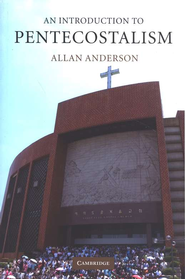
 Allan Anderson, An Introduction to Pentecostalism: Global Charismatic Christianity (Cambridge: Cambridge University Press, 2004).
By way of introducing his topic, Anderson begins the book by describing his visits to four Pentecostal churches in different parts of the world, the Yoido Full Gospel Church in Seoul, Korea; the Christ Apostolic Church, Lagos, Nigeria; a Vineyard church in South Birmingham, England; St. Luke Church of God in Christ in Chicago, Illinois, USA. He also adds the story of a friend’s visit to Claudio Friedzon’s church in Buenos Aires, Argentina. His intent here is to illustrate the worldwide scope and variety of Pentecostalism, a theme that is the foundation for the entire book.
Before looking at the work itself, it is important to note that Anderson acknowledges the difficulty in describing what Pentecostalism actually is, given that it appears in various forms throughout the world. In rejecting a definition of Pentecostalism that is based on strictly on theology, specifically speaking in tongues, which would be the norm among classical Pentecostals, he prefers a more inclusive definition that includes “all churches and movements that emphasize the working of the gifts of the Holy Spirit, both on phenomenological and on theological grounds—although not without qualification†(pp. 13-14). Throughout the book, however, he appears to give emphasis more to the phenomenological (phenomenology attempts to describe the way things are) than the theological in defining what Pentecostalism is. While I am not comfortable with any definition of Pentecostalism that is not at least primarily theological, I acknowledge the difficulty in describing Pentecostalism in general.
The book is divided into two parts, the first describing the history and development of Pentecostalism in various parts of the world and the second deals with Pentecostal and Charismatic theological and sociological issues in their context.
Anderson begins his review of the history of Pentecostalism with the first century church and traces the thread of Pentecostal distinctives throughout church history to the late nineteenth century. Then, in dealing with the massive outpouring of the Holy Spirit that has marked the 20th century, he begins with the Azusa Street revival that took place in Los Angeles from 1906-09, giving particular emphasis to the African-American cultural milieu that impacted the movement. In Anderson’s opinion, this emphasis is lacking in other accounts of the Azusa Street revival and gives valuable insights into this issue.

From there, Anderson takes the reader around the world, describing the development of Pentecostalism in every major area of the world except for the Middle East, a lamentable and unexplained omission. The facts that he marshals are impressive and comprehensive. The various phenomenological and theological themes are carefully explained. In looking at the historical beginnings of the Pentecostal movement in Europe, Korea, and India, which in some cases had no contact with Azusa Street, Anderson challenges the assumption of many authors that Azusa Street was the preeminent place where the Spirit was being poured out and calls for a rewriting of Pentecostal history. In the end, I find myself thanking God for the work of the Holy Spirit in various ways and means throughout the entire world.
In summarizing the first part of the book, Anderson must be commended for his thorough efforts to present the whole package of Pentecostalism. This is no piece of hagiography. He not only relates the overwhelmingly positive fruit that Pentecostalism has borne, he also gives plenty of space to describing the schisms and problems that have marked the modern Pentecostal movement. In not sweeping things under the proverbial carpet, he has done his readers a great favor in giving an honest assessment of the impact, both positive and negative, of the Pentecostal movement in the 20th century.
Anderson also contends that the writing of Pentecostal history has been one-sided, coming mainly from Westerners. He complains that missionary biographies and newsletters tell only one side of the story, that of the missionary. He states that the work of nationals is seldom given its due in these writings and issues a call for the rest of the world to pick up their pens and write their own stories, thus providing a much needed corrective to Pentecostal historiography. While his complaint is legitimate, he does not appear acknowledge the fact that missionary newsletters are written as they are because the missionary (this reviewer is one) feels the need to report on their work to the home constituency and time and space do not permit telling the whole story. Neither are they intended to be historical documents. He also complains that missionary newsletters often reflect racist attitudes and cites several examples. While this is undoubtedly true, I believe he overstates the case. He feels that terms such as “native†or “national†are pejorative (an opinion not shared by this reviewer) and seems to read the newsletters through his own lenses, not recognizing that no pejorative intent may have been intended, and the missionary may have simply used terms common to their day. In doing this he fails to recognize that terms change their meaning over the years and what may be considered pejorative today may not have been so in the time of the newsletter’s writing.
The second half of the book details the pertinent theological and sociological issues relevant to Pentecostalism. He reflects the traditional theological themes of the Baptism in the Holy Spirit, mission, evangelism, and eschatology. While his treatment of these issues is certainly adequate, he doesn’t say anything new. I get the impression that Anderson is more at home with historiography than theology.
In his chapter on “The Bible and the ‘full gospel,’†he stresses that Pentecostal hermeneutics is borne from an emphasis on the experiential, and his point is legitimate. In dealing with education and ecumenism, he gives excellent treatment to the tension that Pentecostals have had in these areas. In looking at Pentecostals and Charismatics in society, he notes that through the power of the Spirit, the poor, marginalized and dispossessed are empowered. He accurately notes that Pentecostals “with their offer of full participation to all regardless of race, class or gender, effected what amounted to a democratization of Christianity, a protest against the status quo.†I was challenged to do more study in this area. He concludes the book on the positive note that the Pentecostal movement shows no sign of slowing down.
In conclusion, this is an outstanding book that I thoroughly enjoying reading. I believe that it provides a wonderful introduction to Pentecostalism, and all serious students of this particular arm of Christianity are encouraged to read it.
Reviewed by Dave Johnson
Â
Preview An Introduction to Pentecostalism: http://books.google.com/books/about/An_Introduction_to_Pentecostalism.html?id=IPbPTOi0Rk4C
Â