Cheleb: The Finest

Seeing grace and mercy in the Old Testament story of Cain and Abel.
“For I am the Lord, I change not†(Malachi 3:6).
God has changed. Or at least that seems to be what many are teaching in our day. There are denominations that teach that the God of the Old Testament is different from the God of the New Testament holding that the old God was mean and wrathful, but the new God is loving and full of mercy. One theory goes so far as to state that God has matured from a juvenile attitude to having a more adult disposition.

It is certainly true that God demonstrates awesome power in the Old Testament. Yet it’s fair to say what happened in ancient days will be mild compared to what He is going to do in the end of days, when the wrath of God is poured out and entire segments of the world’s population will cease to exist! This demonstrates either a God who cannot make up his mind, or a changeless God of perfect continuity.
I will assume that if you are reading the Pneuma Review, you agree with Scripture that God is changeless. This conjecture being true, then the grace, mercy, and compassion “others†claim are absent from in the Old Testament must, in fact, be there. Such is the case in the story of Cain and Abel.
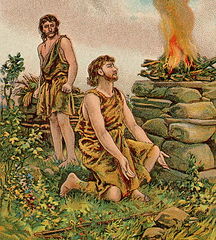
“And in process of time it came to pass, that Cain brought of the fruit of the ground an offering unto the Lord (Gen.. 4:2).†This sounds reasonable. It even sounds like Cain had a good head on his shoulders to have decided to bring an offering to the Creator.
Yet the key to understanding the sibling rivalry between Cain and Abel is found in the next verse.
And Abel, he also brought of the firstlings of his flock and the fat thereof. And the Lord had respect unto Abel and to his offering.
The Hebrew word for offering is minchah. It is not merely any offering, but a specific offering. This comes to a fuller understanding in the tabernacle period, but there are elements we can appreciate in Cain and Abel’s offering (See Pneuma Review Vol 2 No 2 Spring 1999 for more explanation on this and all the Levitical sacrifices).
Cain’s offering—also called minchah in our text—was a perfectly acceptable “form†of sacrifice. There is no apparent deliberation on God’s part as to whether Abel’s lamb was more acceptable—or more appropriate—than fruit. To make such a distinction on our part is to say that Abel’s works were better than Cain’s, and we know that people are justified not by works, but rather by faith.1
So what was the problem?
We also read of Abel’s offering that it was “the firstlings of his flock and the fat thereof†The firstlings also point to later days, when God would require the firstborn of every womb,2 but it also points to a Firstfruits offering3—a tithe if you will.
We therefore see a remarkable picture of Yeshua in Abel’s offering. The sacrifice was voluntary, the Firstfruit, and the best—without spot or blemish.
“Able made his offering … based on the purest and most humanly natural motive for any sacrifice: thankfulness. It was to thank God for His infinite goodness and kindness that Abel chose the firstlings of his flock and the choicest parts thereof. He put his heart into giving the offering. He desired to make it of exceptional quality. [Rabbi] Ramam points out that this example should serve as a model for all who wish to offer a sacrifice to God.â€5
One of the most important lessons for us in Abel’s sacrifice is that he was expressing sacrificial love. He was willing to give his first and finest to the Almighty. His sacrifice was accepted not because of its components or ritual, not on the basis of works, but because of the condition of Abel’s heart. It is in this regard that the Old Testament reminds us, “The sacrifices of God are a broken spirit and a contrite heart, O God, thou wilt not despise.â€6
But for Cain and for his offering He had no regard. So Cain became very angry and his countenance fell (Gen. 4:5).
When one “goes through the motions,†there is a lack of satisfaction. Whether we are talking about work, about family life, about church life, or about pastoring a congregation; if your heart is not in it, there is no satisfaction to be derived.
Depressed people find themselves saying things like, “If only …,†or “Why doesn’t anyone ever …?†or the granddaddy of them all, “No one cares about me or my needs.†This frame of mind can become spiritually cannibalistic, making everything seem distant and meaningless because “I’m†not being ministered to.
If Cain was simply going through the motions, lacked satisfaction, and saw Abel’s successes, he may very well have slumped into a self-centered depression.
Now you or I would probably load accolades on Abel, the nice boy, the good boy, and might leave Cain to his own devises. But this is not what God does. The changeless God of compassion reaches out to Cain.
Then the Lord said to Cain, “Why are you angry? And why has your countenance fallen?†(Gen. 4:6).
Does this sound like the voice of an Old Testament, wrathful God? Rather, it sounds like a concerned brother or father. He sees Cain’s depression (Why has your countenance fallen?), and the resulting anger.
As Cain had sown, now he would reap. By his own bad attitude, his offering received no respect, and his darkened mind does not receive or respect God’s offering of omniscient advice—even though the Almighty is reaching out to him.
If you do well, will not your countenance be lifted up? And if you do not do well, sin is crouching at the door; and its desire is for you, but you must master it (Gen. 4:7).
The Creator offers wisdom from on High. “Try harder, apply yourself,†is the advice. In other words, “If you give it your best, you can beat the depression. Give up the ‘what does it matter?’ attitude and get over your pity party. If you settle for second-best, sin will overcome you.â€
God’s desire is to heal Cain and to help him master sin. He is telling Cain he is sinning—even though no biblical definition of sin exists yet. Cain apparently has an inborn knowledge of sin and even though not worthy, God is wooing him, calling him back into fellowship and relationship. This is a God of compassion.
Cain told Abel his brother. And it came about when they were in the field, that Cain rose up against Abel his brother and killed him (Gen. 4:8).
Then the Lord said to Cain, “Where is Abel your brother?†And he said, “I do not know. Am I my brother’s keeper?†(Gen. 4:9).
Again, God speaks with Cain. You or I might be on our faces, trembling with fear of retribution, but Cain still seems to be totally self-absorbed.
The Most High never asks a question for His benefit. Rather, He tries to get people to think before they answer. The merciful Judge was giving Cain an opportunity to repent. God knew a murder had taken place. He knew that Cain was guilty and deserving of capital punishment, yet our God of compassion was offering him one more chance to change.
As already mentioned, Cain was deserving of capital punishment, yet this Old Testament God grants Cain unmerited mercy. God had cursed the ground when Adam and Eve were exiled from the Garden of Eden, now that ground curses Cain, the consequences of his sin. Even with mercy come consequences.
At this point, a man of good conscience should be on his face pleading for forgiveness and escape from the pronouncement. But not Cain.
Cain said to the Lord, “My punishment is too great to bear! Behold, You have driven me this day from the face of the ground; and from Your face I will be hidden, and I will be a vagrant and a wanderer on the earth, and whoever finds me will kill me†(Gen. 4:13).
Cain understood the depths of his crime, though he still did not admit having perpetrated it. At no point did the merciful God say He was going to hide his face from him. Yet Cain knew that is what he deserved. At no point did God say that anyone else was going to be allowed to kill him, yet Cain’s depression and self-centeredness was fast becoming paranoia! Truly, as God had lovingly warned Cain, sin was no longer crouching, but had deceived and taken him.
You or I might have said, “Enough!†and thrown Cain out. This is not what God did. Rather, He affirms his love and provision for Cain:
So the Lord said to him, “Therefore whoever kills Cain, vengeance will be taken on him sevenfold.†And the Lord appointed a sign for Cain, so that no one finding him would slay him (Gen. 4:15).
Despite modern detractors, that the God of the Old Testament is wrathful and mean, God does not respond to Cain spitefully or wrathfully. He responds with a grace gift.
PRÂ
Notes
1 Romans 3:28
2 Exodus 34:19
3 ref. Leviticus 23:10
4 Exodus 29:13 , 29:22, Lev 1:8, 1:12, 1:16, 3:3, 3:4, etc.
5 The Call of Torah, Bereshit, ArtScroll Tanakh Series, p. 65, brackets mine.
6 Psalm 51:17
All Scriptures are taken from the New American Standard Bible unless otherwise noted. © 1960, 1962, 1963, 1968, 1971, 1972, 1973, 1975, 1977 by the Lockman Foundation. Used by permission.
Scripture quotations marked (NKJV) are from The New King James Version. © 1979, 1980, 1982 Thomas Nelson, Inc. Used by permission.