The Coming of Pietistic-Pentecostalism: Summary and Reflection on Amos Yong’s 2015 Downey Lectures

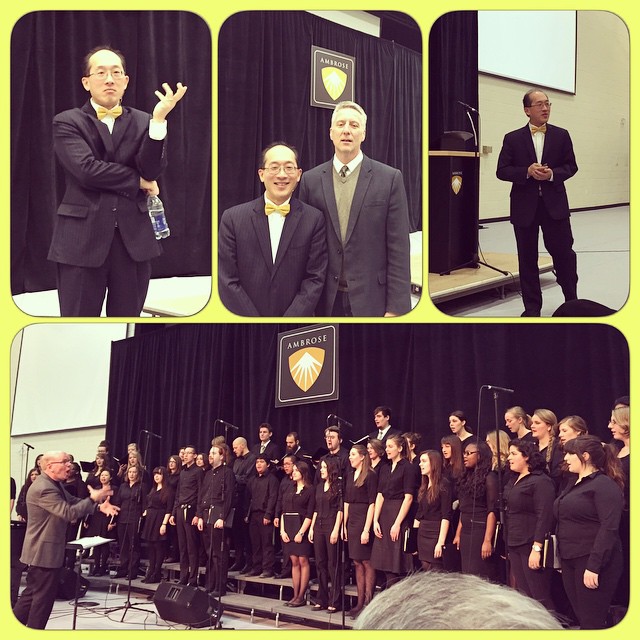
On February 11th and 12th 2015, Amos Yong delivered a two-part series of lectures at Ambrose University for the annual Murray W. Downey Lectureship. Ambrose University is a Christian institution of higher education in Calgary, Alberta, Canada, composed of a denominationally diverse community seeking to represent Christ in their respective fields. Yong is currently Professor of Theology and Mission and Director for Missiological Research at Fuller Theological Seminary. He is a prolific author who has written, edited, and contributed to scores of publications. At this lectureship, Yong explored the impact of Pentecostalism on Christianity in his lectures titled, “The Coming Global Christianity: Pietistic-Pentecostal Challenges and Opportunities.â€

From the Ambrose University page introducing the 2015 Downey Lectures.
In his first lecture, Yong introduced the issues at hand by defining his terms and then presented the challenges facing Pietistic-Pentecostalism. This stream of Christianity is “coming†in the sense that it is a present reality that has not yet arrived in its fullness, as seen in its continual growth. It is “global†in that it is affecting communities all over the world. Yong noted that some prefer the term “World Christianity†rather than “Global Christianity†because the former emphasizes not only the expanse of Christianity around the world (as the latter does) but also the diversity seen among the different Christianities. Pietistic-Pentecostalism is one of these expressions. While Pietism and Pentecostalism are not identical, they are related in many ways. In fact, a Pietistic form of Pentecostalism has emerged. The merging of strands from these two traditions into one unique expression of Christianity can be traced to the Azusa Street Revival in the twentieth century, where many of those involved in this Pentecostal movement came from Pietistic backgrounds. Thus, while not the same thing, these two traditions are organically interrelated and may be regarded as spiritual and historical cousins, perhaps even siblings.
After defining his terms, Yong identified two characteristics of Pietistic-Pentecostalism: first, its place within evangelicalism (in that it is committed to a born again experience, Christ-centered spirituality, a focus on the cross, and a commitment to evangelism a la David Bebbington’s definition) and, second, its emphasis on orthopathos (right feeling) and orthopraxis (right behavior). While it does not neglect orthodoxy (right thinking), it defines it differently—primarily in its necessary relation to both orthopathos and orthpraxis—rather than primarily in its relation to creeds and confessions. In order to illustrate this understanding of orthodoxy, orthopraxis, and orthopathos, Yong explained what a conversation between Pietistic-Pentecostals looks like. He said it is only after the two parties agree that they “love Jesus†that they would get into a discussion of other theological issues. None of the emerging theological issues, however, would ever be seen as being as important as the already established fact that they both love Jesus. While “loving Jesus†may need to be defined, this defining must not take precedence over the fact that love must be displayed in one’s actions. In fact, Yong proposed, this is exactly what theology is—a reflection on how one has experienced the risen Christ in the power of the Holy Spirit. It is not, primarily, abstract hypothesizing.
This is the kind of Christianity that is sweeping the world. Not only have Pietists sent missionaries (largely out of Europe and North America in the nineteenth-century missionary movements) but, because of their deep influence in diverse contexts, the Pietist-Pentecostals have been affected by reverse-mission initiatives (largely out of Africa, Asia, and Latin America). The “Pentacostalization†of Global Christianity is a documented trend. Although some may not identify as a Pietistic-Pentecostal (understanding themselves to be part of an independent or indigenous movement, or even an established denomination, such as the Roman Catholicism), the spirituality of many individuals who identify as Christians and are a part of these growing churches contain the defining features of Pietisitic-Pentacostalism.
Second, ongoing fragmentation is a current concern in Pentecostalism. Just as Pentecostals can use subjective experiences to justify anti-intellectualism, so can they use subjective experiences to justify breaking with their past. While such breaks do not always displease God, they still may. This attitude has led to an emphasis on “apostolic†networks and lone charismatic personalities rather than on confessions and creeds.
Third, this expression of Christianity is at risk of overemphasizing prosperity to an unbiblical degree. While prosperity is not necessarily evil, “prosperity gospels†are heretical. According to the apostle Paul, there is only one gospel, and it is not the “prosperity gospel.†This overemphasis on prosperity can lead to a blurring of distinctions between consumerism and the gospel which, Yong asserted, clearly profanes the true gospel.
In his second lecture, Yong explained the historical contributions of Pietism to the church, responded to the challenges identified in his first lecture, and proposed opportunities that Pietistic-Pentecostalism has to positively influence the church today. First, Pietism has brought about a restoration of heart religion, a nurturing of a communal life and witness, an evangelistic and missionary impulse fed by relational orientation, a missionary exemplarity, a spiritual vitality, and an appeal to the masses. Love of God and neighbor, a central biblical theme, is clearly emphasized in these points. Yong suggested that Christians often domesticate these ideas of love and lose sight of the amazing fact that finite creatures can respond to God and neighbor in love by God’s grace. Reflecting on this should cause us to stand in awe of God because of the grace he gives us to make possible what is impossible by our own strength.
This implies that our lives should be lived in communion with God and others, which also leads to a concern for missions. Yong noted that there is no space or time that is not claimed by God or to which his redemptive word does not resound. Hence, part of the Pentecostal gift is to listen to this redemptive word echoing throughout the world and to ensure it continues to echo into its furthest corners. Furthermore, spiritual vitality is intrinsic to the kind of oral culture that permeates Pentecostal movements and provides a response to those hungering for spirituality. Because of this oral culture and the emphasis on love, community, missions, and spirituality, Pietist-Pentecostals are able to connect with all kinds of people on a deeper level.
Finally, Yong provided a response to the challenges he shared in the first lecture. In short, the best way to guard against the negative tendencies of Pietistic-Pentecostalism is to view orthopraxy, orthopathos, and orthodoxy as interrelated and to view the life of loving in the power of the Spirit as the same life as that of the mind. In other words, Yong called for a more holistic understanding of one’s life as a Christian: a material, rational, and spiritual being who cares about submitting behavior, feelings, and thinking to the lordship of Christ.
In the final question and answer time, Yong’s responses again emphasized the holistic nature of the Christian life. He explained how all spheres of life are sanctified and that it is so difficult for us to create a synthesis between academic rigor and the Spirit-filled life because we have been taught to compartmentalize our lives. Yong also observed that for constructive conversations to take place between Pietistic-Pentecostal types and other types of Christians, that the latter must understand how the former defines orthodoxy, since they define it differently.
Yong’s lectures were valuable on a number of levels. Yong’s grounding of his lectures both in history and currently-observed trends was particularly valuable since one must understand a tradition’s origins if one hopes fully to understand its current iteration. Being of a more Reformed stripe, I appreciated Yong’s willingness to celebrate in the strengths of his tradition while simultaneously being honest about its weaknesses. Constructive conversations between individuals from different backgrounds are only possible when both parties appreciate and challenge one another. Failing to treat another as a valued person made in the image of God shuts down conversation; as Proverbs 16:21 states positively, “sweetness of speech increases persuasiveness.†On the other hand, one need not abandon one’s convictions in order to love another. In fact, as Yong said during a dinner I had the privilege of attending on the night of his second lecture, it does no one any good to agree with everything another says because then the two cannot challenge each other and thus lead each other to grow in areas of weakness.
As a Christian aiming to glorify God in everything I do, I appreciated Yong’s emphasis on the holistic nature of the Christian life, including aspects that can often be neglected, such as the role of the body in one’s life, and the interplay between one’s intellect and the Spirit. Finally, as a Christian whose life exists because of God’s love, I came away encouraged by the Pietistic-Pentecostal emphasis on the importance of seeking to understand and exhibit this love in my life. I believe that this is an area in which traditions such as this can contribute to my tradition’s emphasis on orthodoxy, and an area in which my tradition can contribute the fruits of responsible exegesis and thoughtful theologies to the understanding of what this kind of love looks like. I pray that those in my tradition will not dismiss all of what Pietistic-Pentecostals have to say about the importance of love because of their disagreements in other areas of theology, and that the Pietistic-Pentecostals will not dismiss our emphasis on orthodoxy, since, rightly understood, it necessarily leads to orthopraxy and orthopathos.
Reflecting his own tradition’s emphasis on orthopraxy, Amos Yong shows himself to be a good example of these proposed ways of moving forward as he has given himself to academic and spiritual work, not as separate areas of his life, but all for the purpose of achieving the highest goal of loving God and neighbor. By exemplifying openness to identifying his tradition’s weaknesses and celebrating in its strengths, he set the stage for others to follow him in creating a culture of love made possible by God and carried out by his people.
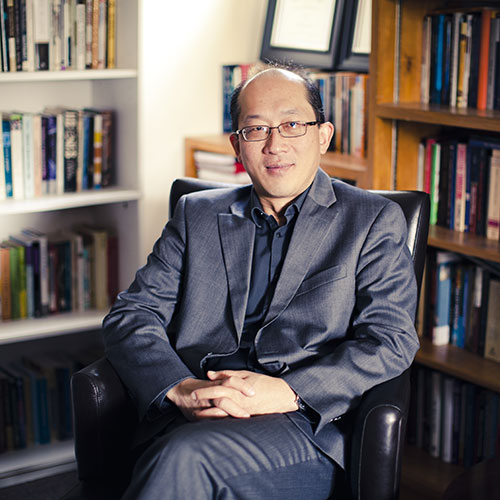
Editor’s note: Special thanks to Alma Yong for use of her collage of Amos Yong at Ambrose University.








I am grateful to the editors of this site to upload the videos of my talks, and also to Jenny-Lyn Harrison for taking the time to listen to the talks, to take great notes, and then to write up this excellent summary. There is much to discuss that I will leave to others. I did want to suggest one slight amendment to Harrison’s summary of my first point on historiographical method. Although those who take the time to listen to the video recordings can draw their own conclusions about what I actually said, I think it would be clearer to summarize my view by saying that history-writing does not unfold in objectivistic terms as that is impossible for a context-bound human creatures to achieve, but is done perspectivally, we might say; our quest to understand the past is shaped by more than just accounting for “the facts†since even our way of telling about these “facts” is framed how we present the context, etc. Harrison’s summary suggests an objectivist-subjectivist dualism so that my pietist-pentecostal view of history would be of the latter, relativistic sort, according to which history is no more an account derived from our subjective whims & fancies. I am urging a more nuanced position that acknowledges historical factuality and actuality, but also recognizes that our accounts of the past are imbued with the historian’s perspective and other related biases (here understood descriptively).
I would like to thank Dr. Yong for his kind comments and clarification. In my use of the word “subjective” I intended to convey an idea similar to “contextual” or, in Dr. Yong’s words, “perspectival” rather than an idea that connoted whims and fancies, but can understand why he prefers the latter two to the former. I appreciate his clarification of his view and suggested revision and would like to express my gratitude to him for taking the time to present at Ambrose University and read and interact with my written summary and reflection.
-Jenny-Lyn Harrison