Leland Ryken: J. I. Packer: An Evangelical Life

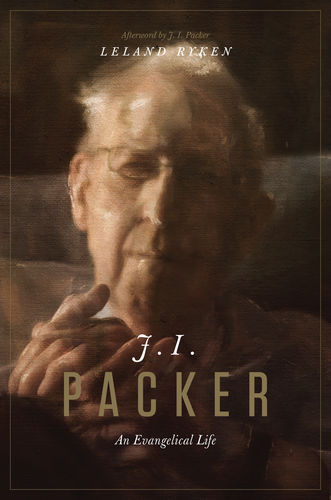
 Leland Ryken, J. I. Packer: An Evangelical Life (Wheaton: Crossway, 2015), 432 pages, ISBN 9781433542527.
The Thesis
In J. I. Packer: An Evangelical Life, Leland Ryken aims to not merely recount the life events of leading evangelical scholar J. I. Packer, but also to show who he is as a man. Packer has served in various vocations and several areas of the world and has experienced significant setbacks and accomplishments. However, in his ever-changing external circumstances, amidst critique and admiration, his internal drive has remained the same for many decades: that is, to teach and represent to the world and the church an evangelical Christian worldview. Underlying his distinctives as an Anglican and a specialized academician has flowed a continual commitment to basic gospel truths, articulated with precision and applied to the church.
The Method
The uniqueness of Ryken’s book is his method, which he calls a “combination of chronological biography and thematic biography†(p. 10). He uses this method for the purpose of integrating plain facts on a timeline with charming stories about more intimate details of Packer’s life, which results in a display of Packer the man. To achieve this, Ryken separates his book into three sections, titled “The Life,†“The Man,†and “Lifelong Themes†and alerts the reader to certain signposts to look out for as they read.
The Content
At attempt to summarize the content of this book would only prove to obscure the complexity of that which is a Spirit-empowered human life, such as J. I. Packer’s. However, it is useful to mention some themes that stand out, namely, Packer’s 1) continual work in the institutional Anglican Church despite his Puritan convictions, 2) instincts as peacemaker and yet his involvement in many controversies, and 3) equally strong emphases on academic excellence and practical church ministry.
First, Packer has maintained both his commitment to Anglicanism and his Puritan convictions for a long time. His unabashed love for and specialized scholarship on the Puritans as well as his definitively Reformational theology are clearly seen in his written works, public addresses, and personal stories, as explained by Ryken. However, at various forks in the road during his lifetime, he chose to remain within the institutional Anglican Church, even when other viable (and, some may argue, significantly better) options were open to him. Ryken’s recounting of Packer’s professional life in England returns again and again to this theme: Packer was one of the foremost evangelical forces in the Church of England during his time, always working to garner support for this cause regardless of what role he was filling (and this included many, such as faculty and later principal at Tyndale Hall, warden and librarian at Latimer House, and leader on the Keele Congress). Furthermore, even after his expulsion from the Anglican Church of Canada, he found a way to remain within Anglicanism. Though Packer’s influence has spread beyond Anglicanism, much of his personal efforts have been directed towards the institutional Anglican Church.
Second, Packer has peacemaking instincts but also became involved in a seemingly endless string of controversies. On the one hand, he adapted to less than ideal situations more than once in his life and chose to work towards a mutual understanding rather than a split on certain occasions. For example, he facilitated, coordinated, and mediated between those who disagreed about the charismatic movement that was on the rise in Anglicanism. One such person involved in these debates recalls that Packer voiced his opinion in such a conciliatory spirit that “even those who [were] supposed to disagree with him [could not] seem to help themselves†(p. 401). On the other hand, Packer has been drawn into many fierce controversies and has often found himself as one of the primary spokespeople on the less popular side. For example, he wrote a scathing review of a book that promoted Keswick theology while working at Tyndale Hall with those who held the Keswick view (a risky move that could have easily led to his dismissal), he publicly disagreed with Martyn Lloyd-Jones regarding separatism from the Church of England (which contributed to the demise of the Puritan Conference) and with John Stott regarding ministry goals and structures of the Church of England, and he vehemently opposed Liberal theology (by defending inerrancy, the penal substitution theory of atonement, and the existence of hell).
Third, Packer has consistently emphasized the importance of both academic excellence and practical church ministry. For example, while in his first ministry position, he was also finishing his dissertation, publishing articles, and speaking at the Puritan Conference. Similarly, Packer’s vision for Latimer House (a study center) was for it to not only be a place of research for the sake of new findings in and of themselves, but research done for the sake of applying findings to the Church of England. In North America, he has been teaching at Regent College for “the theological education of laypeople as well as prospective clergy†(p. 151) and has contributed a massive amount of work towards Christianity Today, what Ryken evaluates as “single-mindedly…channel[ing] his efforts into ensuring the theological integrity of the church†(p. 176). Packer himself identified these equal emphases on academia and the church when he said his “real business was theological education with special attention to tomorrow’s clergy†(p. 123).
My Evaluation
Overall, the thesis and method of Ryken’s book are well-defined and eloquently executed. Ryken is thorough and thoughtful. He knows how to use humor and solemnity. I would commend this biography to anyone who is wanting to go on an exciting, inspirational, and educational journey of one example of the Christian life. The main critique I would pose is the flip-side of Ryken’s thoroughness, namely, the repetition of facts that had already been explained. I found myself sometimes wondering if Ryken thought I, as the reader, had forgotten what he said several pages earlier. However, Ryken’s repetition does have an upside: it leads the reader to integrate previously learned facts with new information and thus meditate on the facts, rather than glance at them and move on, not letting them change oneself or stir up any kind of deep thought about the Christian life. I suspect that in this case, Ryken had to repeat himself to achieve the intended goal of writing a biography that had both chronological and thematic elements.
My Application
Though the apparent tension in the three themes listed above cannot be and should not be ignored by oversimplifying the life choices that Packer made, it is interesting to note that in these instances, Packer was always concerned with “things of first importance†(p. 145). Though he is distinctly Anglican, he has not let secondary ideas overshadow his larger commitment to evangelicalism. He once said, “before I am an Anglican I am an evangelical, and I have tried to write in such a way that all evangelicals…will benefit†(p. 325). Similarly, he acted as peacemaker or “crusader†(pp. 383, 409) in various controversies depending on whether or not, from his perspective, ‘first things’ were at stake. When ‘first things’ were not at stake, he promoted tolerance, but when they were at stake, he would not move an inch in his consistent and unapologetic defense of them. Finally, Packer’s commitment to academia and the church has focused on ‘first things’. He himself said that “right from the start I found myself unwilling to let any book [that I had authored] go which hasn’t got the gospel in it somewhere.†(p. 245). Overall, his confidence in defending ‘first things’ has given a world of evangelicals confidence to speak out against the stereotypes of evangelicals as irrelevant and ignorant.
Packer’s life shows us that keeping first things first and wholeheartedly giving oneself to the church and academia can involve tension in our lives, but this tension should not stop us from acting according to our convictions and trusting that God, in his providence and good-will, leads us. Although Packer would not appreciate us thinking of him so highly that we forget his flawed humanity, he also would not be opposed to us recognizing God’s great work in his life and aiming to follow in his footsteps by submitting our time, talents, and goals to God. Let us, like Packer, commit to bring out the best of evangelicalism, informed by the church and Christian academics, in our areas of influence. Let us identify the best of our distinctives, how they speak to ‘things of first importance,’ and consciously choose to emphasize those ‘first things’ in our life and ministry. Let us not grow weary of reasserting the same fundamental truths of the Christian faith by thinking on those who have faithfully fought against the “neglected, slighted, misrepresented†view of evangelicalism with a “clear voice…speak[ing] with conviction and love…to state [their] true position and its relevance to the world crisis†(p. 169). Let us periodically ask ourselves, “what legacy are we leaving?†and imitate Packer by always “promot[ing] present and forward-looking fellowship with God†(p. 415).
Reviewed by Jenny-Lyn de Klerk
Engage Further:
Video: J. I. Packer’s Life and Legacy “In this video, Justin Taylor sits down with Sam Storms and Leland Ryken to discuss the life and legacy of an evangelical titan: J. I. Packer.†https://www.crossway.org/blog/2015/06/video-who-is-j-i-packer/
Publisher’s page: https://www.crossway.org/books/j-i-packer-hcj/
Preview: https://books.google.com/books?id=4na0CgAAQBAJ