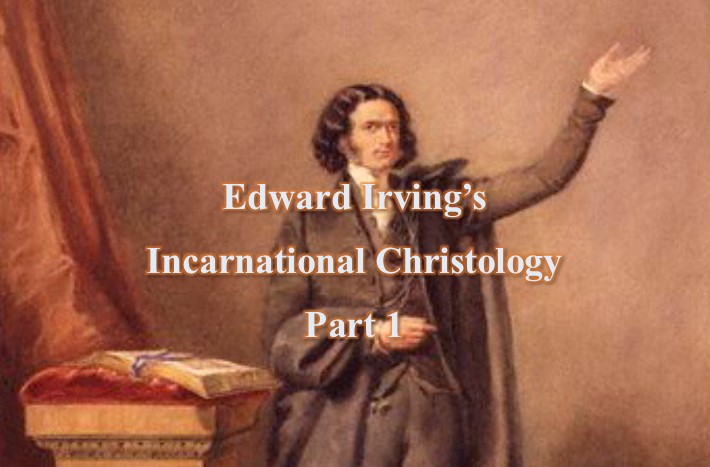
Edward Irving’s Incarnational Christology, Part 1

Edward Irving’s Incarnational Christology: A Theological Examination of Irving’s Notion of Christ’s Sinful Flesh as it relates to the Fullness of the Incarnation

In this three-part series, Trevor Martindale gives us an in-depth look at how Edward Irving, one of the 19th Century’s most important church leaders, understood the meaning of God coming in the flesh. What does that controversy have to teach us today?
Abstract
This dissertation examines the theological viability of Edward Irving’s notion of Christ’s ‘sinful flesh’. The foundational element of this notion determines that his belief in Christ to have been fully consubstantial with mankind necessitates the positing of his assumption of a fallen human nature under the same conditions that are common to all humanity. We argue that Irving’s contextual claims challenged the predominant doctrinal formulations of Federal Calvinism, which had departed from earlier Patristic and Reformed theological requirements for the vicariously salvific nature of the Incarnation and Atonement of Christ to be based primarily on ontological or substantial union with mankind.
Â
Introduction
At the heart of the Christian faith is the resolute conviction that “the Word became human and lived here on earth among us.â€[2] The belief that Jesus Christ is “God with usâ€[3] exhibits the foundational driving force of the Christian message – the Incarnation. While the origins of this doctrine are Biblically traceable,[4] its development has often prompted intense controversy. From the great Christological controversies of the Patristic era[5] to a more recent debate over the Incarnation as ‘myth’,[6] such examples illustrate the church’s continual quest to understand what the Incarnation means for humanity within each generational context in which she finds herself. The importance of this doctrine cannot be underestimated, as the age-long struggle concerning issues pertaining to the Incarnation has often led to radical reinterpretation of foundational truths of the Christian faith[7] – interpretations that are not always welcomed by the established church community.
As we begin, some remarks concerning the methodology used to achieve this are necessary. The aim of Chapter one will be to provide a ‘bird’s-eye view’ of the historical controversy. This will involve a brief summary of pertinent biographical details of Irving’s life followed by a review of the significant literature that has been written both in support and rejection of his ideas since his death.
Chapter two will then provide an exposition of the ‘crux’ of Irving’s theology. The original controversy itself, including various theological issues in question, will be examined. Rather than arguing in favour of one side or another, we will seek to uncover the dominant theological issues concerning the ‘sinlessness’ of Christ, which held sway over the controversy’s outcome. Attention will then be directed to exposing the foundational issue that has all-too-often escaped many who have taken part in the debate. It will be argued that the crux of Irving’s notion of Christ’s sinful flesh primarily relates to the fullness of the Incarnation, in that his humanity is fully consubstantial with ours, rather than being a statement about Christ’s sinlessness. The significance of this interpretation will then be unpacked by revisiting questions of the relationship between doctrinal issues of Incarnational Christology and Atonement theory in light of Irving’s understanding.
In Chapter three we will then offer a final assessment as to the viability of Irving’s views in the context of his place within the development of his theological tradition as well as being based on recent developments in theology. The considerations offered herein will reflect a postmodern interpretation of heterodoxy and highlight conceptual difficulties that are inherent within the framework of Irving’s theological tradition. Nevertheless, Irving’s views will be evaluated based on the perspectives both of his place within his own historical context as well as on the possibility of their continuing application in contemporary theology.
Chapter 1
The Controversy That Was Edward Irving
The overall aim of this chapter is to introduce the Christological controversy for which Edward Irving has been known. We begin by briefly introducing Irving’s personal life and ministry while highlighting the various aspects that have been viewed as controversial. Contemporary literature that has specifically been dedicated to understanding Irving’s Christological views will then be reviewed in order to highlight his continuing significance within theology. A brief examination of the original controversy will then follow as we consider the theological issues pertinent to its historical outcome.
Â
1.1 The Controversial Irving
It is appropriate to introduce the personality of Edward Irving in a brief summary of his life and ministry. Our intention is not simply to discuss the biographical detail of Irving’s life,[9] but rather to draw attention to the contentious nature of Irving’s brief ministry. T.C. Gordon makes note of the many aspects of Edward Irving’s ministry that was known for its controversial nature. Yet, Gordon simultaneously ear marks Irving as a significant figure within Scottish ecclesiastical history.[10] Therefore, awareness of Irving’s personal context is necessary to prepare for proper consideration of his theological significance.
Edward Irving was born in Annan, Scotland, on the 4th of August 1792. Being intellectually gifted, he enrolled in the University of Edinburgh at the age of thirteen and graduated with a Master of Arts degree four years later. Irving’s desire to become a minister with the Church of Scotland led him to study for a Divinity degree[11] at the University of Edinburgh whilst supporting himself financially by teaching at a school in Haddington. Within six years he had completed his Divinity degree and gained a licence allowing him to preach in the Church of Scotland. In 1819, he accepted an invitation by Dr Thomas Chalmers to serve as assistant minister at St. John’s Parish Church, Glasgow. By July 1822, Irving, aged thirty, had accepted a charge to pastor the Caledonian Chapel in Hatton Garden, London. His ministry grew in popularity[12] and by 1824 the church had built and occupied new premises in Regent Square[13] to accommodate the exponential growth of its congregation. It was during this time that Irving became known for his interest in a number of contentious theological issues.
Irving exhibited an intense interest in Eschatological issues and had interacted with J.N. Darby and other leaders of the Brethren movement as they shared views regarding the Second Advent of Christ.[14] Despite this reception of his Eschatological views, Irving is perhaps more famously known for his Pneumatology, which sparked a separate controversy that certainly runs concurrent to the Christological one. Irving believed that there was in progress a resurgence of the manifestations of the gifts of the Spirit,[15] especially that of prophecy and ‘tongues’, which was to precede Christ’s Second Coming. His belief in the operation of spiritual gifts would no doubt have conflicted with the predominant theological milieu of Cessationism. Benjamin Warfield, a well-known proponent of Cessationism in modern times, dedicates some sympathetic attention towards Irving but describes what he calls the ‘Irvingite Gifts’ as fanatical.[16] Even in more recent times there are those who, while being open to the operation of spiritual gifts for today, have expressed their weariness of Irving for his standing in this doctrinal area.[17]
So then, discussion will now turn to the Christological controversy in question. Oliphant, Irving’s first biographer, points out that the focus of his ministry on the importance of the Incarnation was evident as early as 1825.[21] The topic of the Incarnation was the first major concentrated series of teaching that Irving delivered to his church after his ministry had reached its height of popularity in London.[22] It is undoubtedly evident that these teachings regarding the Lord’s human nature were greatly accepted by his congregation, as it was requested that they be published.[23] In response to which, Irving, referring to the Doctrine of the Incarnation as the “great head of the Christian faithâ€, states that the purpose of these sermons was to pastorally instruct and encourage his church.[24]
While this publication was in progress, an infamous confrontation occurred with Henry Cole, a retired Anglican minister, which led to a charge of heresy against Irving. Having been disturbed to hear his use of the term ‘sinful flesh’ in regard to Christ’s assumed human nature,[25] Cole attended the evening service of Irving’s church on 28th October 1827 for a first-hand experience of what Irving was preaching.[26] In reaction to hearing Christ’s human nature being referred to as a “sinful substanceâ€, Cole forced an impromptu interview with Irving after the service. He soon after published a tract accusing Irving of heresy due, as he saw it, to Irving’s denial of the sinlessness of Christ.[27] Irving believed that Cole’s publication would face criticism due to his reputation for contentious divisiveness among fellow Christians. However, the opposite had taken place and a great controversy erupted.[28]
Irving was expelled from the ministry of the Church of Scotland on 18th March 1833 but independently continued pastoral ministry in an un-ordained capacity with some eight hundred loyal congregants from Regent Square who had followed him to start a new church.[36] This formed the foundation of what became known as the Catholic Apostolic Church.[37] However, he became fatally ill shortly afterwards on a mission trip to Scotland and died of ‘consumption’[38] in Glasgow, Scotland, on the 7th December 1834.
The memory of Irving has lasted on through the generations, as there are various monuments to his name.[39] Apparently, his life and ministry was tenderly remembered despite the degree of controversy that surrounded it. Still we suggest that it was these very controversial doctrinal issues that significantly affected the direction and nature of his brief 15 years in ministry. As a result of the socio-theological stigma surrounding Edward Irving, the likelihood that personal attitudes of believers might hinder any genuine interest in his Christological ideas, for fear of being labelled heretics themselves, is a real concern. We, therefore, briefly pause to consider how debate over Irving’s theological views has continued long after his death.
Â
1.2 Reviewing a Development in Theological Perspectives
In the following survey, we review significant literature dedicated to examining Irving’s views regarding Christ’s human nature. It is not within our scope to review all literary works that mention Irving. Rather, our intention is to consider how the range of theological attitudes towards Irving’s views has developed within contemporary scholarship. Thus we hope to demonstrate Irving’s emergence as something of a figurehead within this debate.
In moving beyond the purely anthropological question of whether Christ had sinful or sinless flesh, other attempts have enquired further into the role that the doctrine of the Holy Spirit had upon Irving’s theology. Gordon Strachan examines the inter-relationship between Irving’s views on Christ’s human nature and the gifts of the Holy Spirit.[43] While acknowledging the merit of the Barthian tradition’s agreement with Irving, he points out that Barth in no way adopts Irving’s Pneumatology; which he argues is integral to Irving’s Christological assertions.[44] Furthermore, Strachan responds to much of the negative opinion concerning Irving, as he argues that Irving’s Christological statements and writings invoked controversy due to “the intrusion of interpretative categories which have been alien and inappropriate to the subject-matterâ€.[45] As a result, Irving’s doctrinal assertions were understood out-with the context in which they were written. Strachan, therefore, dedicates substantial space to reviewing large portions of Irving’s writings in their own context in the hope of inspiring future examination of Irving’s views to be more appreciative of his theology.[46] More recently, Graham McFarlane, who has been hailed as one of the most capable apologists in favour of Irving’s cause,[47] has advanced Strachan’s work by examining how Irving’s Christology and Pneumatology are intricately linked.[48] Additionally, Colin Gunton commends Irving’s theology for being ‘broad and systematic.’[49] Such recent developments in favour of Irving’s views have attempted to show an integration and coherence within his theology.

Image: Wikimedia Commons
Further attempts at proving Irving’s orthodoxy have focused on the Christological issue as it takes priority over other doctrinal areas in Irving’s thought. Some have sought to present unequivocal evidence for the validation or refutation of Irving’s views within the whole range of theological history. Thomas Weinandy explores the historical foundations of the Patristic, Medieval and Contemporary Christological traditions that may lend weight to the doctrinal understanding of Christ assuming sinful flesh in the Incarnation, thus making a case for the doctrinal and scriptural concurrence with Irving.[50] Yet, one of Weinandy’s weaknesses is that he does not engage with the main issues pertinent to Irving’s context. David W. Dorries, on the other hand, does not make this mistake when arguing for the coherence of Irving’s views.[51] Dorries refutes earlier claims that Irving’s notion of sinful flesh had been developed over time and thus was inconsistent with his earlier theology.[52] Like Weinandy, Dorries argues that Irving’s views are consistent with Patristic and early Reformed theological traditions. This contradicts Donald Baillie’s prior claim that Irving’s idea of Christ’s humanity as fallen had “always been regarded as heretical.â€[53] Unfortunately, this type of argument is all too similar to the inconspicuous ethos of the whole debate – whomever successfully claims the most adherents to their theological interpretation wins the day.
A growing amount of scholarship has been dedicated to carefully considering Irving’s theology. This suggests a departure from the once volatile dispute over his orthodoxy. David Allen describes Irving as one who was “almost universally condemned in his own day as a showman, crank and fanatic, but has more recently been taken seriously as a theologian of the front rank.â€[54] Still, there are respected contemporary scholars who have confidently disagreed with Irving without engaging in personal insult. Hugh Mackintosh finds Irving’s views eccentric though touching.[55] Whilst there have been those who have acclaimed him for being somewhat of a forebear of the Pentecostal Charismatic movement,[56] Arnold Dallimore seems to attribute Irving’s ‘Charismatic’ tendencies to have had a destructive effect upon his initially promising ministry.[57] Dallimore attributes the cause of Irving’s departure from orthodox doctrine to the influence of Romanticism upon his thought, being specifically due to his friendship with Samuel Taylor Coleridge. More recently, Donald MacLeod has often written in opposition to Irving’s views, agreeing with Dallimore’s opinion that they were heretical.[58] Significantly though, MacLeod offers no ‘new’ evidence contradicting Irving’s theology, except to continually reaffirm the argument of Irving’s original critics.[59] It seems that contemporary opponents of Irving are limited to the doctrinal objections of the historical debate.
It is somewhat remarkable that theological discussion over Irving’s views has long outlasted his ability to participate in debate. Many varied opinions of respected theologians continue to give attention to Irving, regardless of what conclusion is reached over the orthodoxy of his views. Incarnational issues such as this one seem to remain a significant part of Christological discussion in this generation, as with any other. Irving’s longevity in this particular debate suggests that he is a worthy theological figure whose views have come to present a considerable, sustained significance within contemporary scholarship. Hence, his theological contribution should not be frivolously dismissed. Therefore, the following chapter presents the foundational elements of Irving’s views in order to then determine their significance within his historical context.
PR
Coming in Part 2 (Fall 2018):
The Crux of Irving’s Christology
Notes
[1] John 1:14 (NIV)
[2] John 1:14 (NLT)
[3] Isaiah 7:14, Matthew 1:23
[4] J.D.G. Dunn, Christology in the Making, London: SCM Press, 1980. For a review article on this book, see: L. Morris, “The emergence of the doctrine of the incarnation†in Themelios (1982) 8.1:15-19
[5] Much theological development within the early church was focused on Christological/Incarnational questions. The formulation of various foundational creedal statements, such as The Apostle’s Creed, The Nicaean Creed (325 AD) and the Chalcedonian Definition (451 AD), are evidence of the response to refute beliefs that were found to be heretical.
[6] J. Hick (ed.), The Myth of God Incarnate, London: SCM Press, 1977; M.D. Goulder (ed.), Incarnation and Myth: The Debate Continued, London: SCM Press, 1979; O. Skarsaune, (trans) T.R. Skarsten, Incarnation: Myth or Fact?, St Louis (MO): Concordia Publishing House, 1991
[7] B. Hebblethwaite, “Incarnation†in D.W. Musser & J.L. Price (eds), A New Handbook of Christian Theology, Nashville: Abingdon Press, 1992:250-4
[8] Cited in T.C. Gordon, “Edward Irving 1792-1834â€, in R.S. Wright (ed), Fathers of the Kirk, London: Oxford University Press, 1960:142. Gordon here quotes the inscription engraved on a stone tablet near the Old Fish Cross of Annan marking the birth town of Edward Irving. This monument no longer stands near this site. Instead, there is an impressive statue of Irving which today stands on the site of the very church that condemned him for heresy and stripped him of his ministerial status. These tributes to him are ironic since it was the attitudes of his enemies that were influential in his downfall.
[9] For literature adequate for this purpose, see: W. Jones, Biographical Sketch of the Rev. Edward Irving, Late Minister of the National Scotch Church, London: With extracts from, and remarks on, his principal publications, London: John Bennet, 1835; M.O.W. Oliphant, The Life of Edward Irving Vols. 1, 2, London: Hurst & Blackett Publishers, 1862.
[10] Gordon, “Edward Irving 1792-1834â€, in Wright, Fathers of the Kirk, 142-155
[11] Irving’s theology was later accused of being inadequate simply due to his part time study of divinity. For a defence to this, see Gordon, “Edward Irving 1792-1834â€, in Wright, Fathers of the Kirk, 143
[12] T.C. Gordon remarks: “By 1823 the experts of eloquence in the House of Commons and the House of Lords were envious, and George Canning publically declared in Westminster that in Irving he had found the most eloquent preacher he had ever listened to.†See Gordon, “Edward Irving 1792-1834â€, in Wright, Fathers of the Kirk, 145-6
[13] This church building later had to be demolished after it suffered severe damage from German bombs in World War II.
[14] Iain Murray notes the similarities of Darby’s eschatology with that of Irving’s. See I. Murray, The Puritan Hope, London: Banner of Truth, 1971: 197-202
[15] 1 Corinthians 12:4-11
[16] See B.B. Warfield, Counterfeit Miracles, Edinburgh: Banner of Truth Trust, 1972 (1st Published in 1918): 125-54
[17] Dr Martyn Lloyd-Jones expresses his concern over Irving as he warns his readers to test the evidence of what came from Irving’s ministry as being grounds for accepting his theology. See M. Lloyd-Jones, Joy Unspeakable: The Baptism and Gifts of the Holy Spirit, Eastbourne: Kingsway Publications, 1984: 189; (Further, more in-depth critique can be seen in M. Lloyd-Jones, The Fight of Faith, 72-3; M. Lloyd-Jones, Spiritual Gifts (iii), sermon on Romans 12:6 (Tape 3314) – cited in T. Sargent, The Sacred Anointing: Preaching and the Spirit’s Anointing in the Life and Thought of Martyn Lloyd Jones, London: Paternoster, 2007: note. 219)
[18] A. Haldane, The Lives of Robert Haldane of Airthrey, and his brother, James Alexander Haldane, (3rd Edition) London: Hamilton, Adams & Co., Paternoster-Row, and Edinburgh: W. Whyte & Co., 1853:567 [Italics mine]
[19] Ibid.
[20] Ibid., 565-70
[21] M.O.W. Oliphant, The Life of Edward Irving Vol. 2, London: Hurst & Blackett Publishers, 1862:3
[22] C.G. Strachan, The Pentecostal Theology of Edward Irving, Peabody, MA: Hendrickson Publishers, 1973:25
[23] E. Irving, Sermons, lectures, and occasional discourses, in three volumes, London: R.B. Seeley & W. Burnside, 1828
[24] E. Irving, Sermons, lectures, and occasional discourses: Vol. 1. The Doctrine of the Incarnation Opened in Six Sermons, London: R.B. Seeley and W. Burnside, 1828: iii
[25] Irving had used this term in a sermon delivered to a new society for the distribution of Gospel Tracts on 10th of July 1827. Although the exact date of this event is contested, see D.W. Dorries, Edward Irving’s Incarnational Christology, Fairfax, VA: Xulon Press, 2002:30
[26] Jones, Biographical Sketch of the Rev. Edward Irving, 228-9
[27] H. Cole, A Letter to the Rev. Edward Irving, in Refutation of the Awful Doctrines of the Sinfulness, Mortality, and Corruptibility of the Body of Jesus Christ, London: J. Eedes, 1827
Irving later writes his own account of his meeting with Cole: “…I gave the stranger an invitation to come to me at leisure on the Thursday following for the further satisfying of his conscience. He did not think it worth his while to do this, and could reconcile his conscience to the betrayal of pastoral and ministerial confidence, and to the publication of a conversation without ever asking me whether it was correctly reported or not.†E. Irving, Christ’s Holiness in Flesh: The Form, Fountain Head and Assurance to Us of Holiness in Flesh, Edinburgh: John Lindsay & Co., 1831: v-vi
[28] Irving’s records his astonishment in E. Irving, Christ’s Holiness in Flesh, vi
[29] Irving temporarily withheld the publication of his sermons on the Incarnation while he added two additional sermons of a polemical nature to the original four, in response to Cole’s accusations. Further works by Irving can be found: E. Irving, The Orthodox and Catholic Doctrine of Our Lord’s Human Nature, London: Baldwin & Cradock, 1830 (This was compiled from earlier writings that Irving had submitted to ‘The Morning Watch’ newspaper for publication.); E. Irving, Opinions Circulating Concerning Our Lord’s Human Nature, Tried by the Westminster Confession of Faith, Edinburgh: John Lindsay, 1830; E. Irving, Christ’s Holiness in Flesh: The Form, Fountain Head, and Assurance to us of Holiness in Flesh, Edinburgh: John Lindsay, 1831
[30] Dorries, Edward Irving’s Incarnational Christology, 40
[31] Irving, Christ’s Holiness in Flesh, xvi-xli
[32] The doctrinal errors in Irving’s views were identified by the London Presbytery to be the proclamation of original sin in Christ and subsequent sinfulness of his person, leading to a denial of the doctrines of satisfaction, substitution and imputation regarding the atonement. Cf. London Presbytery, A Brief Statement of the Proceedings of The London Presbytery, in Communion with the Established Church of Scotland, in the Case of the Rev. Edward Irving, London: Basil Steuart, 1831:15, 23-5, 26-7, 28-9, 30-1
[33] The Kirk Session of Irving’s church refuted these accusations, declaring that Irving indeed upheld the teachings that Christ was free from original and actual sin, was holy and spotless with regard to sin and therefore satisfied God’s requirement of divine justice as he offered himself as a substitutionary atonement for the sins of mankind. Cf. Ibid., 16-17
[34] The Trial of the Rev. Edward Irving, M.A. Before the London Presbytery, London: W. Harding, 1832: 3, 88
[35] Trial of the Rev. Edward Irving, M.A., London: E. Brain, 1833: 4, 96
[36] J. Hair, Regent Square, Eighty Years of a London Congregation, London: J. Nisbet, 1899:124
[37] W. Wilks, Edward Irving: An Ecclesiastical and Literary Biography, London: W. Freeman, 1854; E.J. Miller, The History and Doctrines of Irvingism: or of the so-called Catholic and Apostolic Church [in two volumes], London: C. Kegan Paul & Co., 1878; P.E. Shaw, The Catholic Apostolic Church sometimes called Irvinite: A Historical Study, New York: King’s Crown, 1946; R.A. Davenport, Albury Apostles, the story of the body known as the Catholic Apostolic Church (sometimes called ‘The Irvingites), London: Free Society, 1973; C.G. Flegg, Gathered Under Apostles: A Study of the Catholic Apostolic Church, Oxford: Clarendon Press, 1992
[38] Known today as Tuberculosis
[39] The Church of Scotland has since recanted on their position and honoured Irving by setting his bodily remains to rest in Glasgow Cathedral. Also, a portrait of him is displayed in the current Church of Scotland building in London.
[40] A.B. Bruce, The Humiliation of Christ: in its physical, ethical and official aspects, Edinburgh: T&T Clark, 1889: 236-83 (especially 250-6)
[41] K. Barth, Church Dogmatics, Vol. 1:2, Edinburgh: T&T Clark, 1956: 153
[42] See T.F. Torrance, The Mediation of Christ, Grand Rapids: Eerdmans, 1983; J.B. Torrance, “The Vicarious Humanity of Christâ€, in T.F. Torrance (ed.), The Incarnation, Edinburgh: Hansel Press, 1981; W. Pannenberg, Jesus: God and Man, London: SCM Press, 1968:354-64. For a summary of other influential proponents, see: H. Johnson, The Humanity of the Saviour, London: Epworth Press, 1962:167-78
[43] C.G. Strachan, The Pentecostal Theology of Edward Irving, Peabody, MA: Hendrickson Publishers, 1973.
[44] Ibid., 21-2
[45] Ibid., 22
[46] Ibid., 23-52
[47] D. Allen, “Regent Square Revisited: Edward Irving, Precursor of the Pentecostal Movementâ€, in Journal of European Pentecostal Theological Association (1997) 17:47-58
[48] G.W.P. McFarlane, Christ and Spirit: The Doctrine of the Incarnation according to Edward Irving, Carlisle, Cumbria: Paternoster Press, 1996
[49] C. Gunton, “Two Dogmas Revisited: Edward Irving’s Christology†in Scottish Journal of Theology (1988) 41.3:365
[50] T.G. Weinandy, In the Likeness of Sinful Flesh: An Essay on the Humanity of Christ, Edinburgh: T&T Clark, 1993
[51] Dorries, Edward Irving’s Incarnational Christology, 2002. Earlier published as D.W. Dorries, Nineteenth Century British Christological Controversy, Centring Upon Edward Irving’s Doctrine of Christ’s Human Nature, Ph.D. thesis, University of Aberdeen, 1987
[52] P.E. Davies, An Examination of the Views of Edward Irving Concerning the Person and Work of Jesus Christ, Ph.D. thesis, University of Edinburgh, 1928
[53] D.M. Baillie, God was in Christ: An Essay on Incarnation and Atonement, London: Faber & Faber Limited, 1948:16 (Italics mine)
[54] D. Allen, “A Belated Bouquet: A Tribute to Edward Irving (1792-1834)†in Expository Times (1992), 103.11:328-31
[55] H.R. Mackintosh, The Doctrine of the Person of Jesus Christ, (2nd Ed), Edinburgh: T&T Clark, 1913:278
[56] See: D. Allen, “Regent Square Revisited: Edward Irving, Precursor of the Pentecostal Movementâ€, in Journal of European Pentecostal Theological Association (1997) 17:47-58; D. Vreeland, “Edward Irving: Preacher, Prophet & Charismatic Theologianâ€, in Pneuma Review (2002) 5.2:55-73
[57] A. Dallimore, The Life of Edward Irving: A Fore-Runner of the Charismatic Movement, Edinburgh: Banner of Truth Trust, 1983
[58] D. MacLeod, “The Doctrine of the Incarnation in Scottish Theology: Edward Irving†in Scottish Bulletin of Evangelical Theology (1991) 9:40-50; D. MacLeod, The Person of Christ, Downers Grove, IL: IVP, 1998:221-230; D. MacLeod, From Glory to Golgotha: Controversial Issues in the Life of Christ, Fearn, Ross-shire: Christian Focus Publications, 2002.
[59] This suggests that, for MacLeod at least, the strength of argument against Irving is determined and settled by Irving’s peers. This line of objection will be examined in more detail in the following section.