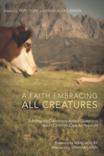
A Faith Embracing All Creatures, reviewed by Stephen Vantassel

From Pneuma Review Fall 2013.
 Tripp York and Andy Alexis-Baker, eds., A Faith Embracing All Creatures: Addressing Commonly Asked Questions about Christian Care for Animals (Eugene, OR: Cascade Books, 2012), 212 pages, ISBN 9781610977012.
This book is another in an ever growing line of texts attempting to convince Christians that the Church’s traditional understanding of human-animal relations is wrong. Put another way, the authors contend that Christianity’s long-standing belief that animals were created for human use and food is fundamentally misguided. These authors argue a different reading of scripture reveals that:
- God’s ideal and original plan was for humans and animals to co-exist in non-violent (i.e. vegetarian) relationship.
- God only allowed humans to eat of meat because of the conditions following the Noahic flood.
- Adoption of a vegetarian lifestyle is part of our call as Christians to extend Christ’s compassion toward all of creation and his work to redeem and restore harmony in the broader creation.
At first glance, these points appear Christian. What Christian doesn’t support the notion of compassion and redemption? However, a closer look at these points reveals that adopting them requires believers to undergo a dramatic paradigm shift in the interpretation of large sections of scripture. Since paradigm shifts are intellectually and emotional difficult for people to make, each of the 15 authors take up a particular concept in scripture or theology to show how it can be harmonized to support a vegetarian or vegan perspective.
As expected, the book focusses on specific scriptural and theological issues that would be troublesome for a vegetarian mandate, such as the dominion mandate, the Noahic Covenant, animal sacrifices, the value of humans in relationship to animals, and Jesus’ diet and treatment of animals. The authors repeatedly suggest that Christians should read scripture differently and through the prism of peace, harmony (i.e. shalom), Christ’s compassion and reconciliation, and the eschatology of Isaiah’s prophecy concerning the wolf and the lamb (Isa 11:6; 65:25).
Christians should pause whenever an individual or group claims to correct the church’s historic understanding of Scriptural teaching and like the Berean’s (Acts 17:10-11), investigate the claims carefully against the testimony of scripture fairly interpreted. Additionally, Christians should inquire whether the new interpreters have engaged proponents of the traditional view in any substantive way as the Reformers did when debating with Catholic teaching and practice.
Regrettably, the authors of this text fail on both points. Though ostensibly offering a new interpretation of scripture, a closer look reveals that their argument requires an arbitrary neglect of vast sections of problematic scriptures. Even the passages selected for discussion are handled in such a cursory and fanciful manner that readers should question the strength of their claims.
Permit me to provide just a few examples of their fanciful treatment of scripture. Andy Alexis-Baker, in the chapter “Didn’t Jesus Eat Fish?,” reviews various ways to interpret Christ’s fish eating behavior. Strangely, he argues that we can’t eat fish just because Jesus did as that interpretation is too simplistic (p. 73). Really? We can’t eat fish because our Lord did? What about when Jesus declared all food clean (Mark 7:19)? I’m confident the response would be, “That statement was a later editorial insertion.” Perhaps, but Christianity is an apostolic faith, we only know Christ through the eyes of the Apostles so we had better come to grips with all that the Scripture teaches. Either their viewpoint was correct, irrelevant, or it was wrong. At minimum, Christ’s behavior suggests that the burden of proof is on vegetarians to show that we are obligated to avoid meat.
Another area where the authors abuse Scriptural evidence is their failure to read the passage in its historical context. Isa 11 and 65 are classic examples of this error. The authors want to understand these passages as envisioning a world where predation, including meat consumption by humans, no longer exists. But that isn’t what the passages say. Isaiah, in a pastoral world, was looking for a day when shepherds wouldn’t have to watch their flocks at night because the wolf ate grass. Children wouldn’t have to worry about the asp when they played amongst the rocks because nothing would harm in God’s holy mountain. The passages says nothing directly or implied that God’s futuristic vision for mankind would be filled with vegetarians.
I found it particularly troubling that many of the authors sought to diminish humanity’s standing vis à vis the animal kingdom. A few authors designated humans with the moniker “other animals” thereby reducing our ontological superiority. Others were more subtle, choosing to argue that humans were just creatures like the animals and therefore suggesting that humans really don’t have any right to make life and death decisions over the animal kingdom. I would direct reader attention to the testimony of Scripture which portrays humans as special and in the God-placed position of authority over the animal kingdom (Gen 1-2; Psa 8). I suggest that we are all suffering because Adam and Eve failed to take dominion over the serpent. Furthermore, God thinks humans are so special that his Holy Spirit can indwell us, something that is never promised for animals (Joel 2:28ff; Acts 2).
Likewise, the authors ignore the arguments of contemporary theologians that uphold the traditional interpretation of human-animal relations. Unlike Martin Luther and Jon Hus, who loved their critics enough to engage them, these authors choose to avoid living theologians in favor of criticizing dead ones (like Aquinas) who are unable to defend themselves.
For Christians who have a limited understanding of Scripture or the Christian faith, this book will have a significant impact. It will give them something to feel guilty about (i.e. eating animals) and place them on the destructive path of a works-righteousness where they can work for holiness by avoiding food declared by God as good and to be received with thanksgiving. But for mature believers, this text is little more than a theory in search of evidence.
Reviewed by Stephen M. Vantassel