
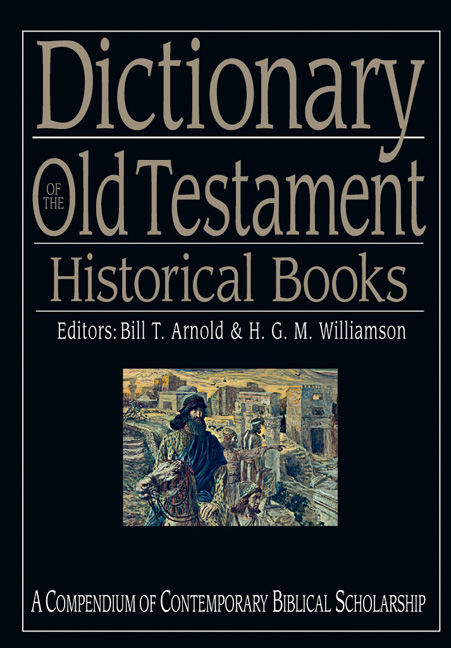
Dictionary of the Old Testament: Historical Books

 Bill T. Arnold & H.G.M. Williamson, eds., Dictionary of the Old Testament: Historical Books (Downers Grove, IL & Leicester, England: InterVarsity Press, 2005), xxiii + 1060, ISBN 9780830817825.
It is exciting to see this present work in print. Many in ministry consistently reach for reference works in the IVP dictionary series to help them in their teaching preparation. This series includes New Testament Background, Jesus and the Gospels, Paul and His Letters, The Later New Testament and its Development, as well as the Bible Background Commentary volumes for both Old and New Testaments. These were later followed by an Old Testament series beginning with Dictionary of the Old Testament: Pentateuch. Each volume has proven to be of superior quality in both scholarship and ease of use. The present volume, Dictionary of the Old Testament: Historical Books covers a wide variety of topics covering the books of Joshua, Judges, Samuel, Kings, Chronicles, Ezra and Nehemiah.
It should be noted that the IVP Dictionary series are written by American and European scholars who are not necessarily Pentecostal or charismatic. Because of this, some may find the articles somewhat disappointing.
Of general interest for Pentecostal/charismatics will be the biographical articles on such notables as “Caleb,†“David,†“Elijah,†“Elisha,†“Hezekiah,†“Joshua,†“Isaiah,†“Solomon,†“Zerubbabel†and others. While a general article on “Women†is included, specific articles on Deborah, Hanna and other notable women are conspicuously absent. Companion articles can usually be found to enhance the biographies. For example, in addition to the article on “David†there are also articles on the “Davidic Covenant†as well as “David’s Family.â€
Of specific interest for Pentecostal/Charismatics will be topical entries such as “Anointing,†“Faith,†“Forgiveness,†“High Places,†“Prayer,†“Salvation and Deliverance,†“Sickness and Disease,†and the “Word of God.â€
Those interested in theology will find beneficial insights in the articles on “Death and Afterlife,†“Ethics,†“Evil,†“God,†“Justice and Righteousness,†“Law,†as well as the article on “Sin.â€
For those who profit from historical, geographical and cultural context studies the entries on “Agriculture and Husbandry,†“Archaeology,†“Canaanite Gods and Religion,†“Egypt,†“Geographical Extent of Israel,†“Hebrew Inscriptions,†“Israelite Society,†and “Trade and Travel†will be of assistance.
For readers who are more interested in Biblical interpretation, the articles on “Chronology,†“Deuteronomistic History,†“Genealogies,†“Hebrew Language,†“Hermeneutics,†“Inner-biblical Exegesis,†“Linguistics,†“Methods of Interpretation,†and “Oral Tradition & Written Tradition†will prove helpful.
While there is much to like in the DOTHB there is something that is critically absent; that being any kind of article or reference to God’s Spirit. There is no entry on the Spirit of the Lord, the Holy Spirit, the Spirit or God’s Spirit. In the subject index there is not a single listing of any of these phrases. It seems woefully inadequate for a Bible dictionary that covers a select group of historical writings which includes “Judges,†where the Spirit is present in abundance, to not make mention of that same Spirit.
However the article “History of Israel†alone is reason enough to purchase the book. The article is divided into eight different sections totaling more than seventy double-column pages. Each section (Settlement Period, Pre-monarchic Israel, United Monarchy, Division of the Monarchy, Assyrian Period, Babylonian Period, Persian Period, and Postexilic Community) is authored by a different expert on each period. This article could stand alone as a survey textbook on Israel’s ancient history, while the cross-references to other articles in the dictionary make it even more useful.
The articles in the DOTHB are not mere carryovers from the previously published Dictionary of the Old Testament: Pentateuch. Both have different editors and authors. For example, both Dictionaries have an article on “Joshua†written by different authors with different perspectives. The DOTP article is more general since, as its author states, “Joshua plays only a minor role in the Pentateuch†(p. 477), as can be demonstrated by the article’s subtopics which cover Joshua in the shadow of God’s man of the hour, Moses: “Military Leader,†“Moses’ Aid,†and “Moses Successor.â€
In the DOTHB, as might be expected, there are two articles on “Joshua,†one that covers Joshua the man and one that covers the book of Joshua, respectively. The DOTHB article on “Joshua†the man takes a diverse view of Joshua coming out of Moses’ shadow and studies him under the subtopics of “Joshua in Early Tradition and History,†“Traditional Roles,†“Joshua in the Historical Books,†and “Later Developments in the Joshua Tradition.†In the DOTHB the author emphasizes Joshua as God’s man for a new generation. “Even though Joshua remains obscure as a historical figure, the Historical Books emphasize his theological and national importance by presenting him in a wide variety of significant roles†(p. 559).
Those who enjoy going beyond the basics of Bible study will greatly benefit from this text. While not excessively scholarly, it does allow the reader to delve into more than just surface material. The three indices, “Scripture,†“Subject†and “Article†make it a relevant study tool for anyone to use. However, not every subject is readily available for study. For example, there is no dedicated article on the Nazarites, yet they are mentioned in five separate articles. Nonetheless, a little work will reap a great deal of useful background and information from this Old Testament Dictionary.
Reviewed by Mike Rogers
Â
Publisher’s page: http://www.ivpress.com/cgi-ivpress/book.pl/code=1782
Â








This series is required for my OT classes I teach. I have personally found them to be a veritable wealth of aids for research on the OT (as indicated by Michael Rogers’ review). I also have commented elsewhere that one glaring hole in the Historical Books volume is the lack of any article on the Spirit (and worse yet no index citation of such) despite including authors like Tremper Longman and Daniel Block who have written elsewhere on the Spirit in the OT (Block even writing several articles and chapters on the Spirit in the Former Prophets). If there is any update for this volume that would be an oversight that simply must be fixed.
(And I say all of this as someone writing my PhD on “A Theology of the Spirit in the Former Prophets” [Joshua, Judges, Samuel and Kings] and note the dirth of engagement with this topic in the wider literature).
We’ve used mainly dictionaries like Kittle and Brown in our OT studies, which were the standard in our times of studies. Given this is a new edition (2005) we will have to take the opinion of renown OT student as Rick Wadholm Jr and check this dictionary in our studies. The review certainly puts it in good standing with any Biblical scholar out there.