
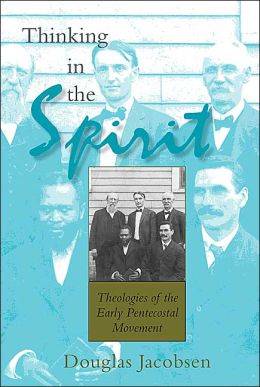
Douglas Jacobsen: Thinking in the Spirit, reviewed by Amos Yong

 Douglas Jacobsen, Thinking in the Spirit: Theologies of the Early Pentecostal Movement (Bloomington and Indianapolis: Indiana University Press, 2003), xvi + 418 pages, ISBN 9780253343208.
This is a book long overdue, and places us all in debt to Douglas Jacobsen, Distinguished Professor of Church History and Theology at Messiah College in Grantham, Pennsylvania. While a large volume, it is nevertheless very focused and precise. On the one hand, Jacobsen limits his survey of early pentecostal theologies to those articulated during the first twenty-five years or so of the movement. On the other hand, Jacobsen is the consummate narrator and historian of theology in these pages, describing early pentecostal theologies with immaculate detail and allowing the theologians he is presenting to speak with their own voices, all the while keeping his own theological perspective effectively muted. He hopes in the concluding chapter that “this book will help contemporary pentecostal theologians and church leaders engage each other in constructive ways, reminding them that a vigorous diversity of opinion has been part of the pentecostal heritage from the very beginning of the movement†(p. 355). This work accomplishes the author’s objectives admirably, in this reviewer’s opinion. Let me mention three reasons why.
First, as Jacobsen notes, is the very important reminder regarding the diversity of pentecostal theologies even among the earliest thinkers of the movement. The six chapters present twelve theologians: the “original visions†of Charles Fox Parham and Richard Spurling (later influential in the Church of God, Cleveland, Tennessee); the Azusa Street era theologies of William J. Seymour, George Floyd Taylor (later of the Pentecostal Holiness Church), and David Wesley Myland (a convert to pentecostalism from the Christian Missionary Alliance); the Finished-Work theology of William H. Durham and the Holiness Pentecostal theology of Joseph Hillery King; the Oneness theologies of Garfield T. Haywood and Andrew David Urshan; the Afrocentric and anti-racist theology of Robert Clarence Lawson; and the “boundary†theologies of independent evangelist Fred Francis Bosworth and mystical thinker Esek William Kenyon. The plurality of early pentecostal theologies should be evident simply given this listing. Jacobsen’s gift to contemporary pentecostal theologians and church leaders is to provide a coherent narrative demonstrating the interconnectedness of these various ideas and systems of thought without compromising their distinctive contributions and perspectives. Here, as in the day of Pentecost, we have a plurality of voices giving testimony to the wondrous workings of the Spirit of God.
Last, but certainly not the least of Jacobsen’s contributions in this book, is the related matter of the pastoral nature of early pentecostal theologies. Clearly, the theologies of Parham and Lawson, for example, included distinctively speculative elements—of history and eschatology on the one hand or of racial theory on the other. However, even these speculative theologies were animated by pastoral concerns and articulated with pastoral sensitivity. Parham was interested in the missionary progress of the gospel while Lawson was anxious to address the prevalent racial prejudice and discrimination of his times. Similarly, Myland’s “poetic theology†was motivated to address not so much the ontological “facts†behind justification, sanctification and baptism in the Holy Spirit but more so their pastoral implications, and Urshan’s Oneness theology was focused on attempting to provide a common platform for Oneness belief and practice. In every case, early pentecostal theologies were forged on the anvil of pastoral experience. Contemporary pentecostal theologians are served an important reminder that even speculative and constructive theology can and should be pastorally informed and applicable.
Beyond these merits, Thinking in the Spirit is simply a captivating and accessible read. Jacobsen makes the ideas of early pentecostal theologians come alive, both in their own contexts and, where pertinent, for our times. Forty pages of endnotes, each documenting entire paragraphs of ideas rather than individual quotations or references, leave the text uncluttered even while providing citations for students and researchers to follow up. The bibliography identifies the original writings of the twelve theologians discussed and a helpful index is included. This book belongs in every library—personal, pentecostal and academic. Three cheers to Douglas Jacobsen for this accomplishment!
Reviewed by Amos Yong
Preview Thinking in the Spirit: books.google.com/books/about/Thinking_in_the_Spirit.html?id=sMih7IBW2x8C
Â