

Forming the Life of the Congregation Through Music

Â
Part One: Three Questions
All churches come together to sing, and most Christians would readily affirm that this shared musical practice is a significant element in spiritual life. Yet the exact manner in which music exerts powers of spiritual formation may seem amorphous and elusive. I will approach the subject by asking three questions:
How do song lyrics affect us?
What kinds of musical experiences may subtly exclude some Christians?
What happens when music in the church borrows from music in the culture?
I will explore each of these and then conclude with suggestions for understanding theologically rich lyrics, inviting participation from all congregants, and innovating in areas where the culture may prove unhelpful.
Question 1: How Do Song Lyrics Affect Us?
Lyrics have the power to teach, but indirectly; there are very few songs that resemble a paragraph from a seminary textbook. To illustrate the point, readers may find it amusing to try setting the following doctrinal statement to music:
We believe in one God (eternal, omnipotent, omniscient, and omnipresent) existing as three persons – Father, Son, and Holy Spirit, one in nature, attributes, power, and glory.
Songwriters will find this text unwieldy, and a congregation will find it downright clumsy, even with a nice melody.
In the same way prosaic theological propositions do not usually make good song lyrics simply because they are too direct and too plain. Songs, by their nature, require language evoking imagery and narrative rather than asserting abstract facts, and they teach by awakening the imagination to Kingdom realities.
 Even the most theologically rich lyrics reach their best moments not in assertion but in evocation: they speak more profoundly in image than in proposition. For example, the unifying theme of Immortal, Invisible is the paradox of God’s immanence and transcendence—that he is both close to us and distant from us. The finest line of the first verse is In light inaccessible hid from our eyes, which is both a vivid image (that of blinding light) and also poetically ironic (insofar as light, normally the vehicle of sight, here precludes it). The second verse also peaks in a poetic line: Unresting, unhasting, and silent as light. The reader imagines the human states of repose and hurry, and then sweeps them both aside as inadequate to describe the activity of God. Light is normally silent, but here the simile illuminates the purity, energy, and life behind even God’s unperceived deeds: he is silent as light, not quiet as a mouse.1
Holy, Holy, Holy is an instance of Trinitarian teaching in song. Nevertheless, the direct statement God in Three Persons, blessed Trinity, while edifying, comes off as static and formulary when compared with dramatic scenes like Casting down their golden crowns around the glassy sea. This latter line draws upon things we can imagine: we have not seen the saints casting down their crowns (let alone the glassy sea) but we do know what crowns are and we have seen the ordinary sea, so our imaginations can make the leap and the text comes to life in our minds.
In recent times writers have not taken full advantage of the power of narrative in song texts.2 While many songs imply bits of narrative, few actually take a story and work it through from verse to verse. By contrast we might note Were You There? which draws a spare outline of the crucifixion, burial, and resurrection in its verses:
Were you there when they crucified my Lord? …
Were you there when they nailed him to the tree?…
Were you there when they laid him in the tomb?…
Were you there when he rose up from the dead?…
Its interest derives in part from the sense of building drama from verse to verse, and also from the aside that reflection upon these events might cause one to tremble.
At the college where I teach, the students seem attached to the rousing tune Lion of Judah, perhaps in part because two of its verses are given over to both narrative and imagery:
On His back, see the stripes! On His head, see the thorns!
And His life was forsaken, His healing hands were torn
As the priests and the soldiers spat out laughing scorn.
With His last breath he cried, “It is finished!â€
And the hands of the Son of God tore off the chains of death: See Him rise!
And the shouts of the seraphim, echoing thundrously, shake the skies!
Â
Hear the sky splitting open, the archangel’s cry!
Hear the trumpet of God, loud commands from on high!
Now descends Christ the Victor, who never can die.
Let the dead in Christ rise up to meet Him!
And the angels crescendo the triumph-song: Satan is bound in chains!
The redeemed cast off mortal flesh, clothed in white, join in their loud refrains!
The text allows the participants to become immersed in the gospel story because it evokes tangible details of that story as if they were present right now. People are more interested in tangible present things than abstract timeless things.
 These examples of narrative indicate that story-telling, like imagery, is a compelling but insufficiently recognized element in song texts. We may conclude that theological teaching in the didactic sense is a lesser function of congregational singing; the more memorable and interesting lines—the ones to which we are drawn—are usually those infused with imagery and narrative.
Question 2: What kinds of musical experiences may subtly exclude some Christians?
The practice of singing creates expectations about our identity within the faith. Standing together and making music is the one activity that is most congregational—it is the most unison thing we ever do. It is when we stand and sing together that we are most visibly and audibly “being†God’s people. (The next best metaphor, of course, is eating together.) Therefore the experience of shared singing will influence the peoples’ idea of what it is like to “stand before God.â€
 For these reasons, the experience of shared singing will quietly and subtly shape the church’s notion of their identity in the faith. Our singing may go wrong, and thus wrongly shape us, in a variety of ways. I will name and consider three such forms of exclusion.
A. The Christian may be excluded from singing by unsingable or unlearnable melodies. Normal folk are not adept singers; their vocal range is about one octave (considerably less for some of my friends), and they cannot execute fast notes, certain syncopations, or large melodic leaps well. They require numerous repetitions to learn a song. As most worship draws heavily on the Contemporary Christian Music industry (CCM) in which the singers are often quite agile, many melodies leave ordinary people unable to sing along in confident participation. Little consideration is given to the layperson’s vocal range (CCM songs are often too high or low) and the constant syncopation of the melodies, while culturally appropriate and sometimes musically compelling, is at times too skittish for a large group to follow. The cruise ship cannot keep up with the jet ski’s moves.
This problem is not deliberate. No one writes music to exclude others. However, because CCM derives from the recording industry, those songwriters are attending first and foremost to their own vocal abilities, to what will sound good when they sing it.
People cannot read music, so churches project words on screens, which is helpful as far as it goes. But how are the people to learn new songs if they have only words? Worship bands often indicate that they are “teaching†a new song, when in fact they merely perform it for the crowd that has no choice but to listen passively while standing awkwardly. This is why I call such songs unknowable: they are so inadequately taught that even an earnest person has little chance of catching on.
B. The Christian may find herself excluded by a loud sound system. When volume reaches a certain point, only people with microphones can be heard. It is common to find worship services in which thousands are drowned out by the speaker system. Some may argue that loud music can be enjoyable. I agree. Nevertheless, worship experiences form the people’s sense of identity, and if the volume is too loud, I contribute nothing if I sing, and am not missed if I don’t. The band is everything and I am nothing. My identity is that of an inactive spectator, or perhaps a useless bystander. Overly loud sound systems are an unintentional way in which ordinary people’s voices are excluded.
C. The Christian may find himself at odds with song texts that portray ecstatic spiritual experiences as normal and expected. Among the most-licensed CCM songs of 2008 one often finds lines like these:
Hungry I come to you
For I know you satisfy
I am empty
But I know your love does not run dry and I wait
So I wait for you
I’m falling on my knees offering all of me
Jesus, you’re all my heart is living for
Hungry (Falling on My Knees), Kara Williamson
Songs like this do speak to the experience of some, but they can be radically alienating to others. Not everyone lives the Christian life primarily as an emotional experience, and a steady diet of songs which depict fellowship with God as an almost physical intimacy (complete with double entendres) may encourage the assumption that a right-living Christian should live daily in a warm, tangible spiritual embrace. But that is wildly out of sync with the lives of many ordinary people.
 There is indeed a place for texts which express aspiration rather than reality, wherein we speak what we wish were true, and hope shall become true, rather than what is now true. Still, it is problematic to give a privileged place to songs of concentrated emotional and quasi-physical intimacy because they imply that the individual Christian ought to find something comparably intense as he worships God. Some do. Some do not. The one who does not may conclude that he is spiritually mediocre, or perhaps that Jesus is just a little too clingy.
(Just as some songs are too romantic, resulting in an implausible mental image, others may be so abstract as to result in no mental image at all. Texts weighed down with abstract words like power, glory, and beauty actually say less than texts which create imagery about something powerful, glorious, and beautiful. But that is a discussion for later in this article.)
Question 3: What happens when music in the church borrows from music in the culture?
Singing together raises questions about the relationship between church and culture. In our time church music resembles cultural practices in a way that (say) medieval church music did not. In the year 1256, it was not possible to confuse the sounds of the cathedral with the sounds of the carnival. Today almost all church music is either derived from or directly imported from a style in the broader culture. This situation is neither good nor bad; it is complex, and calls for deft navigation.
In other words, we will inevitably assimilate from the culture, but we may also choose to innovate upon it.3 (Some problems of assimilation will be presented here, while suggestions for innovation will be given in the closing section.) The culture offers many goods for our assimilation. The tonal system, with its major and minor keys, is a wonderful gift. And we do not need to invent instruments from scratch, but may assimilate guitars, fiddles, pianos and drums.
At the same time, it is possible to assimilate things that are antithetical to the Kingdom of God. The pervasive obsession with sex, debauchery, and violence within popular music culture has been thoroughly critiqued by others, and I will not explore that issue here. Instead, I would like to suggest that a more subtle assimilation continues to occur with little notice and even less critique. The church readily assimilates two things from the culture: celebrityism and consumer passivity.
Because nearly all our music is made for us by the entertainment industry and delivered to us by celebrities, we cannot help but import some of the practices and assumptions of that system into our Christian worship. A celebrity does not merely provide music, as a chef provides dinner. We may enjoy the dinner greatly and never care who the chef is. We care greatly who the celebrity is. The experience of encountering the famous person projecting her stage personality through the medium of the song is more important than the actual aural experience of the music. A celebrity will be forgiven for singing out of tune or forgetting the words as long as she has cool moves, attitude, or whatever combination of intangible but unmistakable qualities make up her stage personality. We are unlikely to forgive the chef for bad food on the merits of moves and attitude.
Living within a culture in which songs are delivered from an industry via celebrity personalities results in a kind of spiritual formation in which we become passive spectators. Congregations have been taught from childhood that music is a thing done by stars, and the role of the crowd is to observe and be entertained. Assimilating celebrity culture discourages the ordinary Christian from participating fully in worship, and gradually shapes him into a consumer expecting entertainment rather than a disciple expecting participation.4
The Christian music industry functions as a business, not a ministry, and serves the interests of the church if and only if doing so yields a profit. (Are there any Christian record labels that operate at a loss because of their commitment to the gospel?) For the last two decades within the industry, many performers have represented themselves as worship leaders.5 Their business goals include convincing us to buy their CDs and DVDs for our personal worship time, license their songs at our churches for corporate worship, buy tickets to their live shows, and see their products as indispensable to our congregational and private lives. They want to act not as entertainers only but also as worship leaders, chief emotional officers6, and interpreters of life’s events.
But these business strategies assume that such a role, which is essentially pastoral, can belong appropriately to someone who is unknown to us, who is not a part of our local faith community. Only by convincing us to allow that role can they remain profitable. But because they are also entertainers who market their goods to consumers, their posture toward us is that of the salesman: They offer flattery rather than exhortation, or at least exhortation exactly as we would have it, which is to say, flattery. So our posture toward them, and toward their products, is that of the consumer: a complacent expectation to be pleased, with reasonable demands on our wallets and no demands on our souls. By depending on the entertainment industry for our worship music, we assimilate passivity and allow ourselves to be spiritually formed as consumers.7
Part Two: Practices That Form the Congregation
I have drawn a picture of obstacles to good music-making. Taken together, they are daunting. That is why it is best not to take them together, but rather choose a few small matters for attention and labor. Several simple practices are within the power of the ordinary pastor and worship leader, and some do not require musical ability.
Narrative and Imagery: Picturing the Gospel Story
The power of well-chosen words is worthy of… remarking upon in well-chosen words. I suggest three practices, in ascending order of difficulty, for bringing interesting and descriptive texts to our congregations.
A. The place to start is with the songs we choose. As often as possible, we should select those with vivid, descriptive language or interesting story lines (or both). Naturally, not every song is consistently good or bad in this regard, but most will show whether or not the lyricist has truly crafted the words. In Christ Alone is an example of a text finely done:
There in the ground His body lay,
Light of the world by darkness slain;
Then bursting forth in glorious day,
Up from the grave He rose again!
Â
In Christ Alone, Keith Getty
Not only does Getty’s text avoid setting off the cliché alarm, but it demonstrates an attention to consistent metaphor: the idea of light runs through the verse. Light of the world refers to Christ, and its opposite darkness stands for the forces of evil. Finally he draws the Easter morning sunrise into the picture as he pens bursting forth by glorious day. He also creates an implied simple narrative: as the song proceeds, Christ goes from the grave to the resurrection. The text holds together nicely, each part complementing the others, with no lines sticking out as thoughtless filler.
It is only fair to offer a few of my own lyrics for scrutiny and critique (let the reader fire at will):
See in verdant growing things, and hear in sweetest singing
This lavishly created world, in beauty ever ringing!
See in withered dying things, and hear in loud war-making,
This tragic’ly distorted world, in sin and sorrow breaking!
The following is an example of carelessness which I wrote for my students to demonstrate cliché. I made them sing it in class but I pretended that it was serious. It was wonderful to watch them repress laughter at the last line:
Sunset on the sea
Breezes in the tree
Jesus always be
Super close to me
B. Non-musicians may write additional lyrics to existing songs as a way of developing their lyrical abilities, extending the narrative and imagery of a favorite song, and blessing their congregations. This practice limits the difficulty of writing because the meter and rhyme scheme are already in place. That is, the number of syllables and the points at which they must rhyme need simply to be imitated from the song. This first example fits Jesus, What a Friend for Sinners and extends that hymn’s idea of God helping those who depend on him:
Gracious Father, You have taught us
In the Gospel: ask, be bold!
Yet some worldly snares have caught us;
Now our faith seems weary and old.
In our earthly imagination
We have doubted Your Fatherly grace.
Hear our humble supplication:
All our sins of doubt erase.
The next example fits the chorus As the Deer, and like the original text, also derives from Psalm 42. Working Scripture text into songs is challenging and enjoyable, because the writer must preserve the meaning and tone of the original while making its syllables and rhyme fit the confines of the song. Readers who know the song may easily imagine these words to its tune:
O, my soul, so disturbed within me,
Why are you downcast and sad?
Put your hope in the faithful Savior;
I’ll yet praise Him and be glad.
Â
You alone are my God and King;
To you alone shall my spirit sing.
You alone are my heart’s desire
And I long to worship you.
Â
Send your light and your truth to guide me;
Let them lead me to where you dwell.
Bring me up to your holy mountain,
And in you, my soul is well.
C. The more ambitious worship leader may wish to delve more deeply into the craft of lyrics.8 In addition to gaining a command of rhyme and meter, the aspiring lyricist should learn to think in terms of guiding or controlling ideas for each song. There should be an overarching story or picture upon which he can draw to fill in smaller details and events in each line. For example, if a song is about communion, references to bread, wine, hunger, eating, and serving all resonate with the overall idea. A sudden line about soaring like the eagle or standing on the battle line would be laughably out of place.
In order to understand the idea of an overarching picture, we will look at one example of taking a text of Scripture and turning it into song lyrics.
On this mountain the Lord Almighty will prepare a feast of rich food for all peoples, a banquet of aged wine—the best of meats and the finest of wines. On this mountain he will destroy the shroud that enfolds all peoples, the sheet that covers all nations; he will swallow up death forever. The Sovereign Lord will wipe away the tears from all faces; he will remove the disgrace of his people from all the earth. The Lord has spoken.
 Isaiah 25:6-8 presents a picture of what God’s final redemption of the world will look like. Three images stand out: a banquet, the removal of a veil, and the removal of tears and disgrace. Taken together, the overall scene is one of a family dinner (or even a picnic) in celebration of God’s healing work in the world.
After working these images into matching numbers of syllables with a rhyme scheme, we come out with this:
On this mountain God will make a banquet,
All the people feasting, as a sign:
God’s delight is lavished on his people,
Laughing, singing loud, and drinking wine.
Â
On this mountain God will rip the veil;
All the people wore it as they mourned.
God delights to swallow death forever.
Laughing, singing loud, the grave is scorned.
Â
On this mountain God will heal our sorrows,
From the people wipe away all tears.
God delights in comforting his people,
Laughing, singing loud, uncounted years.
The opening phrase On this mountain repeats in each verse, providing unity not only to the text but to the scene itself: these events are all happening here. The concluding phrase laughing, singing loud lends a sense of celebration, not so much of sober reflection as of giddy and unrestrained joy. (Loud instead of loudly is poetic license.) The second verse does not mean that the grave itself is laughing, but that the people cheerfully deride the powerlessness of death.
Worship leaders will find that rigorous engagement with imagery and narrative, along with rhyme and meter, can become an avenue of blessing their congregations.
Musical Practices of Christian Inclusion
A. People can only sing melodies that are within their abilities and that have been truly learned. In retrospect, this seems obvious: how does one sing what one does not know and cannot do? Leaders must consider the matter of teaching their people with greater attention and intention. Some may find it possible to project not only words but also music notation of the melody on the screen. Even though most people will not immediately be able to read music, everyone can understand that the dots go up and down with the melody. Prolonged exposure to music notation will result in a basic reading ability: many who grew up in hymnbook-using churches acquired musical literacy simply by showing up and trying once a week. The ability to read music is not only an aid to corporate worship, but is a beautiful gift that worship leaders can quietly and slowly give their people.
Finally (and this is really an area reserved for musicians), melodies with extended vocal ranges, awkward leaps, and difficult syncopations should be revised to place them within the people’s abilities.
B. Sometimes the fellow behind the mixing board is not musically sensitive. Most churches rely on volunteers, a case in which the most important ability is availability. Still, guidance from a musician would probably improve the situation. The needed musical wisdom includes knowing the difference between a melody and an accompaniment, good sense about instrumental balance, and a determination that no matter how good the band is, the sound of the people is more beautiful still. The level of the sound system subtly shapes the congregation’s sense of their own necessity, their thoughts about their own role in the ministry. Setting the volume control is an act of ecclesiology.
 C. Worship leaders must pursue music that is truth-telling. By this I mean songs which tell the truth about how life actually is, honoring that reality and helping us to carry on with it. God is close, but in this present age he is also distant. We do not yet live in the time when the dwelling of God is with men and he wipes away their tears. Many songs are written with the assumption that such an eschatological closeness is available, and should be the status quo, today. Even those songs that speak of a hunger or a desperation for God often include a claim that it has been satisfied. Perhaps we are even invited to imagine that the hunger is fed and the desperation answered during and by means of the song: it serves as a dramatically-enacted spiritual encounter.
Again, songs of aspiration are appropriate for the church. It is good to sing of closeness with God. It is not good to fail to learn to live with his distance. In selecting and writing songs, worship leaders have an opportunity and an obligation to serve as chief emotional officers for their people, teaching them (as the Psalms do) how rightly to enjoy God’s presence and faithfully wait out his absence.
Frankly, I do not think that narcissism and consumerism are the only reasons we have so much spiritual navel-gazing in our songs. The fact is that texts about vague personal feelings, without any specific references to concrete events, are easy to write. (Especially if they don’t have to rhyme.) It is difficult indeed to compose lyrics that, say, lament socio-economic injustice in a particular neighborhood, call on God to act, and urge the church to do something. It is much easier to come up with the following:
As I stand in your presence
I can feel your mercies flow
As I bathe in your essence
I can feel my spirit grow
I just wrote that right now, in about fifteen seconds. It was easy because it is bad. It is bad because it says nothing, yet reinforces within us all that is self-absorbed and adolescent.
Yet it is possible, through patient learning and labor, to offer our people songs that are specific, memorable, edifying, and poetic. Again, at the risk of presumption I will offer some of my own work:
On Creation, wrecked by sin,
Seemingly forsaken;
Streets and fields and human hearts,
By sorrow overtaken:
Lord have mercy, Christ have mercy!
Â
On your children held as slaves
By sin’s strong addiction;
On your people crushed by debt,
Threatened with eviction:
Lord have mercy, Christ have mercy!
Â
On your people whom you send
As the hands of healing;
Work in us incarnate deeds,
Jesus’ love revealing:
Lord have mercy, Christ have mercy!
Â
Christ Messiah on the cross
In that dreadful hour
Crushed, disarmed, and triumph over
Every evil power:
Lord have mercy, Christ have mercy!
Â
(This song uses the chorus from Steve Merkel’s Lord Have Mercy, with a different tune and text for the verses.)
Songs that invite Christians to give priority yet again to their private emotional experience are pervasive, easy to produce, and superficially attractive. Truth-telling in songwriting is hard work, badly needed.
Innovation: When the Culture is Unhelpful
Our culture offers us many musical gifts and some sonic perils. We should assimilate the gifts whenever they are musically viable and helpful to the work of the gospel. But what can we do when we find the culture either ignorant or hostile in a certain area? In the section Borrowing from Culture two such unfortunate assimilations were mentioned: celebrityism and consumer passivity. I suggest they be subverted with innovations of local creativity and disciple participation.
Local creativity answers the mass-marketed superficiality of celebrityism with songs that are written by members of the community, for the community. Just as a pastoral role does not belong to an outsider, it is not appropriate to give so many of our musical tasks over to an industry. While there is nothing objectionable about a portion of our music coming from people we do not know, encouraging our own people to create some of our songs could be an exciting and life-giving innovation.
Only insiders can know the needs of their communities. They can more fittingly help it to lament and celebrate in its own, home-grown way. Just as identical shopping centers drain away the individual character of towns, so industrially-produced music empties congregations of their local color, humble though it may be. To imagine churches across the land singing nearly identical songs licensed from Nashville is not only a depressing thought, it is almost an affront to the God-ordained diversity of his people.
The passivity of the consumer must be answered with the participation of the disciple. Just as the industry’s music must be intentionally supplanted by our own, so the people’s participation will only happen if the leaders undertake it deliberately. We have already explored some ways that may help in Musical Practices of Christian Inclusion, above. I suggest three more.
A. People in our churches are like musical sheep: they go where they are led. In order to get them to sing with full participation, it is probably necessary to instruct them directly from time to time. This certainly should not come across as a scolding but rather as a kind invitation that all voices are wanted and welcomed, without regard to beauty or intonation. It may even be appropriate to explain briefly that each person’s voice is an encouragement to others; the full sound of the people is a compelling sign of the Spirit in our midst.
B. A practical way to elicit participation is through songs structurally designed for greatest involvement. Call-and-response songs consist of a leader singing a line which is imitated by the congregation. An advantage is that the people can join in immediately, simply by imitation.
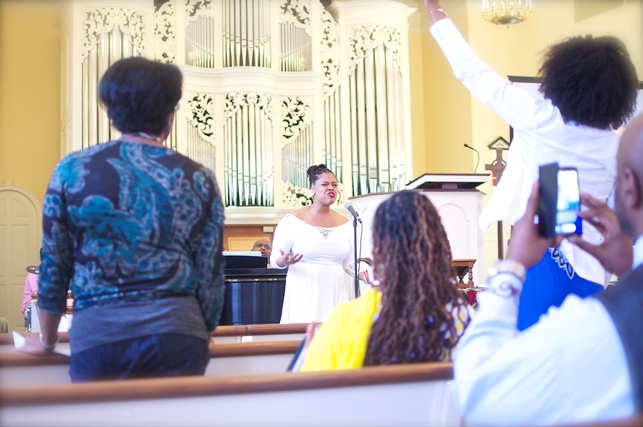
Similarly, one can use simple songs that change only a few words with each verse. Soon and Very Soon by André Crouch needs only two new syllables each time around. The song lists griefs that will be absent when the Kingdom comes in full: no more crying there, no more dying there. Our church once did this song, but stopped between verses to ask for suggestion from the people. One child beset by troublesome food intolerances shouted, “No more allergies there!†The syllables were perhaps a little crowded, but no matter: we sang away. Then a dear woman with a physical disability cried out, “No more wheelchairs there!†These beautiful moments were possible because the people were drawn to participate.
C. Creating songs for underserved people is not only a way of inviting involvement, but also puts into practice Jesus’ command to honor those normally considered least important. Using music produced by the industry gives a privileged place to those who are most familiar with it: its customers. In my congregation we have some people who own collections of Christian music CDs in styles typical of the middle class, but others who do not know this music and cannot afford to buy it. If we sang only the music of the middle class, it would certainly send a message of marginalization to those in poverty: this is our music, not yours, because this is our church, not yours. When we call upon local creativity for new songs, the playing field is leveled and everyone is a beginner.
Â
Conclusion
Making music together is delightful and demanding; problematic and pragmatic; mystical and mirthful. Christian leaders who understand the subtle inner workings of texts, inclusion, and culture will more ably guide their churches into richer ways of singing.
PRÂ
Notes
1 Latin texts like the Credo have served in Christian worship for centuries and are arguably the kind I have just described as too direct and dry. A full consideration of historic worship texts is beyond the scope of this article and perhaps beyond the scope of the reader’s interest. It must suffice for now to suggest that the Credo is actually rather poetic by the standards of its time.
2 With the obvious exception of country music.
3 I am indebted to journalist Andy Crouch for these helpful terms.
4 Pastors who lament their congregations’ inertia might ask how they got that way.
5 It is also a common strategy to market themselves as “vulnerable.†(Vulnerability is really hot right now.) But no one is truly vulnerable with an unseen and distant customer base. Feigned vulnerability is the highest form of insincerity.
6 A person who guides a community by teaching them to respond emotionally rightly at the right time: how to celebrate, contemplate, and grieve. It is a pastoral role.
7 This description of the economic dynamics of the Christian music industry may offend some readers. I fully expect some emails about (or from) committed, faithful believers who undertake fruitful labor for the gospel within the industry. Of course there are such folk. I have met many, liked most, and played music with some. None of this ameliorates the underlying tensions and inconsistencies of an industry that has set out to make a profit—a very large profit—by selling us the experience of worshiping Jesus.
8 I have written elsewhere on the subject. Interested readers may visit http://people.cedarville.edu/employee/johnmortensen/works/writings.html [no longer accessible as of Nov 12, 2014, please see John Mortensen’s author page for information about his blog]
9 Recently a man in my church neighborhood asked for money so he could turn his cable television service back on; otherwise the children had nothing to do. He could not conceive of a family creating its own fun. Indeed, he could barely conceive of enjoyment at all without the entertainment industry. He is the archetypical man formed into consumer passivity.