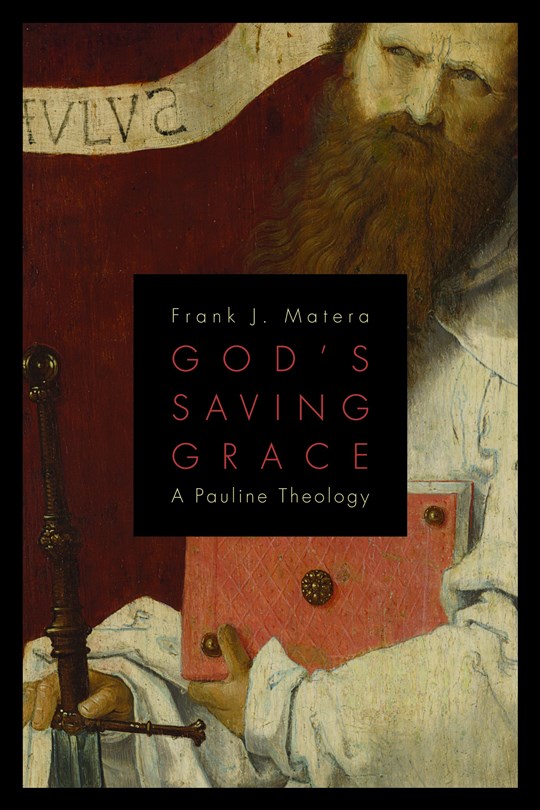
 Frank J. Matera, God’s Saving Grace: A Pauline Theology (Grand Rapids: Eerdmans, 2012), 283 pages, ISBN 9780802867476.
In Frank Matera’s God’s Saving Grace: A Pauline Theology the author considers with careful and solid scholarship the totality of Paul’s themes in the canonical thirteen letters of scripture. Matera, a Roman Catholic and professor of Biblical Studies at Catholic University of America, Washington D.C., speaks as a scholar who studied Reformation teaching. He recaptures Pauline theology, succinctly unwrapping the apostle’s original framework concerning salvation in Jesus Christ. Utilizing Paul’s conversion experience and call, he builds a case that the grace of God remains the foundation for the apostle’s soteriology. In Ephesians 2:8-9 (NRSV) he states “for by grace you have been saved through faith, and this is not your own doing; it is the gift of God-not the result of works, so that no one may boast.” Matera writes, Paul “no longer knows God except in Christ;”(248) therefore, there is nothing that sustains him but Christ alone. Again, he continues, “once the mystery of God’s redemptive plan has been revealed, however, it is clear that there has always been one plan, which is revealed in Christ”(248). Through the motif of the saving grace of Jesus, Matera outlines the meaning of salvation and redemption in his book.
Ch 1 A Pauline Theology of God’s Grace
Pauline theology, whether christology, pneumatology or eschatology is centered in the saving grace of God through the cross of Jesus.
Pauline theology, whether christology, pneumatology or eschatology is centered in the saving grace of God through the cross of Jesus. Searching for the historical Paul in both Acts and his thirteen epistles, Matera reveals a difference between a
theology of Paul and a
Pauline theology. A Theology of Paul “seeks to clarify and synthesize the theology of the historical figure Paul” (2), and A Pauline theology “seeks to clarify and synthesize the theology embedded in the thirteen canonical Pauline letters” (3) Thus, the purpose of Matera’s book is a Pauline Theology, unpacking Paul’s interpretation of Jesus’ mission.
Ch 2 Paul’s Experience of God’s Saving Grace
Paul’s calling and apostleship is grounded in the Damascus Road christophany (Acts 9) where he encountered with Christ. In Gal. 1:13-2:21, the apostle’s autobiography divulges this defining moment of his life. Matera indicates that a number of his letters commence with the launching of his apostleship by “the will of God” (1 Cor. 1:1). Paul defends his ministry with the Damascus christophany as his conversion was both a transformation and calling in one event. As Matera examines each of the three accounts of his christophany recorded in Acts 9, 22, 26, he writes that Paul’s commission was of divine origin, built on the kerygma of the cross of Christ (1 Cor. 1:18). Hence, he observes “Paul’s call, his gospel, and his apostleship are intimately related to each other” (42). Matera’s Pauline theology, is established in the Damascus Road christophany, and in that momentous event, Christ became the focus of the apostle’s life.
Ch 3 Christ the Embodiment of God’s Saving Grace
The meaning of grace embodying Pauline theology divides this chapter’s theme into three areas. First, he unveils the identity of Christ. Titles such as Son of God, Christ/Messiah, and Lord confess Jesus as “God’s redemptive agent” (62) in salvation history. These titles for Christ summarize his preaching. Second, Matera investigates three hymn-like texts from Philippians 2:6-11, Colossians 1:15-20, and 1 Timothy 3:16. Jesus remains the consummation of God’s kingdom as he is likewise the firstborn of all creation (Col. 1:15), proclaimed in his incarnation, and coming again (Tit. 2:13). Third, Christ is revealed as the eschatological Adam to the apostle on his Damascus road experience. In Jesus’ death, resurrection, and exaltation, Christ transcends life. Thus, God’s redemptive agent, Christ, remains rooted in Paul’s Damascus road experience.
Ch 4 The Saving Grace of Jesus Christ
Everything begins and ends with grace as humankind must make a decision to receive or reject it.
As grace is the unmerited favor of God to humankind, the apostle’s letters are laced with the grace of Jesus. Matera works through each epistle displaying the sinful plight of humans, yet affirming the grace of God for unredeemed humanity (1 Cor. 1:21). God’s redemptive work through Christ consummated God’s justification, reconciliation, and salvation. Thus, everything begins and ends with grace as humankind must make a decision to receive or reject it. Ultimately, grace leads to holy living as sanctification and glorification are discovered in Christ.
Ch 5 Living in the Community of God’s Saving Grace
Matera uncovers Paul’s soteriology and christology in the context of the community of the church, unpacking the apostle’s personal experience as a basis for his ecclesiology. The church as the local assembly (ἐκκλησία) is viewed within the confines of homes; hence, the church is not a building, but God’s people, called to declare the death and resurrection of Jesus. The author examines the meaning of the metaphor Body of Christ which constitutes the church, edifying God’s people. Spheres of ministry such as spiritual gifts (1 Cor. 12-14; Rom. 12), and ministry offices (Eph. 4; 1 Tim.; Titus) are viewed as complementary, not separated. Matera writes that both the charismatic ministry and ministerial offices are ordained by God to lead the church in works of grace. Finally, he turns a different direction to Israel and the church. Both are called by God as an example before others and each one is a remnant, called as the eschatological people of God in the world. Thus, the apostle’s ecclesiology remains based in the saving grace of God and founded in God’s eschatological plan.
Ch 6 Living according to God’s Saving Grace
Both the charismatic ministry and ministerial offices are ordained by God to lead the church in works of grace.
In chapter six God’s grace informs Paul’s ethics. Grace infuses sanctification in the believer, which in turn directs one’s moral and ethical decisions. Matera divides the Pauline ethic into five areas: soteriological, Spirit-empowered, sacramental, love, and eschatological. The soteriological ethic is grounded on God’s redeeming work in Christ. He surveys the Pauline corpus unveiling the indicative, which positions “the pattern of Christ’s life as the pattern of the believer’s life” and the imperative, where “God is at work within believers so that they can work out their salvation”(161). The saving grace of Christ provides the power for a moral life. A Spirit-Empowered ethic connects “the indicative of salvation and the moral imperative” (162) Believers as free moral agents, by the power of the Spirit can live moral lives that please God. In essence, Matera adds that it is “a choice between living according to the flesh and living according to the Spirit” (168). Baptism and Eucharist are the sacramental symbols combining the indicative of salvation and moral imperative. Both sacraments establish believers in a morally good life. The sacramental ethic invites Christians to the transformational life that comes as a result of Jesus’ ethical teaching centered in the love ethic. As a result, Paul positions love as the action we must have for God and each other. God’s plan in salvation history exhorts believers in living holy lives until they see the day of the Lord. Thus, the
parousia motivates believers to lives of virtuous moral conduct. These ethics are experienced individually and corporately as a believer encounters the saving grace of Christ.
Ch 7 Waiting for the Final Appearance of God’s Saving Grace
Pauline theology begins and ends with God.
God’s saving grace is directly corroborated in Paul’s eschatology as the concept of “the already and the not yet” pervades the apostle’s thinking. The future triumphant victory in Christ includes our present existence as well. Matera divides the chapter into five theological themes. First, the wait for Christ’s imminent
parousia in the Thessalonian correspondence reveals God’s salvific work. Second, the wait for the resurrection of the dead is investigated in the Corinthian letters. The pivotal teaching of Christianity, the resurrection of Jesus, is essential to the apostle’s theology. Third, the wait for the final victory in Christ continues the motif of “the already and the not yet” (Romans 5, 8) as Matera ties Paul’s eschatology with Israel’s eventual return and acceptance of Jesus the Messiah. Fourth, Colossians and Ephesians demonstrate Paul’s realized eschatology. Matera remarks, “the emphasis from the future to the present” (204), sums up the realized eschatology of God’s salvation and grace. Fifth, the wait for Christ’s final appearance consummates his two appearances, when he originally came to earth for salvation and then to complete his salvation over the entire cosmos. Climactically, Christ’s
parousia in the Pauline corpus grounds his salvation, resurrection, and redemption of all creation (Rom. 8:22).
Ch 8 The God Revealed Through the Saving Grace of Jesus Christ
God is revealed by the message of the cross in weakness and suffering.
Matera succinctly begins his concluding chapter that “Pauline theology begins and ends with God” (215). Paul’s Jewish heritage provided a firm foundation for his Christian faith and his Damascus Road experience cemented his theology. Indeed, “Paul’s theology is, at the same time,
Christology” (216). Matera synthesizes the revelation of God’s grace in Christ with several essential thoughts. First, Paul boldly calls God, the Father, who in relationship with Jesus the Son supports the gospel message. Second, God is revealed by the message of the cross in weakness and suffering (1 Cor. 1:18-31). Third, God justifies and remains faithful, performing his plan in our lives. Fourth, the righteousness of God demonstrates his integrity, which justifies his wrath. Matera acutely mentions, “the righteousness of God and the wrath of God are like two sides of a coin” (234). Fifth, God is no respecter of persons in his incomprehensible wisdom based in the experience of the Spirit. Sixth, God shares his name in Christ who has become our salvation. Seventh, Matera sums up Paul’s theology with christological and pneumatological precision.
This reviewer appreciated Matera’s emphasis that Paul’s christophany (Acts 9) remained the basis for his understanding of grace. Matera’s clear and readable arguments, uncovering the deeper meaning of Paul’s Damascus road christophany. I would strongly recommend Matera’s comprehensive study for lay people, clergy, and scholars. A parish library would possess a readable entryway into the major theological themes of the Paul’s theology. In addition, each chapter concludes with a “coherence and meaning” piece suggesting further readings and summarizing his findings. Certainly, an erudite reading reveals meticulous and creative scholarship on the saving grace of God.
Reviewed by Cletus L. Hull, III
Preview: https://books.google.com/books/about/God_s_Saving_Grace.html?id=ZZJYTWhVdzwC
Publisher’s page: http://www.eerdmans.com/Products/6747/god39s-saving-grace.aspx
-
Cletus L. Hull, III, M.Div. (Trinity Episcopal School for Ministry), D.Min. (Fuller Theological Seminary), Ph.D. (Regent University), has served as a pastor with the Christian Church (Disciples of Christ) for 39 years and psychiatric chaplain for 37 years. He has been an Assistant Adjunct Professor of Biblical Studies in the Oral Roberts University College of Theology and Ministry for 7 years. He has researched the growing Disciples of Christ churches in Puerto Rico and has an interest in the significance of the Stone-Campbell churches in American Christianity. His article, "My Church is a Mental Hospital" appeared in the Summer 2015 issue of Healing Line. He is the author of The Wisdom of the Cross and the Power of the Spirit in the Corinthian Church: Grounding Pneumatic Experiences and Renewal Studies in the Cross of Christ (Pickwick, 2018) and The Call: My Mission and Our Ministry at Trinity United Christian Church, Lower Burrell, PA (Word Association, 2019). X: @cletus_hull, Facebook.