J. P. Moreland: Kingdom Triangle


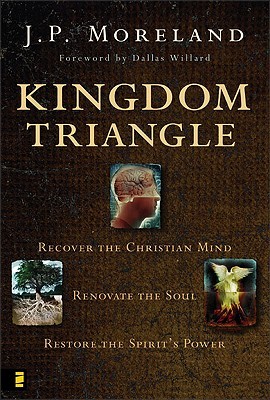
J. P. Moreland, Kingdom Triangle: Recover the Christian Mind, Renovate the Soul, Restore the Spirit’s Power (Zondervan, 2007), 237 pages, ISBN 9780310274322.
I want to foment a revolution in Evangelical life… My purpose is to mobilize, inspire, envision, and instruct an army of men and women for a revolution on behalf of the cause of Christ.
If I could pick out for you a few of the most formative books in my own intellectual development, as a believing Christian, J.P. Moreland’s Love Your God with All Your Mind would be jostling at the top. I wish I could thrust a copy of it into the hands of every Christian student, pastor and teacher. I can at least commend it to you as essential reading—after C.S. Lewis’s Mere Christianity, of course. But before you read either, I believe you should read Kingdom Triangle. And I think if you do read it carefully, cover to cover, you might just forgive me for putting J.P before Jack.[1]
Kingdom Triangle is a biblically grounded vision of Christian discipleship, uniting J.P Moreland’s concern for the Christian mind with his pursuit of the spiritual disciplines, and calling for the whole Church to rediscover the power of the Holy Spirit. Taking the parts in isolation, it doesn’t appear to be saying anything radically ‘new’. As Moreland himself admits, the first point of the triangle will come as no surprise to anyone familiar with his writings; J.P is well-known among evangelicals as a philosopher and apologist, and Love Your God with All Your Mind was but one incarnation of his characteristic emphasis on a more tough-minded Christianity. It is a concern shared by many writers besides J.P. The ‘spiritual disciplines’ also have a well-established literary corpus and a number of contemporary advocates. And the charismatic stress on the manifest power of the Spirit is something many of the readers of this article probably share. What is rather unusual—and exciting—is to see all three of these emphases united together, without one being played off against the other.[2]
The first part of the book is decidedly philosophical. J.P offers us a penetrating expose of the cultural milieu of the West. In the discussion that follows, Moreland identifies naturalism, postmodernism, and Christian theism as the three major worldviews vying for our allegiance, and concerns himself with expounding both naturalism and postmodernism in some detail. Both are exposed as pervasive, pernicious, false—but also dangerously ‘thin’ worldviews, lacking the resources to ground objective value, purpose and meaning, and ultimately destructive of the good life, plunging us into a shallow and sensate culture. ‘Under the influence of naturalist and postmodern ideas, many people no longer believe that there is any ultimate meaning to life that can be known. These folks—and they are legion—have given up on seeking that meaning and instead are living for happiness. Today, the good life is a life of happiness’. And the drive for happiness – construed as ‘pleasurable satisfaction’—has produced a culture of ’empty selves’.
J.P however believes ‘we are wired for more than happiness. We are made to live for God’s honour by learning how to become spiritually competent, mature members of his Kingdom and to make that Kingdom our primary concern’. Claiming the supremacy of the Christian worldview, Moreland exhorts believers to recognise the superior spiritual and intellectual resources available to them in Christ, and to start taking their faith seriously, heart and mind. ‘We were made for greatness’, he argues, but our present culture ‘undermines both its intelligibility and achievement’. ‘The only way we are going to move from our boring lives to lives filled with the drama of the Greatest story is for those who embrace mere Christianity to set aside the shallowness of their thought and the weakness of their spiritual practices, and corporately to enter afresh into the Kingdom forms of life and thought worthy of the name of Christ’.
To this end, J.P, seeks to raise awareness about some major ‘paradigm shifts’ in the thinking of Western society—shifts that have ‘greased the skids from a thick world to a thin one’. The first Moreland discusses is the demotion of religious knowledge to the deliverances of a non-rational ‘faith’. It is commonly believed today that religion ‘is not a domain of fact’ in which one can acquire knowledge, or become expert. Unfortunately Christians, to some extent, have allowed themselves to be coloured by this perspective. J.P objects, for instance, to talk about ‘the integration of faith and learning’—as if the insights gathered from Chemistry or Physics, say, were ‘learning’, and the insights gathered from Scripture and Christian theology were ‘faith’. ‘Christians must stop talking about “belief” in life after death, heaven and hell’, he urges, ‘and must reexpress their views on these and related matters as expression of knowledge of reality’. A second shift J.P identifies is the downgrading of the good life as a life of human flourishing, ‘constituted by intellectual and moral virtue’, to simply the satisfaction of desire. As it was formerly understood, happiness was ‘a life of virtue’ and ‘the successful person was the person who knew how to live a life well according to what we are by nature because of the creative design of God’. It involved ‘suffering, endurance and patience because these are important means to becoming a good person who lives the good life’. All of this, of course, presupposed ‘the availability of the moral and spiritual knowledge needed to grasp the nature of human flourishing and the journey required to achieve it’. The first two shifts are connected, then. And so are the remaining three. ‘Loss of moral knowledge’ has brought about a third ‘shift from a view of the moral life in which duty and virtue are central to a minimalist ethical perspective’, a fourth shift from a ‘classical’ conception of freedom as ‘the power to do what one ought to do’ to freedom construed as ‘the right to do what one wants to do’, and a fifth shift to a new understanding of ‘tolerance’ that is pluralist in nature and ‘fosters moral relativism’. All five of these moves are the concomitants of a more substantive shift away from a Judeo-Christian worldview to a naturalist and postmodern one, proliferating a culture of ’empty selves’ and producing the Zeitgeist that is ‘killing our lives, our religious fervour, and our relationships’.
The second part of the book seeks to redress the problem, presenting the Kingdom Triangle—and you will have to read the book to get the details! Moreland’s discussion of the ‘recovery of knowledge’ (the first prong of his tripartite vision for the Christian Church) is another philosophically meaty section for the reader to master, discussing the problem of philosophical scepticism, defining knowledge and faith, confronting popular misconceptions in these areas, and laying out a plan for strengthening them both. ‘Appropriate faith’, Moreland explains, ‘is grounded in knowledge and it is as good as its object… It is on the basis of knowledge… that one is able to exhibit the confidence in the respective object or possess a readiness to act as if the relevant proposition is true’. Among other pieces of advice, Moreland urges believers to ‘be ruthless in assessing the precise nature and strength of what you actually believe and develop a specific plan of attack for improvement’.
His chapter on ‘the renovation of the soul’ draws on the insights of writers like Dallas Willard, Richard Foster and Henri Nouwen. Diagnosing four traits of ‘the empty self’, J.P. offers an expose on ‘the art of Christian self-denial’, carefully tracing out the relevant concepts and seeking to acquaint the reader with some of the ‘disciplines of abstinence’ and ‘engagement’ that disciples can purposefully employ to target areas of their lives where ‘sinful habits’ are residing. But Moreland is keen to emphasise that spiritual development is not something we should do solo—and goes so far as to strongly endorse the use of trained Christian therapists, counsellors and spiritual directors at the local Church. As ever, J.P.’s emphasis on knowledge undergirds the discussion. If you find parts of this chapter a little surprising (as I admit that I did), maybe it is worth asking yourself whether it has something to do with the fog of our contemporary Zeitgeist. Perhaps we expected spiritual development to be something rather vague and cloudy. J.P’s ideas about it, however, are rather more precise. Our culture is individualistic, infantile, narcissistic and passive—and if we are to escape the shadow of the empty self there are things we must do (corporately and individually) to foster authentic Christian spiritual formation.
Finally, Moreland fixes his attention upon the charismatic dimension of the Christian faith (and probably loses a few friends in the process!). Relating his own experience of divine healing, and pointing the reader to the current revival in the Third World, which has been ‘intimately connected to signs and wonders’, J.P (now affiliated with a ‘Third Wave’ church) suggests that ‘Western Christians have absorbed more of a secular worldview than we may like to admit’, and contends that cessationism is neither supported by Scripture or by the evidence. But he is anxious to affirm the emphasis on Scripture and theology often fostered in cessationist Churches, and unwilling to blindly endorse the charismatic end of the spectrum. Whilst praising Pentecostals and charismatics for bringing ‘healing, deliverance and the prophetic back to the Evangelical community’, he complains that, all too often, ‘you are too anti-intellectual’, too ‘addicted to seeking experiences’, too little concerned with ‘Christian counselling, the life of the mind, study, memorising Scripture’. Among other advice for becoming more ‘naturally supernatural’, Moreland urges Christian to gain real knowledge in this area of ministry, and to build our faith through ‘study, meditation, risk, learning from successes and failures, and in related ways’. Learning to live and use the Spirit’s power, as well as cultivating the inner life of the soul, and the development of the mind, are ‘central to Jesus’ ministry in the Gospels, in Acts, and in the first four centuries of the church’. J.P ‘refuse[s] to believe it has to be an either/or’.
Kingdom Triangle is a book is for both the heart and the mind, the fruit of many years of thoughtful ministry, apologetic engagement and philosophical reflection, articulated with passion and erudition. It is not always easy reading. But then, why should it be? We have been lazy and simple for too long. If we are really going to exemplify the mind and character and power of Jesus Christ, enter the Kingdom Triangle and take our place in the Grand Drama—where the stakes are so high, and the rewards are eternal—it will demand our best efforts. But that’s what we were created for.
Reviewed by W. Simpson
Notes
[1] “Jack” was C.S. Lewis’s nickname.
[2] I also think it’s heartening to see an intellectual of J.P’s calibre coming down firmly in support of ‘the supernatural’ in contemporary Christianity —though not without aiming a few well-placed (but friendly) criticisms of charismatic excesses.