
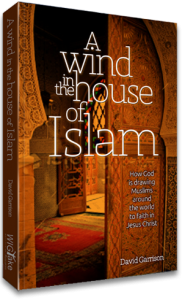
David Garrison: A Wind in the House of Islam

 David Garrison, A Wind in the House of Islam: How God is drawing Muslims around the World to faith in Jesus Christ (Monument, CO: WigTake Resources, 2014), 307 pages.
As the sub-title of Garrison’s book suggests, this book provides both an historical narrative and analysis of how the wind of the Holy Spirit is drawing Muslims from the nine rooms of the Dar al-Islam (House of Islam). The rooms refer to the nine different geographical sectors of the globe from West Africa to the Indonesian islands where Islam is dominant.
Garrison’s work is the result of his work as a missionary pioneer with the Southern Baptist International mission Board for thirty years. Over the years he traveled a quarter-million miles in the nine different areas of the Muslim world. Well-versed in twelve different languages, he was able to interview and converse with Christians having a Muslim-background before their conversion.
A Wind in the House of Islam became part of his responsibility as global strategist for evangelical advance on behalf of the Southern Baptist International Mission Board. The book, however, is of a much broader scope than that of Southern Baptist interests. He discusses the contributions of the Assemblies of God, the Brethren, Lutherans, and other Christian bodies as the Reformed Churches of the Netherlands within each of the nine geo-cultural rooms of the House of Islam.
Garrison distinguishes “2,157 distinct Muslim cultures and people groups” which are found in nine different “affinity clusters cohering around shared experiences of geography, language, and history (p.31).” Apart from the introductory and closing chapters, Garrison devotes a chapter to each of these affinity clusters. He identifies them as Indo-Malaysian, Eastern South Asian, Western South Asian, Persian/Iranian, Western South Asian, Turkestan, North African, Western African, Eastern African, and ends with the Arab “room.” He begins his narrative with the Indo-Malaysian “room” of the House of Islam and closes with the “Arab” which includes the Arabian Peninsula along with Egypt and the western coast of the Red Sea.
The author identifies eighty-two Muslim movements to Christ throughout history with two occurring in the nineteenth, eleven in the twentieth, and sixty-nine in the twenty-first centuries. Garrison distinguishes the Arab Christians from those who, under the mantle of Islam, swept across the Near East and northern Africa and toward the Pacific in the late seventh and eighth centuries. The time frame of Garrison’s work is, therefore, concentrated within that time frame and the consequent centuries leading into the 21st century.
Garrison writes of six different Muslim cultural groups: the Alawite, the Sunni, Shi’a, Sufi, Ibodite, and Ismaili. The major ones are the Sunni, Shi’a and Sufi, the last-named being a “mystical”—for lack of a better word—form of Islam. The ones making the most news are the Sunni, Shi’a, and Alawite, the last named being the smaller of the three and confined mostly to Syria. Assad, the “president” of Syria is Alawite.
With twelve chapters in the book, counting the introduction and the closing chapter which offers an excellent critical analysis of the factors leading toward conversion to Jesus and of barriers to conversion, the middle chapters devote themselves to the nine different “rooms” or geographic-cultural settings in which Muslim movements toward faith in Christ occurred. After giving an historical prologue which describes the reaction of the Christian church to the Islamic armies as they advanced both toward where the Mediterranean met the Atlantic, Garrison switched to Islam’s penetration within India and the countries bordering the Bay of Bengal and into the western Pacific shores.
While acknowledging the earlier attempts to reach Muslims with the gospel and the attempts of Ramon Lull and William of Fiore during the Medieval era, the author far more space to the years between the 17th and 21st centuries. These were the centuries when Christianity began to make headway within Muslim cultures.
His first full narrative dealt with the evangelistic work of Indonesian evangelist Sadrich Surapranata (1835-1924) which eventuated into the formation of the Kresten Jawa Churches. His adopted son Yothan Martarejan assumed the mantle of Surapranata upon the latter’s death and during his leadership led the Muslim-background Christians into a merger with the Dutch Indische Kerke congregations in 1932.
This reviewer found Garrison’s description of the Muslim movement toward faith in Christ Jesus in East Africa most interesting. This reviewer met Muslim-background Christians when in Malawi in 1985 and again in 1986.
Garrison wrote of the witness of Sheikh Hakin and mentioned the ministry of the indigenous Gospel of All Nations Church.
One outstanding feature of Garrison’s work was the translation of Muslim terminology. Isa al Masih translates as Jesus the Messiah; Injil is the Arabic New Testament. He does this throughout his book. When he describes the movement of Muslim-background believers to Christ in North Africa, Bangladesh, Iran, Turkestan, West Africa, Afghanistan, Pakistan, and the western states of India, he translates the regional dialects. What is interesting is that nearly all Muslims cannot read the Arabic of the Quran (Koran) which is the Islamic holy book. This ignorance proved an advantage for both indigenous and overseas Christian missionaries. When a person is able to read the Koran and also the Bible, the difference between the two is discerned. The reader opts for the Bible. Most Muslims rely on the words of their Islamic leaders as to what the Quran says or teaches and thus are ignorant of its actual contents. This is one of the factors contributing to the movement toward faith in the gospel of the Christ Jesus. When the Quran is brought into the dialect and colloquialisms of the muslims who are not Arabic speakers, they see the big difference between Mohammed and Jesus and move away of Islam and toward the Christian gospel.
Other factor mentioned by Garrison as contributing toward the conversion of Muslims to the gospel of Jesus the Christ is that most of the converts are cultural Muslim rather than actual believers in Islam. They live in countries in which are predominantly Muslim in character due to military conquest and the consequent islamization of the social order. In other words, the converts were civic Muslims. In many instances, as in East Africa and in the islands of the western Pacific, the believers came into the Muslim fold out of an animistic background. The ethnographic and linguistic differences had a lot to do with the growth of the gospel within the “house of Islam.”
Garrison also touches upon the parts played by the indigenous evangelists and also the western missionaries. For the most part, the indigenous leaders did not encourage the integration of Muslim-background believers into Catholic, Orthodox, or Protestant churches but instead encouraged the creation of indigenous communities of faith in Christ Jesus which operated either as “underground” Christian communities or took distinctive names of their own such as the Gospel for All Nations Church which is indigenous to East Africa. They also encouraged their indigenous languages. The Kitab al-Moqadis is the Bengali term for The Bible; the Injil is the Arabic New Testament. The Isai Moslem identifies one of the Christian communities in Bangladesh.
As this is a review of Garrison’s tremendously well-researched and well-written book, this writer is unwilling to re-tell everything Garrison has put into print. As hinted at, Garrison did relate the work of western missionaries out of Europe and America and of Armenian Christians who came into Persia (Iran) in the late 16th century and then again in the wake of the Turkish genocide in 1915. He considered William Carey’s translations of the Bible into the languages of northeast India, Burma (modern Myanmar), and Thailand to be of great importance in facilitating the spread of the gospel in those lands.
Garrison identified ten bridges of God which crossed the chasm between the predominantly Christian west and the Muslim world. They were identified as [1] bold obedience in the middle of insecurity, [2] prayer, [3] the translation of the scriptures (Indonesian languages, the Amharic of Ethiopia, the Kabyle of Algeria, the Farsi in Iran, and Musulmean, Bangladesh), [4] Holy Spirit activity, [5] faithful Christian witness, [6] learning within the believing Christian community, [7] conversational communication, and [8] discovery.
He also touched upon the role of [9] satellite televised broadcasts and [10] internet chat rooms both of which were used to great extent by Abouna Zakaria Botros (Father Zechariah Peter), a 79 year Egyptian Coptic Christian priest. In 2008 al Hayat (The Life) satellite program reached 60,000,000 Arabs and other Muslims a day.
In the words that caught the attention of St. Augustine and brought about his conversion, this reviewer encourages the reader: tolle lege (“pick up and read”).
Reviewed by Woodrow E. Walton
Companion site to the book: http://windinthehouse.org