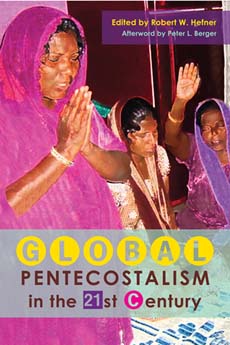
Global Pentecostalism in the 21st Century, reviewed by Dave Johnson

 Robert W. Hefner, ed., Global Pentecostalism in the 21st Century (Bloomington, IN: Indiana University Press, 2013), ISBN 9780253010810.
This book lives up to its claim to study global Pentecostalism, not because it covers it country by country, but because it is grounded in the places in the world where Pentecostalism has had a major impact on society. These places are Brazil, sub-Saharan Africa, China, Russia and the Ukraine, India and the Philippines. However, the case of the Philippines, the reflections relate mainly to the Catholic Charismatic Movement, the largest Pentecostal/charismatic group in the country.
The book is written from a sociological point of view and the focus is detailing Pentecostalism’s impact on things like economics, community life, and politics. Other issues, such as one’s relationship with God and dealing with the ever-present spirit world in the Majority World, are noted (p. 116) but not considered in depth.
The layout of the book is straightforward and not divided into sections. Following Hefner’s introductory chapter, “The Unexpected Modern—Gender, Piety and Politics in the Global Pentecostal Surge,” there are a total of eight lengthy chapters. (1) “Pentecostalism: An Alternative Form of Modernity and Modernization,” by David Martin. (2) “The Future of Pentecostalism in Brazil: The Limits to Growth,” by Paul Freston. (3) “Social Mobility and Politics in African Pentecostal Modernity,” by David Maxwell. (4) “Tensions and Trends in Pentecostal Gender and Family Relations,” by Bernice Martin. (5) “Gender, Modernity, and Pentecostal Christianity in China,” by Nanlai Cao. (6) “The Routinization of Soviet Pentecostalism and the Liberation of Charisma in Russia and Ukraine,” by Christopher Marsh and Artyom Tonoyan. (7) “Pentecost amid Pujas: Charismatic Christianity and Dalit Women in Twenty-First Century India,” by Rebecca Samuel Shah and Timothy Samuel Shah. (8) “Politics, Education and Civic Participation: Catholic Charismatic Modernities in the Philippines,” by Katharine L. Wiegele. Peter Berger’s afterward then sums up the book excellently by tying the articles together.
As Hefner and others note (p. 9) Pentecostalism focuses much more on personal rebirth or transformation than social structural change. All authors report, however, that the personal transformation also brings positive to change to families and communities. Men no longer visit the bars and brothels and pour their resources into their families instead, providing social lift. Women, who are often oppressed in male dominated societies, find their voices in the Pentecostal Movement. Martin, for example, mentions that women are often used in prophecy (p. 38). Transformed individuals then, do positively impact broader society.
A lot of attention is given throughout the book to the impact of the prosperity gospel in the Majority World. Much of the impact has been positive, although the prosperity gospel in these regions is much less focused on money than its American counterpart and appears to be more along the line of Yonggi Cho’s three-fold blessing prosperity gospel based on 3 John 2.
Some sociologists had been predicting Pentecostalism’s demise.
Gender relations also occupy quite a bit of space. Bernice Martin notes that in the Latin American context:
Although moral restrictions fall heavily on women, those laid on their menfolk—giving up alcohol, tobacco, drugs, promiscuity, violence—compensate by drawing men out of the culture of ‘machismo’ of the street and bar and returning them to the home. Money not wasted on male vices puts food on the table and sends the children to school. Men find a new dignity as head of the household and responsible providers, while marriage, though formally based on the superiority of the man and the submission of the woman, in practice becomes more compassionate (p.126).
All of the authors demonstrate sensitivity to the context in which they are writing and do well in describing Pentecostalism within their African, Asian and Latin American contexts. My personal favorite was Katharine Wiegele’s article on the Catholic Charismatic movement in the Philippines (223-46) because my wife and I live and work as missionaries in the country. Wiegele demonstrates a deep knowledge of the culture and the movement she describes. It is probably fair to assume that the other authors do the same.
—Robert W. Hefner in his introduction
While the authors do touch on spiritual issues such as having a relationship with God, the Baptism in the Holy Spirit, the charismata, spirit world issues and so forth (i.e. p. 116), they do not delve into them in any great degree, nor do they seek to find answers to Pentecostalism’s dynamism there to any great degree. Consequently, they fail to notice some of the major reasons for the movement’s explosive growth.
Nevertheless, for those looking to study Pentecostalism’s social impact, this book is a fine contribution to the field and I heartily recommend it.
Reviewed by Dave Johnson
Publisher’s page: http://www.iupress.indiana.edu/product_info.php?products_id=807065
Preview: https://books.google.com/books/about/Global_Pentecostalism_in_the_21st_Centur.html?id=4bHHAAAAQBAJ