

Jim Goll: Deliverance from Darkness

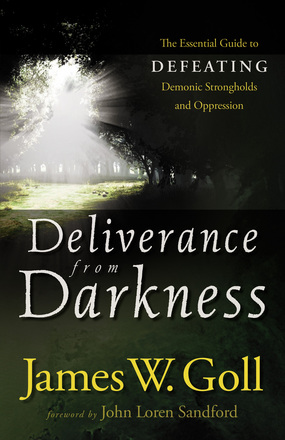 James W. Goll, Deliverance from Darkness: The Essential Guide to Defeating Demonic Strongholds and Oppression (Grand Rapids, MI: Chosen Books, 2010), 224 pages, ISBN 9780800794811.
In this book, James W. Goll examines the demonic through the lens of spiritual warfare. He argues that every Christian has the responsibility to engage in battle against the forces of evil. In so doing, they follow in the footprints of Jesus. The author writes, “The question is not only how did Jesus do it when He walked the earth, but also how does He want to continue doing it through people like you and me today?” (15). Later he adds, “You were born to war….For your own protection and for the sake of the Gospel, you need to learn all you can about how to war and wrestle with evil forces” (38). Goll understands that spiritual warfare is not an option but a necessity.
The book is divided into four parts. The first examines Jesus’s dealings with demons, the early Church’s view of the demonic, and how they are portrayed throughout the bible An interpretation of these passages leads the author to maintain a fairly traditional – or conservative – view of such beings. Demons have wills and emotions, and they also fall into different classifications according to their tasks and abilities. Goll explains that demons are always looking for ways to attack humans in a multitude of different manners. For example, they can assail one’s mind, but demons can only possess an individual if they are invited in. Yet demons must obey Jesus’ authority, and just as the Apostolic Church also exercised this authority, contemporary Christians can do the same.
In the second part of Deliverance from Darkness Goll delves deeper into the steps that one should take to defeat the demonic. Specifically, he addresses how demons tempt humans and how one can resist these attacks. Here he emphasizes a warfare model to remind his readers that they are in the midst of a serious struggle. He suggests that praise and prayer are ways to guard one’s self, and practical steps, such as getting enough sleep, are also effective. Goll examines scripture to provide a short history of Satan’s fall from heaven and the authority that Christians have over him through Jesus. He maintains that Satan lost his standing when he rebelled against God, so Christians have authority over evil beings and should employ it boldly.

The third part builds upon Goll’s idea of authority. He asserts that Christians must work to remove darkness from all realms of life, including government, education, media, religion, family, and business. They must also expand God’s kingdom in to every area of their lives – one’s mind, body, emotions, and finances – to name a few. But he cautions that we must be careful to discern the demonic from that which is not evil. The first step of deliverance is repentance. He provides signs of demonic oppression and provides guidelines for practical steps to follow when ministering deliverance, such as putting together a deliverance team and to prepare with fasting. This section also provides an example of a deliverance prayer and how to follow-up with the formerly-possessed individual after a deliverance is performed.
In the fourth part, Goll discusses how to break curses and how to instill blessings in one’s life. For him, curses can be generational, they can come from other humans, or they can emerge from disobedience. However he maintains that curses are broken through “prayers for release.” Goll argues that blessings, which include prosperity, good health, and God’s favor, can be obtained from God, although one may have to wrestle with God for its bestowal. Blessings can be claimed through biblical promises, family genealogy, ethnic groups, churches, or geographic area. In conclusion, according to Goll, the key is confession and repentance of sin. He adds that retention of deliverance is secured by praying, fasting, reading the bible, following Jesus, and living in the power of the Holy Spirit.
This book will certainly evoke some controversy depending upon one’s theological leanings. Those who believe in demons as autonomous beings are likely to agree with Goll on many points. But those who hold a progressive or more liberal view are likely to find his personification of demons to be problematic and unpersuasive. Regardless of one’s theological position concerning the ontologization of the demonic, Goll does present some practical and much needed advice. For example, in the section on deliverance ministry he cautions the reader that mental illness can be mistaken for possession, so one should partner with medical professionals to avoid a misdiagnosis. This is a necessary step when we consider notable cases where instances of abuse and neglect arose, some of which have led to death. Despite the value of these points, it is probable that many readers across the theological spectrum will find some of Goll’s remarks to be dubitable. For instance, he writes, “Believe it or not, deliverance can be easy!” (183). He also claims that those who have overcome evil will mostly not be bothered by the demonic. On several occasions he states that demons have a legal right to operate in certain realms. These remarks, in addition to his theology of blessings, appeal to the prosperity gospel and overlook important theological issues, such as theodicy. The third point even contradicts his assertion that demons lack authority. In conclusion this book has a popular audience in mind, but it may face some criticism from an academic audience. Nevertheless, I suspect that one’s opinion of Goll’s work will be influenced largely by the theological commitments that are brought to the text.
Reviewed by David Bradnick
Preview Deliverance from Darkness: https://books.google.com/books/about/Deliverance_from_Darkness.html?id=fJxzBQAAQBAJ
Publisher’s page: http://www.bakerpublishinggroup.com/books/deliverance-from-darkness/319632











I have not read this book, but I’m sure he has made a good contribution in writing about the demonic. This is a subject that academics have all but ignored or rejected. Though not a common conversation in Western circles, in Hispanic or African circles it is very common. Jesus dealt with demons and they’re clearly not gone yet. So what should one do? Good things will come about as we make fresh and needed discoveries in this controversial topic.
This looks like it’s an interesting book! 🙂