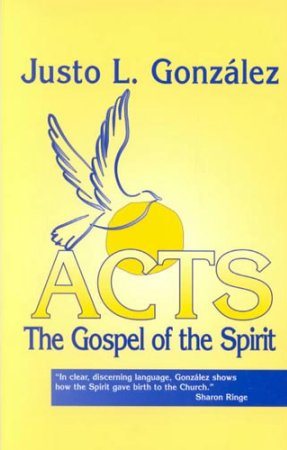
Justo Gonzalez: Acts: The Gospel of the Spirit

 Justo L. González, Acts: The Gospel of the Spirit (Maryknoll, N.Y.: Orbis Books, 2001), 291 pages, ISBN 9781570753985.
Acts: The Gospel of the Spirit is a translation and update of González’s Hechos in the Comentario Biblico Hispanoamericano (Miami, Fla.: Editorial Caribe, 1992). González‘s discussion for each section in Acts is divided into two parts distinguished by two different typefaces. First, González makes academic comments, the text in our context (xiii). Next, he addresses issues confronting the Church both north and south, Hispanic and Anglo. Often González addresses topics at the heart of classical Pentecostalism and even of the faith movement. Although he often speaks from a Protestant-Hispanic perspective, his hard-hitting observations address both the Roman Catholic Church and Protestant English speaking churches.
The academic sections are helpful to all expressions of the academy and ecclesial communities. González addresses traditional questions raised by scholars and maintains openness to the claims of the text. For example, after a discussion of the we passages, he concludes that the most simple and probable notion is to accept that the we refers, as the text would like us to think, to one of Paul’s companions, who is also the author of the book (4). He also discusses the chronology and theology of Paul as presented in the Acts and the epistles and concludes that, though they are different, they are not irreconcilable. Throughout the commentary he interacts with both English- and Spanish-speaking academicians on significant issues. This provides a wider exposure to scholars working in spheres that are often unavailable to many readers.
Although he does not address in detail questions of Luke’s pneumatology normally raised by Pentecostals and Charismatics, González does address the issue of speaking in tongues and Spirit-inspired witness. He also acknowledges the miraculous activity of the spirit. He concentrates on the social issues that the Gospel addresses such as wealth and poverty, power and allegiance to the Church and state, and polity. His is a healthy restatement of the goals of the gospel of the Holy Spirit. Pentecostals and Charismatics are well advised to pay González rapt attention lest we neglect the weightier matters of the spirit.
The application sections identify the major practical issues which confronted the ancient community and challenge the present Church. Notably González accepts much of the first-century worldview. For example he cites Bultmann’s insistence that it is impossible to use modern scientific wonders and medicine and at the same time believe in the New Testament world of spirits and miracles. González objects that much of the Spanish-speaking community of faith does not agree; the truth is, however, that what Bultmann declares to be impossible is not just possible, but even frequent (84).
Many of González‘s applications are quite prophetic and insightful. For example, in the section, Beware of Gamaliel! he warns that the Church often opts for fatalism and inaction by hiding behind the words, If it is a matter of God, we cannot really oppose it, and if it is a human matter, it will fail With that excuse, we allow injustice to continue rampant in our society (85). Other thought-provoking subheadings are, When the enemy Calls Us to Obedience, Between Simon Magus and Simon Peter, When Evil Produces Good, and Good Produces Evil, A Subversive Message, and Beware of Cheap theology! (which is rather expensive). González grapples with issues which confront the Church of all cultures and languages. He warns that Bible interpreters must not be carried by their own ideologies The text says what it says, whether we like it or not. The function of the interpreter is not to take the sting out of the text (76-77). González says Acts is about a strange kingdom which operates differently from all the present kingdoms. Its smallness and insignificance, like the mustard seed and the leaven, turns the world upside down in a reversal of values.
The story here is about the acts of a Spirit who makes it possible for believers to live, even amidst the kingdoms of this world, as the citizens of that other kingdom (21).
For the Hispanic Church, Acts steers her between the Scylla of mere political revolution and the Charybdis of compromise with worldly authority. González‘s commentary provides a warning to the affluent Anglo faith community that indifference to their brethren in Christ to the south and in their midst may well assure that they in the north share the fate of the rich man who gave Lazarus no aid or comfort (Lk. 16:19-31). The problem of materialism is solved by helping those who have not (Lk. 3:1-14). González‘s work is not a mere Hispanic curiosity. This commentary can be ignored by the north only at its own peril.
Given that my native culture is not Hispanic, I have asked Orlando Terrero to review the work as well. His comments follow.
The book of Acts is about the Holy Spirit leading his people in the world as a Church of love, mission, and unity; heavenly minded, but active against the forces of injustice, evil, and the challenges of a world system that opposes the Gospel. Surely the values given by the Holy Spirit to God’s people in Acts transcend race, color, or geography. Yet at the same time, the experiences of the early community of faith speak especially to Hispanics who today seek insight into the Holy Spirit’s standards of true success at home and abroad.
The Pentecostal experience and the work of the Spirit in Acts take place in a world in many ways similar to Latino countries where the masses suffer oppression and injustice from the powerful, who often hide under religious umbrellas, but always oppose anything that challenges their established structures. It is a world that exploits the unlearned, takes their lands, mistreats women and children, and diminishes reverence for human life where it is needed most. Rampant hunger, malnutrition, and sickness dominates the lives of many, while the rulers of the land are too sick themselves to carry out honest handling of the wealth entrusted to them for the common good. Amidst such reality, the Holy Spirit comes to fill the masses with the hope of the Gospel, creating a worshipping community that is united by love, and thus accomplishing his mission through people considered nothing according to society’s standards. He transforms them into anonymous apostles who are filled with praise and gladness, rather than methodology and schooling. These establish churches and turn the world upside down.
The rapid growth of Hispanic Pentecostal Churches is not primarily due to Western missionary work, but to the work of these unknown witnesses who without technology and media have gone from place to place to work with the poor, and to become transformers of history. Their power comes from the divine Spirit rather than from intellectual scales of social values. Their message, like the message of the early Church, challenges established structures and systems amidst many sufferings and persecutions. While some may think that González‘s use of the word subverting is too strong, it is undeniably biblical to say We will obey God rather than men when describing the Christian response to systems that oppose the gospel.
In the excitement of their mission as a Church, many Latin American Christians have missed Acts. The title Acts: The Gospel of the Spirit speaks especially to the present Hispanic Christian community. In the beginning, the message of the kingdom of God to the masses of Hispanic people, already disappointed by their economic and political situations, offered hope and prosperity only in heaven. Since then, millions of people have embraced a Pentecostal experience that separates them from the world on earth, so that eschatology and issues of the end have taken precedence. But the Spirit of Acts does not lead God’s people to a spirituality which ignores what is physical and material. Such religion only increases the evil in what González calls a hemisphere burdened by poverty. Hispanic Christians who hope for heaven as the only place of prosperity, create a life with nothing to give to those who live in poverty and injustice.
I will add that the reason why democracy is a failure in Latin American countries like Venezuela, Cuba, and the Dominican Republic, is because Christians do not get involved in the political affairs of these nations, not even in prayer. González calls Latino Christians to live in the world realizing that material resources are also signs of the presence of the kingdom of God on earth, rather than unimportant and detached from the gospel. Here, González corrects a deadly theological error. The book of Acts proves that the kingdom of God is effective in shaping the world, and that Christians do effect the social, political, economic, and religious systems in which they live. The Holy Spirit is in control of history, active against injustice in leading his people to help the poor and the widows as Stephen did when he served the tables. The message of the Spirit is as much a call to deal with the powerful, the poor, and the dispossessed, as it is to wait for the second coming of Christ. The Church must address injustice. It should not hesitate to do like Paul, who actively participated in the political process to advance the cause of Christ in asserting his rights as a Roman citizen.
The Spirit in Acts also leads his people at the local Church level. Hispanic-Pentecostals can no longer blame past conflicts and errors on the Catholic Church since Pentecostals have polarized their own structures and caused their own blunders. In the book of Acts, the Holy Spirit does not limit the role of women, misuse the gifts to manipulate authority, oppress other Christians, limit the baptism to those speaking in tongues, gossip and spread rumors, prevent the preaching of the gospel because of cultural barriers, cause doctrinal divisions, forbid theological training, etc. Rather, the Holy Spirit leads the Church to take the gospel to the kingdom into new heights regardless of language and cultural barriers. There is no partiality with the Spirit, and he does not try to raise one culture over another. The Spirit leads a pluralistic Church that seeks for new understanding of evangelism, and finds new ways to bring the message of the kingdom to others. The Hispanic Church is called to preach grace even if it means praying for the conversion of those who persecute them. They must see missions as the pivotal role of the Church, understanding that faith may deliver from evil, but it can also result in martyrdom, as the examples of Peter and James. The Spirit in Acts prepares the Hispanic Church to prepare disciples, produce new leaders, find grounds of cooperation, and fulfill its mission amidst peaceful or difficult times. Hispanic leaders must be flexible to new methods for the sake of missions, move forward when dialogue is not possible, and preach the gospel no matter the outcome.
The economic life of the Church must reflect the values of the gospel for the Church’s vision is different. Good theology, doctrine, and vision, must exist. We must join the larger community of faith, realize its world mission, and eliminate the thought that Church is a matter of mere taste. We must be strong against divisions, and find agreements in love and unity.
González brings out four points that cannot function individually. First, the Hispanic Church must give attention to education. Church history gives us examples of those who devoted their lives to the word of God, and of those who eagerly studied the traditions of the Church fathers. Study and learning for us, is the equivalent to the early Church’s perseverance in the Apostles teachings. Secondly, we must also realize that there are economic resources placed by God before us for the benefit of the gospel. Why should we expect reaching the streets of gold in heaven, when we reject the use of the gold given to us by God here on earth? Thirdly, we must engage in evangelism and embrace and develop good doctrine at the same time. It is not enough to say how many people received the Lord in one night, for the real mission is to take those people and join them to the multitudes of Revelation. Fourthly, we must realize that the Gospel of the kingdom advances amidst the opposition of spiritual forces of darkness. The Hispanic Church will not become an Antioch, ready to respond to the challenges of evangelization, if the vision and action of its leaders and congregation are void of intense prayer and spiritual power against the demonic forces working in the world.
González has produced a quality of scholarship of which the Hispanic Church should be proud. It can lead us to the understanding of the work of the Spirit and his will for us as citizens of the kingdom of God here on earth. González‘s work can strengthen and amplify our vision of ourselves. He also has provided a helpful tool for those Latinos, who have little theological education.
González‘s Gospel of the Spirit addresses the Hispanic community. Since the book of Acts is about the Spirit, then the Hispanic community must reinterpret the Pentecostal experience and begin to take responsibility and action as a community with a mission here on earth. The title appeals to a community who loves the Spirit and is willing to be led by him. Yet, it is also a community sometimes with an improper theology of the Spirit. The purpose of the Spirit in Acts was to guide Christians in their behavior and faith during the difficult early times in which the Church was in conflict with Rome, its culture, and civilization. Jesus continues his work through the Holy Spirit today, making it possible for Christians to live in the world as citizens of the kingdom of God.
The authors comparison and contrast of Romes slavery versus oppressed Latinos is also insightful. Those of us who grew up in the poverty and oppression of our countries are less fortunate than some slaves during the Roman age. History records Roman slavery as a major economic force for the empire. Many slaves became so highly educated and skilled that they were greatly valued. The poor and oppressed in Latin America are deprived of economy, education, and training. There is no value attached to their lives by the rich and powerful, and therefore they are an economic burden, rather than an economic power. Now González asserts that Hispanics in the United States are marginalized for economic reasons. Perhaps that broad-brush description needs to be qualified. There are resources and the means to achieve success in the USA. Hispanics who do not prosper in America may have an old way of thinking; for many of them continue to live in the United States as they lived back home. Here in America, though, the problem is not oppression, but education, a goal that is quite attainable, although understandably, there are problems with the INS and other issues.
Rather than an early Church innovation, the election of the seven has an Old Testament background. Helping the poor and the widow was always the responsibility of God’s people, a provision made by the Law of Moses. When one finishes reading Acts one sees what González is referring to the ways in which the Spirit constantly changes established patterns as he leads the Church in its mission to the world, one example being the establishment of the Church in Antioch as the center of mission to the Gentiles instead of Jerusalem.
The Christian community in America, both Anglo and Hispanic, has therefore been given a very important book. For the Anglos, this volume serves not only as a commentary, but also describes a group of people making their way all over the United States. Christian Americans often visit our Hispanic restaurants, and adopt Hispanic cuisine as their own. They participate in Hispanic culture. González is giving the Anglos valuable historical and spiritual background that may help Americans to find venues of bringing Hispanics, not to the American way, but to the Church of Jesus Christ in the United States. The Hispanic community here in the United States is a mission field ready for harvest. There is a danger that we forget our catholic background, and raise children without the Bible basics our ancestors gave us. This mission would spare America from having to deal with a Hispanic society with ever-growing numbers of school dropouts, gang members, drug addicts, alcoholics, and victims of domestic violence. González calls the American Church not to impose dominance of language and culture over us, but to become interested in our language, culture, and identity. We are a mission field in the American backyard, a good opportunity to learn how to reach others for Christ.
For Hispanics, we need to understand that we are no longer just a group of immigrants; the molding has already begun. Hispanics have a voice in the national economy. As such, they also have a responsibility as a Church of Christ to shape society’s political and religious values. Indifference to this fact is a blunder, for we always bring our gods with us. Like the Anglos, our gospel message needs cleansing and refocusing. North Americans can help us. While keeping our cultural identity, you can help us to build churches and become educated. Then we will become the missionaries of our own countries and see our nations becoming nations of peace and democracy.
Reviewed by James B. Shelton with Orlando Terrero
Publisher’s page: http://www.orbisbooks.com/acts-the-gospel-of-the-spirit.html
Preview Acts: https://books.google.com/books?id=44WDAwAAQBAJ
A shorter version of this review appeared in PNEUMA: The Journal of the Society for Pentecostal Studies 25:1 (Spring 2003), pages 150–152. This longer review essay was originally published as a guest review on the Pneuma Foundation (PneumaReview.com’s parent organization) In Depth Resources index in 2004.
At the time this essay was written, Orlando Terrero was an M.Div. student at Oral Roberts University.