
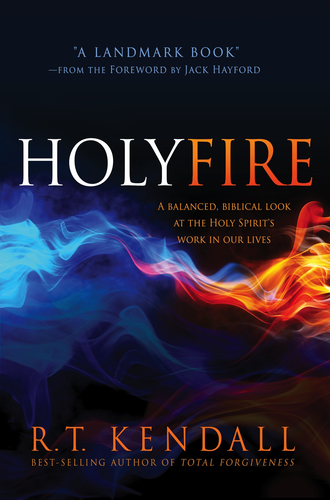
R. T. Kendall: Holy Fire, reviewed by Craig S. Keener

 R. T. Kendall, Holy Fire: A Balanced, Biblical Look at the Holy Spirit’s Work in Our Lives (Lake Mary: Charisma House, 2014), 256 pages, ISBN 9781621366041.
In his nine-page foreword, Jack Hayford rightly titles this “a landmark book.” He also rightly highlights Kendall’s work as irenic (pp. xxi-xxii), offering a notable contrast to some works today. I did not intend my review to prove as long as Pastor Hayford’s foreword, but if readers find my review too long I should mention that its most salient features appear toward the beginning.
Word and Spirit
Inevitably, any book about the Holy Spirit, with “Fire” in its title and coming out at this time, will be compared with Pastor John MacArthur’s Strange Fire. Comparison is difficult to avoid even though Kendall himself does not mention MacArthur and was interested in writing such a book three decades ago (xxxii).
Whereas Pastor MacArthur’s Strange Fire offers a polemical Reformed cessationist approach, Pastor Kendall’s work offers instead an irenic Reformed charismatic approach. Lest one misunderstand me, I strongly appreciate MacArthur’s calling the church back to the Scriptures; as a biblical scholar, I have devoted my life to the same calling. I believe, however, that MacArthur’s theological presuppositions regarding the Spirit’s activity have obscured for him some key portions of the Bible. Here Kendall offers a better way.
The matter is so important for Kendall that he envisions it in terms of a new movement of the Spirit to come. God has used and will continue to use the Pentecostal and charismatic movements, he says, but we need something beyond the helpful emphasis on the Spirit they have already contributed. Rather, we need the bringing together of Word and Spirit (171-72), the bringing together of the gifts of Pentecostals/charismatics with those of conservative evangelicals (174-75). The Spirit often reminds us of what Jesus has already taught (John 14:26; p. 28), and all prophecy must be tested by Scripture (17). In contrast to the counterproductivity of polarizing polemic, Kendall desires for the entire church the best in both evangelical exegesis and charismatic experience.
Kendall concludes the prologue and, more fully, the book as a whole with a prophecy of the early British Pentecostal figure Smith Wigglesworth: “When the Word and the Spirit come together, there will be the biggest movement of the Holy Spirit that … the world has ever seen” (xxxi, 176). Certainly this anticipation appeals to me as a charismatic Bible scholar; indeed, I recently cited this message attributed to Wigglesworth in my contributions to volumes in honor of Benny Aker (But These Are Written) and Ron Sider (Following Jesus).
I can think of no better way to frame the overall message of the book than this message with which he frames it. Regardless of any differences on details, I would recommend this book highly because of this most needed emphasis.
A Reformed Charismatic
Kendall has been charismatic for a long time; he recounts being baptized in the Spirit in 1955 (136) and first praying in tongues a few months later. His initial unexpected experience of the Spirit, accompanied by a vision, deeply transformed his life and ministry (97). He experienced subsequent visions (100-2) and prayer in tongues (100, 104). He further recounts the impact that his wife’s healing had on the entire church (126-27).
Kendall began to become Reformed at about the same time. It was Kendall’s unsolicited, unearned experience of grace that began his journey to Calvinism (99, 104). God’s unearned grace is a biblically-based emphasis in Calvinism that all of us, whether Calvinist, Arminian or label-less, should be ready to affirm. Although most Wesleyans I know today appreciate charismatics and spiritual gifts, the Wesleyan circles in which Kendall moved at the time rejected tongues even more than they rejected Calvinism (100). Meanwhile, many Reformed people at the time also questioned visions and prayer in tongues; Kendall had to exercise the courage initially to develop many of his convictions without being able to depend on any single community of believers.
Kendall’s love for Reformed theology runs deep, including in his Oxford dissertation involving the early history of Reformed theology. Here I offer another aside: those who are not Reformed can nevertheless appreciate this movement’s biblical zeal for God’s glory and sovereignty and for careful study of Scripture. Most Reformed thinkers today are not like the “Old Light” fatalistic Calvinists (who simply waited fatalistically for God to save them or use them if he cared to do so), against whom both Jonathan Edwards and nineteenth century revivalists reacted. Indeed, many today are continuationists.
John MacArthur has complained that Reformed continuationists (of whom there are now many) are inconsistent, but Kendall forcefully challenges that perspective in this book. (By MacArthur’s standard, Reformed continuationists might also ask whether MacArthur is consistent enough to be a Reformed dispensationalist, though he is also not alone in that approach.)
Kendall’s Critique of Cessationism
Kendall was asked to “Write a book that will make people hungry for the Holy Spirit” (xxxii), a task that he accomplishes admirably. Kendall is obviously a preacher, and living application is never far from his exegesis (see e.g., his comments about suffering on 22; about fear on 155; and pastoral concern for those who wrongly fear that they have blasphemed the Spirit, 27). I appreciate that he is thoughtful enough to include even some qualifying caveats that take into account even proportionately small groups of likely readers (such as those of us who seek to be Spirit-led scholars, 20).
Nevertheless, his pastorally edifying objective does not prevent him from addressing theological issues, including errors that he sees in both charismatic and Reformed ranks.
Kendall seeks to be irenic even while undertaking an extended critique of cessationism (107-27). “One should never underestimate our cessationist friends’ love for God, Scripture, sound teaching, and holy living,” he rightly notes (111). Kendall is certainly correct here; whether from cessationists or continuationists, our pride in our doctrine or particular gifts can separate us from other believers for whom Christ died. Most contributions of Warfield and Machen are positive, he argues, but many have followed their theory of cessationism uncritically (118, 122-23). By analogy, he warns that before William Carey many people were cessationist about the Great Commission (118). Further, miracles are reported in earlier Reformed circles (123).
Kendall suggests that most cessationists do not question charismatics’ integrity in testifying of miracles, but rather their critical faculties, because cessationist critiques focus on “flamboyant healing evangelists” and failures in healing (112). Unfortunately, this focus makes it difficult for them to recognize the genuine miracles that do occur elsewhere. Many Pharisees’ negative response to Jesus’s miracles shows that God does not do miracles that cannot be questioned or doubted by those who wish to challenge them. Likewise, nonwitnesses had to take or leave Peter’s testimony at Pentecost that Jesus had ascended (115). Thus believers who have witnessed miracles often must endure others’ skepticism as a test that stretches our own faith (116; cf. 113).
Some argue for cessationism because of the decline of reported orthodox miracles in some eras of history. Kendall counters that if scholarship became rare in some eras, the same argument would suggest that scholarship was meant to cease for the rest of this age (122).
Despite his irenic tone, Kendall regards cessationism as quenching God’s Spirit (1 Thess 5:19; pp. 20, 117-18), even “before He is given an opportunity to show His power” (20). It robs people of some of the experience of grace they could have in this life (55). It kills expectancy (118). It negates the direct relevance of “a great portion of the Bible for today” (120). And far from glorifying God, this doctrine invites many believers to acknowledge continuing demonic activity yet doubt that God’s servants retain authority to cast out demons (122-23).
Kendall suggests that tongues is the gift that most offends noncharismatics, even many continuationists, because it carries a stigma that “challenges our pride” (31). (Sociologically, one might also note that the offense is not surprising; tongues has served historically as a boundary marker demarcating some movements from others.) Yet tongues has proved powerful, for example, in bringing deliverance to large numbers of drug addicts in Hong Kong (141-42, 145). Although excessive zeal about tongues has split churches, he argues, excessive zeal about Calvinism has done the same (140).
Setting the Record Straight about Martin Lloyd-Jones
As pastoral successor and close friend of Martin Lloyd-Jones, Kendall can testify (pace some recent well-meaning claims to the contrary) that Lloyd-Jones was not a cessationist by any means (see e.g., 123). Lloyd-Jones in fact affirmed a subsequent baptism in the Spirit, which he associated with the sealing of the Spirit (35, 43), though it did not need to be associated with tongues (43). He insisted that “The Bible was not given to replace the miraculous but to correct abuses” (119).
Lloyd-Jones believed that “the Holy Spirit spoke directly to him” and he heeded what he believed the Spirit said (120). His “regular publisher would not publish his books on the Holy Spirit” precisely because he affirmed “the immediate and direct witness of the Holy Spirit” and emphasized that the gifts “are available today” (43). I will note later a possible weakness in Lloyd-Jones’s supporting exegesis, but it seems clear that he embraced relational dependence on the Spirit.
More generally, Kendall notes that the charismatic side of evangelical faith is much more “mainstream” in the United Kingdom than in U.S. evangelicalism. Indeed, although it might not impress some U.S. cessationists, two recent Archbishops of Canterbury have been “regarded as charismatic” (127).
Kendall’s Critique of Charismatic Excess
Kendall laments the lack of true understanding about salvation found worldwide among many charismatics, as well as among many noncharismatic evangelicals (10). He complains that many evangelicals have been turned off to the Spirit by charismatics who treat them as spiritually second-class “if they do not speak in tongues” (10). Challenging many charismatics’ apparent overemphasis on tongues, he argues that 1 Corinthians clearly shows that not all speak in tongues (144).
In particular, Kendall’s chapter “Strange Fire” (ch. 5, pp. 56-78) offers valuable correction for extremes in the charismatic movement. Here he includes the sort of observations that most of us biblically literate charismatics will agree that John MacArthur got right, yet without MacArthur’s unhelpful cessationist polemic. Kendall rightly rejects the idea of tarring all Pentecostals and charismatics “with one big brush” (71).
He focuses at particular length on prosperity teaching, narrowly defined, and for good reason. Perhaps more than any other, this popular teaching has harmed the charismatic movement and done more to hinder a fair hearing for the original charismatic focus on spiritual gifts. “Arguably the worst development in our generation,” he laments, “is the way the prosperity message has taken over” (64). He complains of preachers soliciting spiritual dependence on themselves (and consequent financing of their ministries) rather than genuinely developing hearers’ faith (64).
Kendall compares moneychangers in the temple (65) and warns against those who make the cross especially about earthly blessings (66, 93). He further contrasts celebrity evangelists with the humble NT apostles (114). He clarifies that his critique is not against sound principles of God’s provision but against an unbiblical focus on prosperity (93). His analogy with the lottery offers at least a partial helpful explanation for why the poor are often attracted to prosperity teachers (93).
Kendall does admit he has sometimes criticized prematurely. He initially strongly criticized what others called the Toronto Blessing. When he saw the evidence of God’s deep work in people’s lives, however, he had to publicly acknowledge that he was wrong. He felt as if he had acted just like those who had criticized earlier revivals such as the Great Awakening or the Welsh Revival (160-62).
Certainly Kendall does not paint all charismatics with the same brush. He notes that most “Pentecostals and charismatics … are godly and sound” and would prefer solid Bible teaching if it were more widely available (66). He contends that sexual immorality is just as much a problem for noncharismatic conservative evangelicals as it is among charismatic figures (91, 167). He laments the state of “all sorts of churches” in the United States, complaining that most church leaders barely pray privately (78). In this case, too, the divide may be not between charismatics and cessationists but between those genuinely depending on God and those depending on human resources.
Kendall’s Theology of the Spirit
I will not focus here on matters treated above; I will also not elaborate points in Kendall’s theology of the Spirit where all believers or all charismatics agree. Instead I will try to address some distinctive features and contributions of his pneumatology.
Exegetically, Kendall sees an experience of the Spirit subsequent to conversion in both Acts 8 and 19 (135). (Scholars lack unanimity; more scholars, including myself, see it in Acts 8, but exegetes are divided regarding ch. 19.) Yet he also recognizes from Acts 4:8, 31 that believers can be filled multiple times (31-32, 130), as also Martin Lloyd-Jones affirmed (131). D. A. Carson (in his excellent work, Showing the Spirit) and some other exegetes have rightly offered this same point.
Kendall distinguishes between salvation, which may be genuine even without assurance, and the seal of the Spirit, by which God provides irreversible assurance of perseverance (50-51, 55). No one will complain about experiencing assurance, but I must revisit the sealing question in greater detail in the section below on exegetical questions.
Although he affirms the value of prophetic ministry (125), he regards as “presumptuous” prophecies that say, “Thus saith the Lord” or “The Lord told me” (150). Yet Kendall also cites Lloyd-Jones as reporting that “the Holy Spirit spoke directly to him” (120), and reports that in a vision Kendall himself heard the Lord speaking (97). His point may be that while God does speak today, we should acknowledge that our ability to hear him is not, in contrast to the message of the Bible, inerrant.
Kendall’s theology of the Spirit is most of all practical, inviting people to thirst more deeply for the Spirit’s work in their lives. People need to humble themselves, he urges, recognizing their need for the Spirit (23). Some critics, such as MacArthur, might respond that believers need to stand in the reality that we have already received the Spirit. I believe that both approaches convey important, legitimate insights and genuine biblical images; likewise, either can be abused. Whether by “seeking” or “standing,” what is most important is that we recognize our dependence on and continuing relationship with the Spirit whom Jesus has already sent to us.
Kendall on Subjective Experience
Critics will sometimes deem Kendall too subjective, though Kendall is well aware of the dangers of subjectivity (contending from historical sources that many Puritans died without assurance of salvation, 36-38). For instance, in the context of discussing the anointing (1 John 2:27; p. 18), Kendall warns against accepting teaching unless the Spirit attests it to one’s heart (19). Although the Spirit remains with us, he says elsewhere, grieving the Spirit diminishes or causes us to “lose the anointing” (81, 84).
Still, Kendall may be simply emphasizing a subjective experience of what is already objectively true, as in the experience of sealing noted above. When Kendall speaks of “the sense of God that appears to lift from us,” he rightly recognizes that the Spirit does not actually leave us (81). Is this sense primarily a biochemically generated emotional feeling, or should it originate with faith? He might be understood as associating the sense of God with being “calm, happy, at peace” (83).
Yet Kendall might only be thinking of a common byproduct of the Spirit’s activity (such as joy and perhaps peace in Gal 5:22; see p. 90) rather than using feeling as a spiritual thermometer. What matters more than what we feel, he suggests, is that we share the Spirit’s feelings (14); all of us sometimes have fears and we should not follow feelings such as these (155). He may mean consciously walking in light of the knowledge of God’s presence and favor.
Perhaps his illustrations of what he means by the principle provide greater clarity. Kendall associates the departure of the sense of God’s presence directly with wrong attitudes such as anger and impatience (83-85, 90). Particular examples include experiences such as being unable to minister freely until he made peace with his wife after an argument (84-85). His point is biblical and matches the experience of many of us today; disunity in marriage distracts us in prayer (1 Pet 3:7, 12), and unforgiveness, anger and disunity in the body of Christ open doors for the enemy (2 Cor 2:10-11; Eph 4:25-27; 6:14).
We may thus debate semantics, but Kendall’s point is well taken. God’s Spirit is always with his Word and his gift of teaching, and the times of his special blessing and outpouring do not depend on our perfection. Yet we often speak with greater confidence when we are also confident that we are following his will in every way we know. Sorrow and anxiety for the right kinds of reasons need not signal God’s displeasure (Rom 9:2; 2 Cor 7:5-6; 11:28-29; 1 Thess 3:5), but God provides greater than expected joy even in the midst of hardships (Acts 16:25; Phil 1:18) and encourages us to embrace it (4:4-8).
Exegetical Questions
Kendall seems far more careful with context than one normally finds in popular works. For example, he rightly recognizes the relational context of grieving the Spirit in Eph 4:30 (19) and the proper contextual meaning of blaspheming the Spirit (26-27). I have already affirmed many points of agreement above.
Yet reviews normally probe possible weaknesses as well as strengths, and as a biblical scholar I am most qualified to address the exegetical questions. Here I will survey first some very minor, perhaps even nitpicky exegetical questions before turning to some potential major ones that could have theological implications. Happily, some of the apparent problems seem to be homiletically developed applications of principles rather than eisegesis.
Sometimes his conclusion does not follow from what he has stated in the context, though he may have addressed these issues elsewhere. For example, he cites verses about the Holy Spirit’s joy (14) without explaining why this explanation of these verses is more cogent than others. (This is not the only way to construe the genitive in 1 Thess 1:6, although he could well be right about experiencing the Spirit’s joy; see Gal 5:22.)
He cites King Saul’s wrongly feeling “compelled” against charismatic feelings of being compelled when they contravene Scripture (60). Although I would agree theologically, I believe the argument works only on the basis of the NIV, not the Hebrew text or other translations that omit associations with feeling here. Elsewhere he suggests that wisdom is the Spirit’s greatest gift because it “heads the list” in 1 Cor 12:8 (145); but then what of 12:28 or Rom 12:6-8, where different gifts head the lists?
Rarely will two interpreters agree on every point. Nevertheless, unlike minor points mentioned above, the following two points appear to be major arguments undergirding Kendall’s emphasis on the subsequent seal of the Spirit. These questions do not rule out a person experiencing assurance in the way that Kendall describes, but they do raise questions about particular uses of these texts, though more in the second case than the first.
Stronger Exegetical Questions
Two potential problems may elicit more protests from critics, although the first of these probably turns out to be merely a homiletical flourish rather than an interpretation. (After all, even discussion of “strange fire” builds on and applies an analogy rather than stopping with exegesis proper. That analogy, however, at least appears closer.)
The first potential major exegetical problem is with how Kendall depicts an individual’s assurance of salvation in terms of God swearing an oath to the individual (48-55). He uses both Heb 6:17-18 and the analogy of God swearing an oath to Abraham. Granted that Jesus secured salvation once for all in Heb 6, does Scripture explicitly apply a separate experience of this divine oath to individual believers’ assurance of salvation?
One might suppose that Kendall believes that each individual believer is able to experience God swearing an oath to them individually. “Have you ever had God swear an oath to you?” he asks (49). The assurance that God has guaranteed one’s perseverance is indeed the most wonderful gift, but is this always experienced as literally “swearing an oath” to one?
Based on Kendall’s textual examples, however (52), it appears much likelier that he is simply making an analogy and developing it homiletically (somewhat as he uses biblical language about the dove “as a metaphor,” 81). In this case, he is arguing for assurance about salvation rather than every believer specifically hearing God say, “I swear …” He does not recount hearing a literal oath in his own experience (97-98).
A more critical exegetical problem stands at a key point in Kendall’s theology of subsequence. For Kendall, sealing by the Spirit (Eph 4:30) means that one cannot lose one’s salvation (41). But a seal need not mean that a container cannot be opened; seals were used to attest the contents of a vessel, the witnesses of a document, and so forth. One might even read Eph 4:30 as saying the opposite, if Paul might be warning one not to grieve the Spirit because one might then lose this sealing.
Greek grammar does allow for subsequence, but the construction can be interpreted just as easily as two simultaneous actions. If one insists on reading subsequence in this grammatical construction, one would need to so construe the same construction in Eph 1:20, which would mean that God exerted his power in Christ after raising him from the dead and enthroning him. That reading, however, does not fit the context or the rest of Paul’s theology. A grammatical ambiguity is a weak foundation for a key doctrine.
This concern is not meant to deny that subsequent experiences with the Spirit can be argued from other texts, as I have affirmed above. Are these subsequent experiences necessarily linked with assurance, however? And when they do involve assurance today, do all believers highlight them as the supreme case of their subsequent experiences? Kendall’s book shows that he himself has had many experiences with the Spirit, though his experience with assurance was most important in his own life, perhaps not least because of his theological background before this experience. Again, I do not deny that believers can experience a deep and wonderful assurance of salvation after conversion. I merely question whether Eph 1:13 is a good exegetical foundation from which to offer this pattern as a universal model.
Conclusion
As in any work, there will be points where sincere interpreters of Scripture will disagree on points. Nevertheless, Kendall’s humble and gracious style invites dialogue, and his central objective is one that all readers should appreciate. He summons us to a trusting relationship with God the Holy Spirit, and invites us to thirst ever more deeply for his work in our lives. He recognizes that God’s work is not something we can simulate by our own ability; the sovereign maker of the ends of the earth is the one who works in our lives to conform us to the precious image of our Lord Jesus Christ.
This is clearly the work of a sincere man of God who loves God and loves others, who is irenic with the gentleness of the Spirit.
PR
Further Reading:
Tony Richie’s review of Holy Fire
Mark Sandford’s review of Holy Fire
“Are Pentecostals offering Strange Fire?” The panel discussion at PneumaReview.com about John MacArthur’s Strange Fire










how much is the cost of this book? I got a class next on first trimester on Pneumatolgy and believe the book would give lots of Insights.
On sale this month for $11.99 at http://ow.ly/u2Ljb
Amen!
Temporarily available without cost in Kindle format: http://www.amazon.com/Holy-Fire-Balanced-Biblical-Spirits/dp/1621366049
You should snatch it up while it is available.
Amen!
On sale this month for $11.99 at http://ow.ly/u2Ljb
how much is the cost of this book? I got a class next on first trimester on Pneumatolgy and believe the book would give lots of Insights.
R.T. Kendall’s book Holy Fire is a great balance between theology and praxis. A must read for all who hunger for the work of the Holy Spirit in their lives.