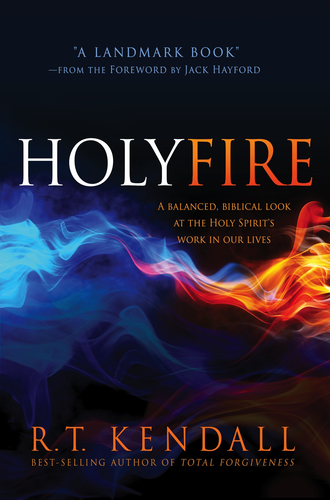
R. T. Kendall: Holy Fire, reviewed by Tony Richie

 R. T. Kendall, Holy Fire: A Balanced, Biblical Look at the Holy Spirit’s Work in Our Lives (Lake Mary: Charisma House, 2014), 256 pages, ISBN 9781621366041.
R.T. Kendall (DPhil, Oxford University) is no stranger to controversy. Raised in the Wesleyan-Arminian tradition he converted to Calvinism as an adult. Yet his scholarship has challenged contemporary Calvinist interpretations of John Calvin’s original thought and his own ministry has been characterized by openness to charismatic gifts. Kendall’s credibility and giftedness have been clearly established in the crucible of public ministry. For twenty-five years R.T. Kendall was pastor of London’s prestigious Westminster Chapel. He has written more than fifty-five books, including Total Forgiveness, The Sensitivity of the Spirit, Grace, and The Anointing: Yesterday, Today, and Forever. He has appeared frequently on Christian television programming. Born (1935) in Ashland, Kentucky, Kendall currently resides in Hendersonville, Tennessee where, although retired, he is president of R.T. Kendall Ministries and continues to contribute to Christian publications and programs.
Like Holy Fire, Kendall’s website (http://rtkendallministries.com) decries the “silent divorce†that has occurred in Christianity over the centuries between Word and Spirit. He suggests the need of the day is for a balanced approach to Christian belief and practice that integrates both solid commitment to the truth of Scripture and contemporary sensitivity to the power of the Holy Spirit. Readers will certainly see these twin dynamics amply demonstrated in Holy Fire. Further, as Kendall’s open letter to John MacArthur, “Dear Dr. MacArthur,†clearly indicates, Holy Fire was written as a response to MacArthur’s book on Strange Fire. (As a matter of fact, it was written by request from Charisma House publishers.) It is impossible to appreciate Kendall’s arguments in Holy Fire without some awareness of this dynamic. Theologically MacArthur is a cessationist, one who believes spiritual gifts such as divine healing, prophecy, speaking in tongues, and so on, ceased after the apostolic age. His Strange Fire book, based on an earlier conference by the same name, aggressively attacks those of the continuationist view. Theologically, Kendall is a continuationist. Continuationists believe that the Holy Spirit continues to equip believers today for Christian service with spiritual gifts, including but not limited to gifts such as divine healing, prophecy, and speaking in tongues. Continuationists are often known as Pentecostal (Acts 2:1-4) and/or Charismatic (1 Co 12-14) Christians. In short, MacArthur’s Strange Fire is mostly a diatribe against the beliefs and practices of modern Pentecostal and Charismatic Christians while Holy Fire comes to their defense.
Interestingly enough, both Kendall and MacArthur are from the Reformed (i.e. Calvinist) branch of Christianity. In his “Strange Fire†conference, MacArthur criticizes other prominent Calvinists (e.g. John Piper, Wayne Grudem, and Kendall) known for their contemporary acceptance of and openness to spiritual gifts. (See John Piper’s response at http://www.christianpost.com/news/john-piper-talks-john-macarthurs-strange-fire-conference-pursuing-gifts-of-prophecy-and-speaking-in-tongues-109022/.) Although likely many Pentecostals and Charismatics might take exception to MacArthur’s conference and book, Kendall’s response is particularly noteworthy as a Reformed Charismatic work. Thus there are two movements occurring in the middle of this debate, including, perhaps especially, in Kendall’s Holy Fire. The main move addresses questions of whether spiritual gifts or charismata continue to be authentically operative and relevant for contemporary Christians or are they really only appendix-like relics of ancient history. The second move gets at the heart of an internal debate about Reformed Charismatic Christianity exploring whether “Reformed†and “Charismatic†are mutually exclusive concepts.
Obviously, if one is a cessationist denying the continuation of biblical charismata for today, then one would assume that whatever branch of Christianity one was part of spiritual gifts would be automatically excluded. This exclusivity aptly describes MacArthur. (This is nothing new. MacArthur has been aggressively attacking Charismatic Christianity for years. See his 1992 Charismatic Chaos.) However, arguably one might start with the latter view that Reformed Christianity is simply not charismatic in nature—whatever one’s views on cessationism in general may be or whatever those non-Reformed/Arminian/Wesleyan-Arminian/Classical Pentecostals may be doing—and therefore insist that spiritual gifts should not be pursued or practiced by Reformed Christians in particular (See R. Scott Clark below). Kendall concerns himself with refuting cessationism in general, that is, he defends and promotes continuationism; but, beyond this point he seems especially anxious to demonstrate that Reformed Christians may be authentically Charismatic Christians as well. In other words, Calvinist theology and Charismatic spirituality are compatible. In Kendall’s own words, “there is no incongruity in holding these views. They are not polar opposites but totally complementary…they not only perfectly cohere but also mutually vindicate and elucidate each other†(p. 104).
In the interest of transparency I must admit that I half agree with MacArthur. Or at least I used to. For years I unwittingly and, now I think, wrongly, assumed that Calvinists and charismatic manifestations of the Holy Spirit were mutually exclusive. As a Wesleyan-Pentecostal, it seemed to me as if the Calvinist theological system is far too rigid for the free-flowing pneumatic liberty often associated with Pentecostal and Charismatic Christianity. Yes, I had read Martyn Lloyd-Jones. So I knew there were rare exceptions here and there. But that’s what they were to me: rare and exceptional. The personal testimony of James K.A. Smith helped persuade me otherwise. His Christianity Today article “Teaching a Calvinist to Dance†(http://www.christianitytoday.com/ct/2008/may/25.42.html), charmingly relates his journey of theological and spiritual transformation integrating his Calvinist theology and his Charismatic spirituality. He even appeals to the piety of American Calvinist icon Jonathan Edwards as a historical precedent! And Kendall makes a similar claim in Holy Fire.
Although I had heard previously of charismatic inclinations in contemporary Calvinists such as Grudem and Piper, somehow Smith’s testimony helped me understand that this was not “an exception that proves the rule†kind of scenario. Perhaps it was because I had personally met Jamie at annual meetings of the Society for Pentecostal Studies. Or maybe it was because we corresponded a bit by email regarding his dancing article. In any case, I certainly sensed something special. Could it be that the sovereignty and liberty of the Holy Spirit transcend and subsume sectarian theological constructs? Yes! I now believe that the Holy Spirit’s charismatic manifestations are not limited to or restricted by my own Wesleyan-Arminian-Pentecostal conceptual categories—or by those of Calvinism either. Not everyone agrees. For a contrary opinion on Jamie Smith’s classic testimony, see R. Scott Clark’s “Reformed and Pentecostal?†blog at http://heidelblog.net/2013/10/reformed-and-pentecostal/. Nevertheless, I confess that I find Clark quite unconvincing. My own continuationist perspective has been determined on biblical and theological grounds and confirmed on experiential grounds. But Jamie Smith helped open me up to a greater awareness of the depth and scope of the Pentecostal and Charismatic movement.
Perhaps not surprisingly, I can see the validity of Kendall’s arguments much more clearly than I can those of MacArthur which Kendall consistently dismantles and debunks. I suspect Kendall and I have a hermeneutics of charity toward Pentecostal and Charismatic Christianity. We tend to look at it with eyes of love (cp. 1 Co 13). It is innocent until proven guilty. That does not mean we can’t or won’t offer correction. Kendall demonstrates willingness to admit and correct abuses and excesses. And he pulls no punches exposing dangerous teachings like hyper-grace, open theism, or the health and wealth gospel. But one gets the impression from MacArthur that he doesn’t at all wish to correct us in any rehabilitative or therapeutic sense. It seems as if he doesn’t want to help me be a better Pentecostal or Charismatic. He wants to stop me from being Pentecostal or Charismatic. His seems more like a hermeneutics of suspicion. We are guilty until proven innocent. At best, our spiritual experiences signify to him that we’re neurotic. At worst, they signify to him that we’re demonic. He’s wrong. And Kendall calls him on it.
Kendall’s Holy Fire is not aimed at academia. It’s written for a more general or popular Christian audience. Yet because it’s not scholarly dense doesn’t mean it isn’t substantively deep. True enough, he declares that his main purpose in writing this book is to make readers “hungry for the Holy Spirit.†Yet he seeks to accomplish this admirable task through careful scriptural and logical argumentation as well as drawing on a wealth of ministerial experience. In fact, much of this work reads like a good solid and accessible Bible study on the doctrine of the Holy Spirit. It also has a lot of great history, especially about the piety of the Puritans and giants like Jonathan Edwards. Further, Kendall draws heavily on his personal and professional relationship with the highly esteemed conservative evangelical preacher and pastor, Martyn Lloyd-Jones. All of this adds up to a popular but substantive defense and affirmation of the continuing activity of the Holy Spirit in the contemporary Church.
Along the way, Kendall exposes “strange fire†on both sides of the aisle. He begins with a Bible study of the occurrence of “strange fire†in the priests Nadab and Abhihu (Numbers 3:2-5). Then he examines contemporary occurrences of sinful attitudes and actions among Charismatics and conservative Evangelicals alike. The result is a balanced and passionate appeal for the sensitivity of (not just to) the dove of the Holy Spirit. In other words, Kendall calls for consecrated holy living that does not grieve the Spirit. And he doesn’t refrain from taking on false teaching either. Whether it’s the failure of popular Charismatic revivalists to actually preach the gospel of Jesus Christ dying for our sins and rising again or the fall into universalism by Barthian-influenced Evangelicals, he is fair but fearless. Unlike MacArthur, Kendall sees the benefits of Charismatic Christianity. However, he’s not blind to its pitfalls either.
In the very center of Holy Fire Kendall gives his personal testimony. As much of my own work tends to affirm the importance of testimony, I paid special attention to this chapter. Kendall’s testimony is inspiring. It’s instructive too. It’s honest but humbling as well. And it has an aura of the holy. It has “holy fire†in it! After reading it one is clear that Kendall isn’t a typical Reformed Christian or a typical Charismatic Christian. However, he certainly is a Reformed Charismatic Christian. When he talks about either or both he is, as the anthropologists say, a participant observer. Kendall isn’t a passive bystander but a passionate participant. And yet he’s no less an astute observer. He’s an insider in both worlds. He’s involved in both realities. In him they’re one. For R.T. Kendall the biblical and historic Christian faith has a Reformed head and a Charismatic heart. Personally, I don’t quite agree with that; but, I do deeply respect and appreciate it in his faith journey and life testimony. Unlike John MacArthur, I don’t doubt that it’s really real.
At this point in his book Kendall tackles cessationism head-on. In spite of the polemical nature of this book, especially its fundamental argument with cessationist views, Kendal remains respectful. He calmly employs Scripture, history, and real life experiences to place the debate in a kinder perspective. Kendall blames the rise of cessationism among Protestants on the overly intellectual nature of the early Reformers and the unstable and eccentric character of charismatic representatives of the time. However, it continues today at least in part due to the fault of flamboyant and downright flakey styles of ministry among many Pentecostals and Charismatics, especially on Christian television programming. Cessationism has also become a dogma for some denominational sectors of Christianity (notably, Reformed and conservative Evangelicals). Kendall describes cessationism as a hypothesis. A hypothesis is not a biblically grounded doctrine but more of an interpretative theoretical grid. A hypothesis shouldn’t be turned into a dogma (ala MacArthur!).
Kendall reminds that it’s the nature of the miraculous, whether speaking of the resurrection of Christ or divine healing today, to leave room for the decision of faith and the internal witness or vindication of the Holy Spirit. That’s a telling point. Does it imply that the same attitude of unbelief may be evident in those who rejected Christ’s resurrection in the New Testament and those who reject the charismata today? That’s too strong. Kendall doesn’t draw that conclusion. Yet it gives cause for pause. There were those who accepted the miraculous in ancient Israelite history but not in contemporary (for them) times (the New Testament age). It seems there are always those willing to acknowledge the miraculous at some other time and place so long as it isn’t here and now! Whether they’re cessationist or deists (a comparison Kendall does make), it’s the same story. At the least, the subtle parallel should encourage cessationists today to use some reserve. No wonder a key verse for Pentecostal and Charismatic Christians, and for Kendall, is “Jesus Christ is the same yesterday, today, and forever†(Hebrews 13:8).
R.T. Kendall warns that cessationism quenches the Spirit and that has dire consequences. Notably, it lessens our expectations of God’s action in our lives so that we then lower our level of experience and service to match it. Kendall is clear: “the cessationist view is not only weak, but it also has no biblical warrantâ€. He points out that the spread of cessationism has been rejected and therefore restricted by global Christianity simply because the miraculous is prominent among its faith communities. They expect miracles and they get them. Cessationism just doesn’t line up with their reality. But Kendall also shares specific testimonies of divine healing even in England and the United States. Apparently, there’s hope.
Having effectively refuted cessationism, Kendall delves into yet another study of the Holy Spirit. This time he focuses on the baptism and gifts of the Spirit. This section is characterized by biblical analysis and pastoral heart. For those who are at least open to the possibility of charismatic manifestations and operations it is instructive and provides helpful assistance for personal experience. One of the most helpful components of this part of the book is Kendall’s discussion of the “proof†of Holy Spirit baptism and spiritual gifts. Having argued for the authenticity of divine healing and speaking in tongues today without quite proposing the well-known “initial evidence†doctrine (all who receive Spirit baptism must immediately speak in tongues), he now goes a step further. Basing his arguments on 2 Timothy 1:7, and on the example of Jonathan Edwards, Kendall suggests that the consistent presence of characteristics of fearlessness, power, love, and self-control amply verify when we’re witnessing the Holy Spirit in action.
Kendall closes his book with a short prophetic style chapter about the next move of the Holy Spirit. He prophesies that when the Word and the Spirit come together the world will experience the greatest revival it has ever seen. If anything, this chapter, which he says is based on his most controversial sermon ever, bears abundant witness to his own hunger for the Holy Spirit—not only for himself but for others as well. Finally, Holy Fire fittingly has a final appendix which is a biblical study of the concept of fire with its spiritual implications. Thus the book begins and ends with strong biblical emphases.
There are times that Holy Fire will appear repetitious for those who have read R.T. Kendall’s previous books. However, Kendall honestly acknowledges when he’s drawing on previous material and integrates it skillfully. And he doesn’t simply repeat material; rather, he usually builds on it and adds further wisdom and insight. At times one could wish for more rigorous biblical, historical, and theological analysis. Yet Kendall gives us the result of his research, not the rigors of the scholarly process. This was probably a good call for a book aimed at the general Christian public. For many, the rigors of scholarship can all-too-quickly become more like rigor mortis. And Holy Fire, surely, is not dead. On the contrary, it is alive with spiritual vigor and vitality.
I highly recommend Holy Fire for those interested in the Holy Spirit and in the operation of spiritual gifts today. I include both cessationists and continuationists. It may have special appeal for those of a Reformed background; however, it will likely be enlightening for other traditions also. It certainly applies to those who have been following the strange fire debate ignited by MacArthur’s diatribes. This text, however, isn’t primarily polemical. It’s biblical, practical, and pastoral—quite a good combination, I think, for such a difficult conversation. We should be grateful to Kendall for this helpful contribution.
Reviewed by Tony Richie
Further Reading:
Craig S. Keener’s review of Holy Fire
Mark Sandford’s review of Holy Fire
“Are Pentecostals offering Strange Fire?” The panel discussion at PneumaReview.com about John MacArthur’s Strange Fire