
Ryan Lokkesmoe: Paul and His Team

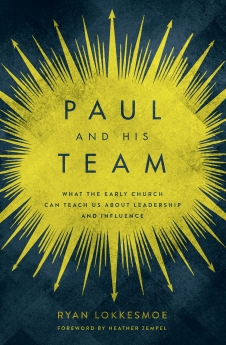 Ryan Lokkesmoe, Paul and His Team: What The Early Church Can Teach Us About Leadership and Influence (Chicago, IL: Moody Publishers, 2017), 224 pages. ISBN-10: 0802415644, ISBN-13: 978-0802415646
Ryan Lokkesmoe has a doctorate in New Testament from the University of Denver. He currently serves as lead pastor of Real Hope Community Church, which he helped plant in the Houston, Texas area in 2015. Paul and His Team is his second book.
As the title suggests, this is a book about relationships. God puts people in our lives in order to mold us, help us, and shape us. He also, at times, gives us people to lead. The author uses the experiences of the apostle Paul to call our attention to important principles of life and leadership that are found in the New Testament. The main body of the book consists of twelve chapters. The titles of the chapters are: “The Quest for Common Ground,” “Watch the Burden,” Offstage Leadership,” More Than a Ceasefire,” “Worthy Conflicts,” Genuine Collaboration,” “Kingdom Diplomacy,” Relational Stewardship,” “Relentless about Reconciliation,” “Trust in the Fog,” and “Fade to the Background.”
In the introduction, Lokkesmoe shows us that a lot of things go into making us who were are. The influences on our lives include family, friends, books, and churches. All of these have in some measure helped shape us into who we have become. Now, we in turn are influencing others. As Christians we should desire to have a positive and powerful impact on our world. However, we cannot do this effectively by ourselves. In order to maximize Christian impact, we need relationships with other believers. Teamwork is essential; the apostle Paul’s example makes this clear. Lokkesmoe says that qualities like humility, self-sacrifice, and radical grace are essential to the task. In the remainder of the book he sets forth the positive principles that we should pursue and the problems that we will encounter along the way. In the book he uses the words leadership and influence interchangeably.
In chapter 1, the author discusses trying to find common ground. He shows us how the apostle Paul sought to do this with the people he ministered to. In the synagogues he sought to build bridges to the Jewish community by citing the Old Testament scriptures, which they would be familiar with. When he spoke to a non-Jewish audience he altered his approach, he directed his speech to connect with them in their particular culture. For example, in Athens he spoke about their altar to an unknown God in an attempt to bring the gospel to them. As Paul himself wrote in 1 Corinthians 9 he became all things to all men in order to save some. He did not alter the gospel message, but he did craft the message to his listeners. The author says that seeking common ground is wise because it helps to reduce the barriers to the proclamation of the gospel. He points out that if we can find common ground with people they are more apt to like us, and this is a great help in Christian ministry.

In chapter 2, Lokkesmoe writes about not overburdening people with excessive expectations. As an example of this he cites the decision of the Jerusalem Council in Acts 15 with regard to what the church should do with the Gentiles who were coming to faith in Jesus. The council decided not to place a lot of requirements on the new Gentile believers but instead to provide them with a few brief instructions in order to help them maintain fellowship with their Jewish brothers and sisters in Jesus.
Chapter 3 focuses on the importance of off stage leaders, that is, people whose ministry is not highly visible. In the New Testament this included individuals who carried the writings of Paul to the churches: Tychicus is one such individual. Luke was also, to a large degree, an off stage leader, but he exerted great influence through the two canonical books he penned, the Gospel of Luke and the Book of Acts. Lokkesmoe says that most people of influence in God’s kingdom are off stage laborers. They are not highly visible but they are necessary. No “on stage” leader can do all of the work, Paul couldn’t and we can’t either. This being the case, off stage leaders need to be empowered and released to do their part.
The topic of chapter 4 is reviving broken relationships. In consideration of this topic the author examines Paul’s disagreement with Barnabas over John Mark and Paul’s later reconciliation with John Mark. One of the takeaways from this chapter is that we should not write off someone because they did not meet our expectations at one time. God can, and frequently does, use them, and He may even have them work with us again.
In chapter 5 the author takes up the topic of conflict. He says that in the ministry conflict is inevitable but that leaders should not engage in every conflict that comes their way. He points out that the apostle refused to engage in a lot of conflicts. The two that he would, however, engage in concerned maintaining the truth of the gospel and seeking to preserve the unity of the church.
Chapter 6 deals with ministry collaboration. The subtitle of the chapter is “Finding Your Friends and Letting Them Lead.” In this chapter he writes about some of Paul’s friends who helped in the ministry. Specifically, he mentions Priscilla and Aquila, who led house churches, and Erastus, who was a city official in Corinth.
In chapter 7 the subject is “Kingdom Diplomacy.” The basis for this chapter is the book of Philemon. In Philemon Paul serves as an advocate on behalf of a runaway slave who had become a Christian. He wrote to the slave’s owner, who was also a believer, in order to pave the way for him to return to his master without negative repercussions.
Chapter 8 speaks about the importance or recognizing and affirming people. It is important for leaders to make people feel appreciated and valued. The author points out that Paul did this in his letters by the ways he referred to his co-workers. He referred to them by such terms as “fellow workers,” “fellow soldiers,” “servants,” “workers in the Lord,” and “sisters.” Such terms speak of relationship, their work, and in some cases, their equality with Paul himself. References such as these can have a very positive impact on the people that they refer to, and on others who hear about them.
The last three chapters, chapters 9 through 11, deal with seeking reconciliation with others who have hurt you (even when it is difficult), persevering in ministry when things are not going well, and realizing that, even as a leader, a person is replaceable. With regard to the last topic not only should leaders recognize that they are replaceable but they should actively prepare others to take their place. Leaders need to invest in the lives of others and help prepare them for leadership. The book closes with a conclusion called “Our Particular Posture.”
Paul and His Team is written in plain language and is thus accessible to a wide readership. It is a great resource for opening our eyes to some of the less visible people and principles in the New Testament. The book shows us the value of relationships and the importance of being connected to others in ministry. I think that this book is a great resource for Christian leaders, perhaps especially for those who labor in local churches.
Reviewed by John Lathrop
Publisher’s page: https://www.moodypublishers.com/books/bible-study-and-reference/paul-and-his-team/