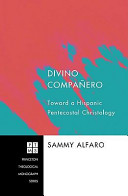
Sammy Alfaro: Divino Companero

 Sammy Alfaro, Divino Compañero: Towards a Hispanic Pentecostal Christology, Princeton Theological Monograph Series 147 (Eugene, OR: Pickwick Publications, 2010), 164 pages, ISBN 9781606086995.
‘Divine Companion’ is an insightful and innovative exploration of ways of approaching both Christology and an understanding of the Spirit at work in our lives. The published version of a PhD thesis, this work is invaluable in exploring the interaction of classical Christological perspectives with contemporary Christianity, especially relating to Hispanic Pentecostal experience. The bibliographic references are themselves rich and contemporary, but the greater value of this book lies in the way it charts a move from classic patristics through the motifs of liberation theology to the concerns of a rapidly expanding, Pentecostal theological consciousness.

The primary thesis of the work is that an understanding of Christology that focuses on the role of the Holy Spirit in the life of Christ better facilitates the development of an understanding that is both pneumatological and rooted in classical Pentecostal beliefs; and that that this is more useful than a Christology focused on the ‘two natures’ of Christ.
This has two immediate effects. Firstly, it allows us to focus on the integrated whole of Jesus, expressed in and through His humanity. Secondly, it causes us to address the relationship between our understanding of the Holy Spirit’s workings and the life of Jesus Christ. As Alfaro puts it,
It is my perception that limiting Pentecostal Christology to a Chalcedonian framework will inevitably bifurcate its potential by ignoring one of Pentecostalism’s most important contributions: the centrality of the experience of the Spirit (p 56).
The notion of Jesus as our Divine Companion, is close to a participationalist understanding of the Christian life, where the integral process of justification-sanctification is found in and through our identification with the life, ministry and victory of Jesus Christ. This participationalist hermeneutic is expressed through an emphasis on reading the conjunction of our life with the life of Jesus being marked by the work of the Holy Spirit in and through the humanity that we share with our Lord.
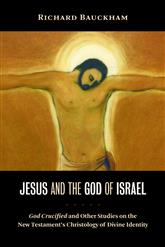 In this, Alfaro’s work compliments Richard Bauckham’s point, made so powerfully in Jesus and the God of Israel, (Paternoster, 2008), first published in book form in 1998, God Crucified. where he summarises his argument thus,
“The earliest Christology was already the highest Christology. I call it a Christology of divine identity, proposing this as a way beyond the standard distinction between ‘functional’ and ‘ontic’ Christology, a distinction which does not correspond to early Jewish thinking about God and has, therefore, seriously distorted our understanding of New Testament Christology. When we think in terms of divine identity, rather than divine essence or nature, which are not the primary categories for Jewish theology, we can see that the so-called divine functions which Jesus exercises are intrinsic to who God is…
“The inclusion of Jesus in the unique, divine identity had implications not only for who Jesus is but also for who God is.” (p. 10).
Where Alfaro’s work disappoints is, perhaps, because of the limitations imposed by a doctoral research project: it does not lead us to engage with key scriptural passages. In particular, an absence of an appraisal of the Christology of Paul, especially the Philippian hymn, leaves a little dissatisfaction. On the other hand, this monograph addresses the rich vein of Pentecostal perspective that develops on from Hispanic Liberation Theology and redresses the need to have a Christology that is practical and not simply speculative.
It is our focusing on the hope of Resurrection, that is ours in Christ, that quickens us into the life of faith. Hope must prefigure faith. That hope is the focus of our expectation in terms of personal development as well as ethical realisation of the justice and the righteousness that characterise the Kingdom of God.
Well worth reading, for those who want to learn from an expanding, growing Christian community and context.
Reviewed by James Purves
Publisher’s page for Richard Bauckham, Jesus and the God of Israel: http://www.eerdmans.com/Products/4559/jesus-and-the-god-of-israel-god-crucified-and-other-studies-on-the-new-testament39s-christology-of-divine-identity.aspx