Matthew Gordley’s Teaching through Song in Antiquity, reviewed by David Seal

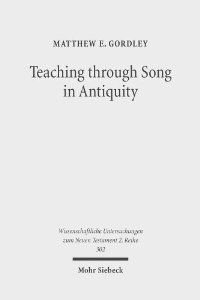
 Matthew E. Gordley, Teaching through Song in Antiquity: Didactic Hymnody among Greeks, Romans, Jews, and Christians (WUNT II 302; Tuebingen: Mohr Siebeck, 2011), 445 pages, ISBN 9783161507229.
Matthew E. Gordley, in his monograph Teaching through Song in Antiquity: Didactic Hymnody among Greeks, Romans, Jews and Christians, explores the variety of means that ancient poets, over time and in numerous locations, employed hymns to instruct their audiences. Gordley argues that many Greek, Roman, Jewish and Christian hymns of antiquity, beyond praising a deity, also had the primary function of instructing and shaping the writer’s community (1-2).
The author maintains, “Didactic hymns, prayers and religious poetry are those which employ the stylistic and/or formal conventions of praise and prayer, but whose primary purpose was to convey a lesson, idea, or theological truth to a human audience” (5).
In this comprehensive work, the author claims through a study of form, content and strategies of a hymn, insight can be gleaned about issues facing the communities for which these texts were composed (2). Gordley also asserts that by comparing didactic hymns from a variety of cultural traditions, a greater appreciation and understanding of how ancient instructional strategies functioned can be achieved (2). A final goal of the author is to explore the types of lessons and instructions conveyed through hymnody (8).
Gordley’s book consists of eleven chapters, a bibliography, an index of references and an index of modern authors and subjects. Chapter one is critical as it conveys the methods Gordley utilizes to identify hymns intended to have a teaching function (9). The features, which may indicate that a hymn had a didactic purpose, are first, a poet’s invitation to his audience to learn from him, (such as Psalm 78:1, which opens with “Give ear, my people, to my instruction …”). A second indicator of a teaching purpose is the presence of prominent instructional language in the hymn.
When these explicit indicators are absent, Gordley notes other characteristics in the hymn that can point to a text with a didactic purpose. They are 1) the direct address of the audience by the author, 2) the presence of direct claims about the deity being praised and/or explicit claims about the community offering the praise, 3) the recounting of an event, in the form of a narrative, from the mythic past or recent past (10). Gordley also claims psalms or hymns that are embedded in a narrative or an epistolary text of the Bible or in other early Jewish and Christian literature could have had an instructional function in its new context (11). Gordley’s methodology leans on reader-response criticism, discourse analysis, performance criticism and the analysis of how communities have remembered themes over time (15-20).
Chapters two through ten each address and illustrate various didactic songs selected from the following areas: Homeric and Hesiodic poetry, philosophy, praises of human rulers, the Hebrew Bible, Jewish writings from the Second Temple period to the second century, the Dead Sea Scrolls, the New Testament Epistles, the Apocalypse, the Gospels and hymns from early Christian writings. The section of the book dealing with didactic praise offered to human rulers (123-138) provides an enlightening comparison to words of praise about Jesus and his message as recounted in the New Testament (e.g., 297-298).
Gordley’s argument is especially convincing when the text under consideration contains an explicit claim of didactic intent such as in Psalm 34 (154), Deuteronomy 32 (168-172) and certain prayers contained in the Dead Sea Scrolls (235-236). Several of the passages, such as the prayers from the Dead Sea sect, have additional features that Gordley alleges indicate a didactic intent. These examples add strong support to his argument.
The final chapter looks specifically at the communities from the Greco-Roman world, the Jewish world, and from early Christian traditions exposed to instruction through song. This section serves as a summary of the entire book and highlights how hymns served as a means of community identity formation. This didactic purpose of song is illustrated by Gordley from the hymns in Revelation chapters four and five (346). Through these hymns, John’s audience came to understand they were purchased by the blood of the Lamb (Rev 5:9), have been made into a kingdom of priests who serve God (5:10) and in the future will reign on earth (5:10).
Gordley’s work is one of the most extensive treatments of this topic. It has raised awareness of the didactic purpose of ancient hymns. This is a welcome book for several reasons. First, it provides useful information for further research. Second, preachers and teachers can benefit by knowing the original intent of a passage before moving on to the text’s significance and application. In addition, knowing the function of a particular passage can also assist preachers or teachers in shaping the form of their message. Both the content and structure of their instruction will be enhanced, bringing fuller meaning to their listeners.
Reviewed by David Seal
Preview Teaching through Song in Antiquity
Originally published on the Pneuma Foundation (parent organization of PneumaReview.com) website. Later included in the Winter 2014 issue.