The Global Christian Mission: In the Wake


As Western Europeans sailed the seas to trade and settle around the world, how did they carry the mission and message of Jesus with them?
Â

Image: The Books of Kells by way of Wikimedia Commons.
The first long voyages of the Portuguese merchant mariners touched seashores around the world. In their wake came Portuguese Catholic priests to the mission fields of Angola on the western seaboard of Africa, the seashores of Mozambique in southeast Africa, the waters of the Arabian Sea, the southwest coast of India, and on the other side of the world, the Atlantic shoreline of Brazil.
The first long voyages of Spanish galleons left in their wake waters that washed the Philippines in the Pacific Ocean, the western seaboards of Mexico, Central and South America on one side of the world. On the other side, their ships penetrated the Caribbean all the way to the shorelines of eastern Mexico, Texas, and most of northern South America. These became the mission field of Spanish priests when they began arriving. They would soon be matched by French priests debarking from French vessels finding harbor in Mobile Bay and the southeast seaboard of North America.
The Netherlands and the English extended themselves to counter the feats of the Portuguese, the Spanish, and the French. The English had a distinct advantage over the Portuguese and Spanish and to an extent, the Netherlands. This was, in part, because of what happened in the eastern Mediterranean, of all places. In 1517, the Ottoman Turks seized Palestine. The Ottomans allowed other European nations a part of the Palestinian trade. England, under Queen Elizabeth, lobbied for influence at the Ottoman court in Istanbul for the right to bid against Venice and the Venetian merchants. The English were early allies of the Ottoman Turks, as they regarded them as a bulwark against a growing Catholic Hapsburg Empire in Central Europe.

Image: Wikimedia Commons
Queen Elizabeth had a big part in establishing a joint-stock company. She named it the Levant Company and enabled it to underwrite business in the Ottoman-controlled eastern Mediterranean. The Levant introduced a new, fast-moving cargo ship: the Dutch fluyt. Without going into the details of the exchanges between the English and the eastern Mediterranean merchants, trade included such items as worsted wool and a high-tech fabric called kersey in exchange for raisins, wine, camel hair, and chemicals. What made this side-venture so important that there were among these new fast moving ships, twenty-five which were called The Mayflower. It was one of these Dutch-English cargo ships, docked at Leiden, The Netherlands, probably in transit, which gave shipment and transport to a group of Separatist Christians bound for the shores of North America and which made eventual land-fall at Plymouth. This ship was at the end of its grape-running life, from the shores of what is now Israel. The great European grape rush from the Bethlehem landscape to England and thereabout had a large part in the Christian mission by bringing a unique Christian group of individuals we now called the Pilgrim fathers into the American landscape.
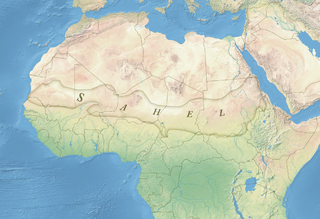
Image: Wikimedia Commons
Even with this English advance, the Netherlands were not eclipsed by England. South Africa was less than midway to the western Pacific, but even with that breadth of distance, by the 1650’s was the depot of the Dutch East India Company for products being transshipped from Indonesia to Europe. Cape Town was as much the entrepôt [warehouse and transshipment port] of the Dutch merchant fleets heading to Rotterdam, Antwerp, Leiden, and Amsterdam as it was the entrepôt of English ships headed for Liverpool and London. Among the merchants were those who represented the Reformed and Arminian Churches of Holland as well. Similarly, the English merchants had among them representatives of the “Presbyterial†Anglicans or as they popularly called “Puritans.â€
In the course of time, southern Africa became a melting pot for western Europeans among the predominant Xhosa and Zulu native residents with the Dutch concentrated at Johannesburg and the English more concentrated at Port Elizabeth. The reason for this focus on South Africa is that it became the opening wedge to the rest of Africa for Western influence as well as Eastern. Most of Africa was a closed continent except for that part of Africa, north of the Sahel, and along the Mediterranean coast which, over the course of time, came under the dominance of Arabic and Ottoman Turkic forces, and consequently, the influence of Islam. Africa, below the Sahel, was a closed continent, which gave it the reputation as the “dark continent†until the late 18th century.
By the end of the 1500s and the start of the 1600s, ships from England, Portugal, France, the Netherlands, Belgium, Denmark, and Sweden, touched base on all continents facing large oceans. This included all major archipelagos and island groups as the Solomon, Hawaiian, Indonesian, the Bahamas, the Philippines, and the island groups within Micronesia (Mariana, Marshall, and Caroline), Melanesia (Bismarck Archipelago, Admiralty Islands, New Guinea) and Polynesia (Samoa, Society and Marquesas Islands) as well as Fiji, Tonga, and others.
England laid claim over the sea-lanes of the southernmost South Pacific and integrated Australia, New Zealand, the Chatham Islands, and Pitcairn Island far to the east adjacent to southern South America.
Where settlements arose, congregations of Christians did arise every place there was interaction between Christians and the islanders. It was not until close to the 1640s that propagation of the gospel came through any other way than the daily contact of settlers with the people of the Pacific islands. This was also true for North America, north of the Caribbean and the forerunners of the missionaries who came were the French Jesuits who gained the reputation of being the most effective in spreading the gospel. More than any other, they followed what was later labeled the “indigenous†principle. The French Jesuits made their greatest imprint in North America, both in Canada and the American settlements south of Canada. The earliest Christmas carol composed in North America was written by the Jesuit Jean de Brefeuf (1593-1649). It was not until a 20th-century Canadian newspaper correspondent in Quebec translated the carol out of the Huron language into English. This writer has a copy of the translation.
Among those who settled in the areas south of Canada from Maine to Florida, the “separatists†who founded the Plymouth settlement on coastal Massachusetts were the forerunners of anything approaching an evangelical presence. The Separatists, now known as Congregationalists, and the Narragansett Indians had cordial relationships with one another. The Puritan settlers of Boston did not have any such mutual relationship with the Narragansett. In fact, the relationship was stormy with one outstanding exception: the exceptional personality of Roger Williams.
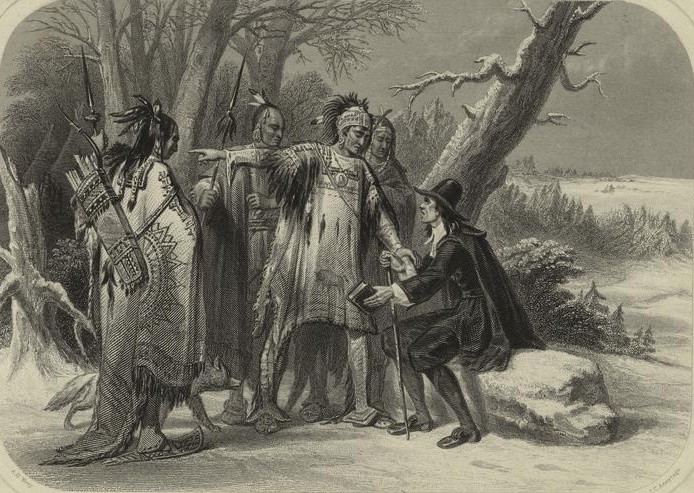
Williams, early America’s leading advocate for the separation of the church from political interests, purchased land in 1635 from the Narragansett. He founded the town of Providence in southern Massachusetts on the northwestern shoreline of Providence Bay, as a place where Native American and English culture could not only co-exist side by side, but also flourish. It was from Providence that the first attempts to understand the Native American perspective on life and land ownership were made and credit is given to Williams to further such understanding as he and his family settled among the Narragansett. Readers may find it interesting that Williams was the first Puritan to enunciate a distinction between civil authority and the righteousness of life as proclaimed by Jesus and the Scriptures. It was from Williams that Thomas Jefferson coined the idea of a “curtain between church and state.†It was also from Williams that the Baptist churches in America emerged.
Providence and Boston are, however, but one example from North America. Further north, Quebec and Montreal reflected their French origins associated with the voyages of Champlain into what would become known as Canada. It is also from the French incursions through the Gulf of St. Lawrence and the St. Lawrence strait that the first French settlers and the first missionaries in America entered. Among the forerunners of actual Christian missionaries among the native “north americans†were Jesuits from France, the most outstanding of whom was Jean de Brebeuf (1593-1649), who arrived in Quebec in 1625, 4 years after William Bradford forged an alliance with Massasoit, chief sachem of the Wampanoag confederation of the Narragansett in 1621. De Brebeuf identified closely with the Huron Indians in Ontario.
North America, however, is not the only place that the Christian missionary enterprise was active. North America was not the only point of contact between Christians with the rest of the world. First of all, it leaves out the expansion of the Orthodox Church in the East, the contact between the Western Christian and the Syriac Mar Thoma Christians in northwestern India, and the work of isolated Christians in Asia and Africa hidden from Western eyes because of the ravages of the Turkic Moslem armies.
At the same time, what occurred in Massachusetts and Canada had occurred elsewhere. Where settlements were made in Southeast Asia and Indonesia ,there were both accommodation where western settlements were made and also conflict. For the most part, southeast Asia was fairly well-settled and the merchants of the coastal bays welcomed potential purchasers of their teak, rice, and other products. Conflict arose mostly between European settlers and the more remote peoples of the backcountry who considered the newcomers as threats. This was also true for the major islands as New Guinea, and parts of the Indonesian chain of islands. For the most part, France fared well with Vietnam until the latter 20th century, with the incursion of Communism into that section of Asia. Saigon was considered to be the Paris of the East.
This set of circumstances also played itself out in South America and Central America where the coastal settlements more often were open to potential European customers than were the interior peoples. This was especially true for Hispaniola and also Brazil and Argentina. When Cortez docked on the East Coast of Mexico, he found the native peoples more welcoming. When he crossed the Sierra Madre Oriental to enter the realm of the Aztecs, he had Nahuatl allies with him and his Spanish troops.
The point of all this information is that the ports of Asia, the major island groups and the Americas were those locations most likely to have Christian settlers and the emergence of churches while the interiors did not. Christian witness flowed from these local gatherings rather than from individuals sent out as missionaries. Confrontation between native peoples and people coming from abroad were far less likely along bays and shoreline where the exchange of goods was to the benefit of all concerned. New England had the hardwood timber needed for ship masts and fireplaces. The Pacific had fruits and coffee as well as other exotic fruits as grapefruit and cocoanut while the Indian Ocean and China had tea. Europe had finished goods from their various craftsmen, agriculturists, and hardware manufactures. Chinese seamen perfected compasses and astrolabes and their artisans perfected newsprint. This facilitated interchange and also the Christian witness. It also brought Christians from western Europe into contact with those Christians whose whereabouts were lost due to the invasions of the Turks and Mongols from the Eastern Asian Steppes into western Asia that had remade the character of Bactria (Afghanistan), Persia, Arabia, eastern Africa.
The focus on the Maritime or the Oceanic phase also has drawn attention away from what had been happening to Christians in Eastern Europe and from the Orthodox Churches situation from Bulgaria, Georgia, Romania, Armenia, and the areas north of the Black Sea such as The Ukraine and the eastern steppes of Russia. These had a part to play in the expansion of the Gospel and the major player in this missiological drama was Nikon of Russia and to a lesser degree, Patriarch Cyril Lukar in Constantinople, the city that was renamed Istanbul around 1500 by its Ottoman Turk conquerors.
The part that Cyril Lukar played was the furnishing of a copy of the textus receptus (The Received Text of the Greek manuscripts of the Old and New Testaments) to the scholars who produced the King James Translation of the Bible. This contribution enabled a more faithful rendering of the Scriptures for the English-speaking peoples. This was a signal contribution to the spread of the gospel throughout the English-speaking world from England to Singapore, from the United States of America to Australia.
The other major player in the global spread of the gospel was the Orthodox Churches of the East. At the time that western and central Europe was experiencing the fall-out of the Reformation that was lit by Luther, Calvin, and Simons, Patriarch of the Russian Orthodox Church Nikon took action during the Synod of 1652-1667. What Nikon did was to make an accommodation of Russian worship to the contemporary forms of Greek Orthodox worship. This created a division in the membership. The believers who wanted to retain the liturgical practices that existed before 1652 split away and were henceforth called the Old Believers. Russian speakers refer to this division as raskol, indicating one who cleaved apart. The Old Believers formed their own groupings, The Popovtsy and the Bezpopovtsy, and went their way. They scattered across the landscape of the Russian steppes and established their own houses of worship. Many left Russia altogether and went as far as Siberia in one direction, as well as to the Grand Duchy of Lithuania and into central Europe in the Danube Delta of Romania.
Congregations of the Old Believers have since scattered all over the world from Europe to Australia, Alaska, Minnesota, New Zealand, and Argentina.
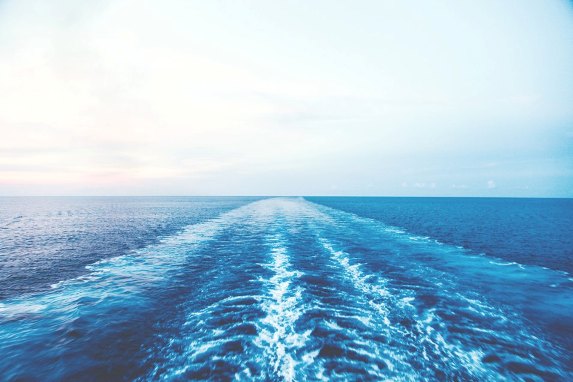
Again, the settlements and resettlements were all the results of the wakes left behind the merchant mariners and the ships carrying refugees from Europe, Eurasia, and elsewhere. It was not until 1794 that Orthodox missionaries from the Valaamo Monastery in the northern Karelia region of Russia arrived in Kodiak, Alaska.
PR
Coming next
The next section of the story looks away from the oceans, their sea-lanes, and the role of Christian settlements and toward the rise of the evangelists around the globe and the evangelical message they brought with them. After that, the final section focuses on the growing awareness of the global Christian world mission and the healing of the fissures that have been allowed to exist within the Christian family as a witness to the world’s own troubled human relationships.
This article is part of The Gospel in History series.