

The End of the Seige of Calais

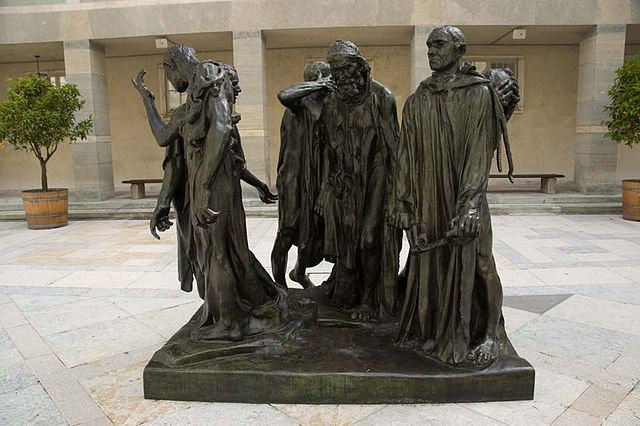
Image: Hansutz / Wikimedia Commons
The following account is derived from Book 1 of Jean Froissart’s Chronicles, a history of the first half of the Hundred-Years War in Western Europe. This account was first written circa 1370. In the late 1800’s Famed French artist Auguste Rodin depicted the six Burghers of Calais in a noted sculpture.
In 1346 the King of England, Edward III, had laid siege the French town of Calais, desiring to claim the town and its castle as his own. The siege dragged on into 1347 as the citizens of Calais were slowly deprived of provisions and food.
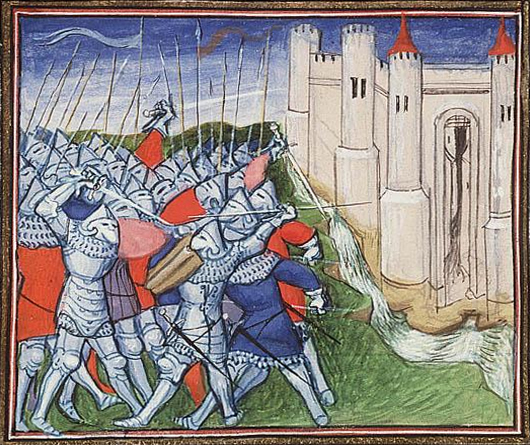
Their last hope was dashed when King Phillip of France withdrew his army, after determining that a battle with the English would result in severe losses for his own troops.
The citizens of Calais had fought bravely in resisting the long siege, and had inflicted heavy losses on the English invaders. However, they now realized their only hope was to throw themselves on the mercy of the King of England. Weakened by hunger and constant deprivation, they decided to pursue negotiations with the King of England.
From the battlements of Calais, Sir Jean de Vienne, the military commander of Calais, called out to King Edward’s spokesmen, Sir Walter Manny. “All of us here will die, or else go mad with hunger unless the noble king whom you serve takes pity on us. Please beg him humbly to have mercy on us. Allow us to leave just as we are, and he can have the town and citadel and everything in them.”
But Sir Walter replied, “We must warn you that it is not the King’s purpose to let you go free as you suggest. The inhabitants of Calais have caused him much trouble and have cost him dearly in lives and money. He is greatly angered against them.”
Nevertheless, Sir Jean convinced the two English knights to ask their King to spare the citizens of Calais. The knights returned to the King and reported all that had happened. The King, who earlier set his mind on the complete destruction of all those living in Calais, completely rejected their appeal of clemency.
But Sir Walter approached the King, reasoning with him, in order to help the defenders of Calais. His appeals did much to soften the King’s heart, and King Edward then decided that six of the principal citizens of Calais were to surrender to him, with their heads and feet bare, halters around their necks and the keys of the town and castle in their hands. “I will do with these six as I please,” said the King, “but the rest I will spare.”
When this news was reported to the people of Calais there was much weeping and sorrow. Even Sir Jean was moved to tears.
Finally the town’s wealthiest citizen, Master Eustache de Saint-Pierre came forward, saying, “It would be a terrible thing indeed to allow so many to die, when there appears a means to avoid such misfortune. An act of such merit would surely find favor in Our Savior’s eyes. Let me be delivered into the King of England’s hands.”
Other greatly respected citizens volunteered to accompany Saint-Pierre, including Jean d’Aire, brothers Jacques and Pierre de Wissant, Jean de Fiennes, and Andrieu d’Andres.
Sir Jean delivered these men to Sir Walter, asking him to intercede with King Edward in order to prevent the death of the six.
Sir Walter replied, “I do not know what the King will decide, but I promise you I will do all that I can.”
When the captives were led into King Edward’s presence, he looked at them with fierce anger in his eyes. The King hated the people of Calais because of the losses they had inflicted upon his army in the past. Though the six burghers of Calais knelt before him and pleaded for mercy, the king’s anger would not subside. He ordered that they be put to death immediately.
The nobles and knights present also begged the King to show mercy, including the brave Sir Walter, yet still the King refused. “The people of Calais have killed so many of my men that it is only proper that these six should die in their turn.”
At this point the Queen of England, Phillipa, who was present during these events, was moved to intercede. Though she was pregnant at the time, she fell to her knees before the King and weeping said, “My lord, since I crossed the sea to join you, at great danger to myself, I have never asked of you a single favor, but now I ask you in all humility, in the name of the Son of the Blessed Mary and by the love you have for me, to have mercy on these six men.”
The King remained silent for a time and finally spoke saying, “My lady, I might wish you were anywhere but here. Nevertheless I cannot refuse your request, though it be against my will. These men are yours to do with what you like.”
And with that the Queen thanked her husband the King, and had the halters taken from the necks of the prisoners. They were presented new clothes and fed an ample dinner. Whereupon they were given safe passage through the English army and released to freedom.
Though this story happened over 600 years ago (the siege ended on August 3, 1347), its lessons are timeless. Intercession on behalf of those less fortunate is indeed a hallmark of mercy.
From True Life Encounters, used with permission.
Originally published on the Pneuma Foundation (parent organization of PneumaReview.com) website. Later included in the Summer 2022 issue.