
Led by The Spirit: The Early Years in the Philippines


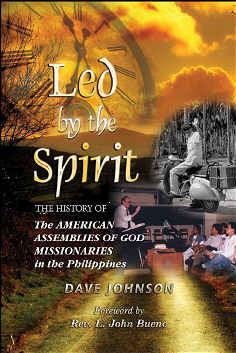
This excerpt from Led by the Spirit: The History of the American Assemblies of God Missionaries in the Philippines is the first chapter. Missionary-scholar Dave Johnson has brought together a chronicle of over 300 Pentecostal missionaries serving in the Philippines from 1926 through the first decade of the new Millennium.
The Early Years in the Philippines
As the Assemblies of God in the United States grew, so did their vision to send missionaries to the far-flung corners of the globe, including the Philippines.
The First Missionaries Arrive
The first United States Assemblies of God (AG) missionaries to the Philippines were Benjamin and Cordelia Caudle, who, with their children, arrived in Manila in September 1926.1 The Caudles came from Kansas. Like many of the early missionaries, neither had any Bible school education, and it appears that they had little ministry experience. Caudle had only been a Christian for about six years before arriving in the Philippines. Yet they had heard the call of God, and for them and those who supported them, that call was sufficient. At the same time, their application for appointment indicates that they were well aware that sacrifice and privation awaited them.2 To what extent they were actually prepared for life in the tropics can only be conjectured.
They settled in Manila and quickly began to work. Manila, a city of at least three hundred thousand people at the time, was the logical choice because it was both the capital and hub of the nation. By the time the Caudles arrived, the Filipinos had been under American rule for twenty-eight years and many had learned English to the point that the Caudles felt it was becoming the lingua franca of the country.3
The Caudles were thoroughly convinced of the validity of the Pentecostal message and had a deep burden for the lost. In an article for the Pentecostal Evangel, the official voice of the Assemblies of God USA, Caudle’s passion for the lost and commitment to Pentecost is revealed:
Do you know that there are many millions of people here that need the Gospel preached to them with power and in demonstration of the Holy Ghost? The Pentecostal message is yet a stranger to the Philippine Islands, but by God’s grace it will not remain so long. For there shall be established in these Islands a lighthouse of the Pentecostal truth where men and women can be free.4
While the claim to be the first to proclaim the Pentecostal message in the Philippines cannot be verified with certainty, it may have been true since the Pentecostal Movement was young at the time. Caudle’s remarks that the Pentecostal message, with its emphasis on signs and wonders, would spread throughout the country, was prophetic, although it didn’t happen as quickly as he hoped.
Caudle recognized that there was a great opportunity for work among the student population. He noted that students came from all over the islands to study in Manila for about ten months of the year. His vision reveals a solid missiology in his communication with the home front:
Can you imagine what a hundred or more students filled with the Holy Ghost would do, during vacation when they go to their home provinces? Can you think how God would bless in these little nipa houses, humble though they be, yet within them human souls, that must be told the precious truth, ere the coming of the Lord Jesus Christ?5
While he recognized the need and tried to raise funds for a mission hall to reach out to students, it is not known to what extent he succeeded.
What is known about the Caudles’ ministry is that they handed out tracts and sold copies of the Pentecostal Evangel in door-to-door evangelism. After about a year of tract distribution and backyard meetings, they had about fifty-five in Sunday School in what appears to have been a church planting effort.6 In less than two years, however, Cordelia’s health broke as a result of Manila’s harsh tropical climate, and they were forced to return permanently to the United States, the ultimate fruit of their work known only to God. Eleven years would pass before the arrival of another missionary, but God was at work in the meantime.
Filipino Pioneers
While the story of the history and development of the Philippine General Council of the Assemblies of God (PGCAG) cannot be told here in any great detail, it must be noted that the permanent work of the Assemblies of God in the Philippines actually began with Filipinos, not missionaries. As such, it is appropriate to briefly outline their story, with the hope that the entire story will someday be written. In the 1920s and 1930s, several Filipino men who had gone to the United States to seek a better life were saved, baptized in the Holy Spirit, trained in U.S. Assemblies of God Bible schools, and felt the call of God to return to their homeland.
The first to return was Cris Garsulao, who returned to the province of Antique on Panay Island in the Visayas region in the central part of the Philippines in 1928, the same year that the Caudles were forced to return home. It is not known if he was acquainted with the Caudles. Garsulao began by sharing Christ with the members of his extended family, and many were saved as a result. He planted a church in his hometown, Sibalom, the first Assemblies of God church in the country. A firebrand for Christ, Garsulao ministered wholeheartedly for the Lord. In 1929, he opened a Bible training school, no doubt patterned after Glad Tidings Bible Institute (GTBI) in San Francisco (now Bethany University in Santa Cruz, California) where he had studied, as he saw the need to train workers. Nine enrolled and studied for two years with emphasis also given to practical ministry. That four of them were still in Christian work more than thirty years later bears testimony to the faithfulness of his labors and the legitimacy of his strategy of training workers.7 He became sick, however, and died unexpectedly in 1935, just seven years after beginning his work.
Pedro Collado was saved in San Francisco in 1927. After attending GTBI, he began his ministry in the United States, apparently among Filipinos. It wasn’t long, however, before he too felt the call to return home. First, he went to his family in Bagumbayan, Nueva Ecija, and many of them came to know Christ. After three months, he took over the work that Garsulao had begun. Sometime later, he went with his family to Mindanao, the second-largest island in the Philippines, located in the southern part of the country, and pioneered the Assemblies of God work on that island.
After graduating from GTBI, Eugenio Suede also returned home to Iloilo province in southeastern Panay and pioneered a church there. Later he would also pioneer another church in Dueñas, Iloilo.
Benito C. Acena, like several of the others, attended Glad Tidings Bible Institute after coming to Christ and was ordained in California in 1934. He pastored for a while in the United States, apparently running from the call of God to return to his native land. Surviving a car accident in which the car burst into flames, he honored God’s call and came home. Apparently finding his family unreceptive to the Good News, he went to Illocos Norte in northwestern Luzon where he found fruitful ministry marked by the moving of the Holy Spirit.
Rosendo Alcantara, a native of the province of La Union on the northwestern side of Luzon, set off to seek fame and fortune in the United States at the age of twenty. A near-fatal car accident led him to consider what really mattered in life, and he turned his heart to Jesus Christ. After Bible school, he traveled for a time among Filipino churches in California and Hawaii, but finally felt the tug of the Spirit to go home. After sharing Christ with his parents, he went to Ilocos Norte and participated in the work of God there.8
Rudy Esperanza was perhaps the only one of the pioneers who did not come directly from a Catholic background, having turned to Methodism while a teenager. Going to the United States in 1928, he was there when the stock market crashed in October 1929, and when it did, so did his dreams. He began to
drift, but the Holy Spirit did not let him go long. Responding to an invitation to attend a full gospel service, he was born again.9 He settled in Seattle, Washington, and pioneered a church among Filipinos while studying at Northwest Bible College (now Northwest University) of the Assemblies of God. Here, his leadership gifts were evident as he became leader of a missionary prayer band for the islands of the sea which gave him reason to contact some of the other pioneers who reported that they were working independently of each other. It may have been here that his burden to see the workers unite under the banner of the Assemblies of God began. Esperanza began moving in this direction by working with Esteban C. Lagmay to organize the Filipinos in California. Esperanza then returned to the Philippines, arriving in Manila on May 9, 1939, and went home to Pozzorubio, Pangasinan, which is about 160 kilometers north of Manila. There, he pioneered a church and began to lay the groundwork for the formation of the Assemblies of God in the Philippines in which he was destined to play a leading role.10
Esteban C. Lagmay, the last of the pioneers to be considered here, played a unique role in the formation of the Assemblies of God in the Philippines. He married an American woman and traveled throughout the United States and the Philippines as a missionary-evangelist. He and Esperanza agreed that Esperanza would return to the Philippines to organize the work there, and Lagmay would continue evangelistic ministry in the States to promote the work of God in the Philippines. He would raise both prayer and financial support, to encourage believing Filipinos to return home and to encourage the Missions Department to send missionaries.11 Both Lagmay and Esperanza would prove faithful to their promises.
In appealing to the Missions Department, Lagmay played a crucial role in securing the appointment of missionaries to the Philippines. With help from a friend, Lagmay was able to meet with the Executive Presbytery in Springfield, the headquarters of the Assemblies of God U.S.A. There, with tears coursing down his face, he pleaded the case for sending missionaries to the Philippines.12 One of the strongest points of his case was that a missionary was needed to meet a legal need. Since the Philippines was a colony of the United States and therefore was under U.S. law, the Filipinos wanted to register with the government as a religious organization but were not able to do so because the law required that the organization be headed by an American. Without this recognition, they could not solemnize marriages and some of them were put in jail.13 Thus, a United States missionary was needed.
After prayer, Noel Perkin, the foreign missions secretary, suggested that Leland and Helen Johnson might be sent. The Johnsons, who had been serving in China, were home in Oakland, California, at the time. Lagmay and Esperanza visited them to make their case. The Sino-Japanese conflict then raging in China may have prevented the Johnsons’ returning there anyway. Consequently, they felt God’s call to change direction and meet this need.
The Pre-War Years
The Johnsons and their two children, Constance and Sammy, sailed to the Philippines, arriving in Manila on Christmas Eve, 1939. A third child, Margaret Joy, was born while they were there. By the time they were ready to leave for the Philippines, war clouds over the Pacific were already beginning to gather. Although they apparently did not expect the Japanese to ever attack the Philippines, the reality of danger in traveling to Asia was not lost on Johnson as he attempted to book passage for his family. He wrote:
In the month of February, 1939, we made an attempt to secure passage on a ship that was operated by the Swedish Navigation Company. When the time of our departure was nearly at hand, the company notified us that they were not taking any passengers. No explanation was offered, but we later received reports that ammunition and other military supplies had replaced the passenger cargo.
Our subsequent attempts to secure passage were equally unsuccessful, and it was not until December 2, 1939, that we could get our passports correctly made out and obtain resulting permission from the U.S.
Government. It was a glad day, indeed, when we were notified that we would finally be able to sail. Saying goodbye to a group of students from the Southern California Bible College [now Vanguard University] who had come down to the pier to sing us on our way, we sailed from San Pedro at noon, December 2, 1939, aboard the President Pierce.
Shortly after we left Honolulu enroute to China [a stop over point on the way to the Philippines], we received notice that our ship would be re-routed [to Japan]. Great was our disappointment, because we were not very anxious to touch the shores of Japan.14
It wasn’t long before they found a house to rent in Manila and got settled. Pioneering a church was their first effort of ministry, which they began in their own home. Not long afterwards, seventeen new converts had gathered and were anxious to receive the Holy Spirit baptism.15
Glenn and Pauline Dunn also came to the Philippines, arriving in March 1940, not long after the Johnsons arrived. They were on their way home from China with the intent that they would serve in the islands after their upcoming furlough. The Dunns made an extensive tour of Mindanao to research the possibility of missionary work there. At that time, most of Mindanao was undeveloped and was only beginning to receive the attention of the government. Dunn reported that he had been told that Mindanao was an island full of untapped opportunity, which he believed was true since much of it was unoccupied by either Catholics or Protestants.16 Because the country had only been opened to Protestants for forty-three years at that time, it was not surprising that Protestants had not yet multiplied there. The claim that Catholics were scarce was somewhat dubious, however. In spite of the strong Muslim presence in Mindanao, Catholicism saturated much of the nation during the more than three hundred years it had been in the Philippines. Whatever the truth may have been, Mindanao had been opened up for settlement, and people were pouring in from other parts of the country. Dunn described the island as vast in resources with fertile areas that were ripe for resettlement. Where others might have seen challenges because of the hardship living there would require, he saw vast opportunities for evangelism and church planting.17 Perhaps part of his favorable attitude came from a wonderful outpouring of the Spirit that they experienced in conducting meetings with Pedro Collado.18
No matter what the opportunities may have been, many years would pass before a missionary could be sent. Fortunately for the Dunns, they sailed home for furlough before the war began and were spared the horrors of the Japanese occupation. After the war they would eventually return for a long and prosperous ministry, spending a number of years in Mindanao.
Now that an American had arrived to head up the organization, the Filipinos moved quickly to make this a reality. From March 21–27, 1940, an organizational meeting of the Assemblies of God was held in San Nicolas, Villasis, Pangasinan, several hours drive north of Manila, near where Esperanza was pioneering his church. Leland Johnson, being appointed by the Department of Foreign Missions (DFM) as the district superintendent, chaired the meeting and the Philippines District of the Assemblies of God (PDC) was formed under the auspices of the Department of Foreign Missions of the Assemblies of God U.S.A, thus separating it from the South China District to which it had been previously assigned. With the exception of Chris Garsulao who had passed away, and Lagmay, who had remained in America, all of the Filipino pioneers were present. Rudy Esperanza was elected as the secretary. Pedro Castro was elected treasurer, with Hermongenes C. Hebrenca, Jose Maypa, and Rosendo Alcantara elected presbyters. An ordination service was also conducted for six new ministers. Those who had been ordained in the United States did not need to be reordained nor have their credentials transferred as the new organization was being constituted as part of the Assemblies of God U.S.A.
From the beginning, a sweet sense of the Holy Spirit’s presence was manifest. On Easter Sunday, God’s healing power was real. Johnson reported:
As the Spirit fell after the preaching of the Word, there was a concerted rush to the altar, and many lay prostrated upon the floor. Then, without any word or suggestion, a line was formed for prayer for healing. It was a unique experience to us. Power! It seemed that we hardly had time to lay hands upon the needy ones before they fell under the touch of the great Healer! Wonderful Jesus!19
At least ten people were also saved during the convention, five of whom were baptized in water in the Easter afternoon service. Fifteen also received the baptism in the Holy Spirit during this time.20 People receiving salvation and the baptism in the Holy Spirit would both become regular features of the early annual conventions.
Part of the meeting involved discussion of the various needs of the Philippine field. In keeping with their understanding of the Holy Spirit’s anointing for ministry, one of the great needs that they saw was for training workers because no Pentecostal Bible school existed in the country at that time.21 Young people wanted to be trained, but there was no place for them to go. Those attending the convention recognized that one of the keys to preserving the harvest of souls that were being saved was the training of workers. The training of workers baptized in the Holy Spirit has been a fundamental part of the Assemblies of God missiology almost from its inception.
While planning for such a school began, the new fellowship was registered with the Securities and Exchange Commission and the Justice Department, thus gaining the sought-for recognition by the government. Meanwhile, the work continued to grow apace. When the Johnsons arrived in 1939, there were a total of five Assemblies of God churches in the country. By the time of the Japanese invasion, the work had grown to thirty churches, which Johnson felt was phenomenal in light of the gathering war clouds.22 After the war, Johnson reflected that during this time “God was doing a speedy work. … establishing his people so that they would be able to carry on after we were separated from them [by the Japanese].”23 The growth of the work accentuated the need to train workers.
By mid-1941, Johnson was able to report that Bethel Bible Institute (BBI) (now Bethel Bible College) would open for classes on August 1 in Baguio City, about 130 miles north of Manila in the Cordillera Mountains and about five thousand feet above sea level. Because of its cooler climate, Baguio had been built as a resort town early in the American era and had a large expatriate community—a characteristic that remains true of the city to this day. The Johnsons relocated to Baguio to take charge of the school along with Esperanza. Why it took so long to open the school is unclear.24 Why Baguio was selected is not known. It may have been felt that the more temperate climate would be more conducive to study. It would most likely have been a cheaper place to live than Manila. Since three of the six pioneers that had returned home were from the north, this may have been the most logical reason, especially since Baguio sat at a crossroads to many of the roads going north.
The Johnsons found a fourteen-room home to house the school which would provide classrooms, dormitories, and a chapel. Sunday services could also be held there for reaching out to the lost. While it was certainly large enough to meet their immediate needs, it was also unfinished, unpainted, and not on the market for rent.25 The landlord was cooperative. He finished and painted the house to their liking, and they moved in—certain that God was leading them.
At BBI, Pentecostal distinctives were emphasized, with many students receiving the baptism in the Holy Spirit, some even after the Japanese invasion.26 Those who were filled had a great burden for the lost and volunteers for sponsored outreaches were never lacking. More help had also begun to arrive. In 1941, Blanche Appleby and Rena Baldwin (later Lindsay), two middle-aged women arrived to help at BBI. Both had served in China for several years, but were unable to return because of the growing Communist threat. Appleby was known as a deeply spiritual woman who had been engaged to a fine minister but she severed the relationship when God called her to the mission field. After the war when her health did not allow her to continue in missions, she capably led a prayer group in her home church in Durant, Florida, and prayed for missionaries faithfully and influenced several in their calling to the field. By her own confession, Baldwin was a rather timid person, but also a gifted musician and poet.27
Gladys Knowles (later Finkenbinder), Doris Carlson, and Elizabeth Galley (later Wilson) also arrived to study Chinese at a Chinese language school that had been moved from Beijing (Peking at the time) to Baguio because of the conflict in China. Apparently, they felt that God would eventually open the door to China again. Robert and Mildred Tangen also arrived, although the records are not clear as to what their ministry was intended to be. And so, in God’s timing and providence, at the outset of hostilities, all Assemblies of God missionaries were together in Baguio.
While the work continued and the blessings of God were obvious, the political situation deteriorated as the possibility of war increased. Radio and newspaper reports were full of doom and gloom, but no one thought that the Japanese would attack immediately.28 Perhaps this explains why there apparently was little or no effort by the missionaries to evacuate. Even the Department of Foreign Missions (DFM) was caught by surprise. They didn’t authorize evacuation until after Pearl Harbor was bombed.29 Whatever contingency plans may have existed are not recorded. While it is tempting to be critical of this apparent lack of planning, it must be remembered that the industrial power and military might of the United States dwarfed that of Japan. Therefore, the common consensus that Japan would never be foolish enough to attack America or her possessions was at least somewhat understandable.
In the weeks before hostilities broke out, the missionaries labored with one eye looking back over their shoulder at the worsening situation. During this time, the Johnsons, Appleby, and Baldwin, along with the Filipinos, concentrated their efforts on putting the Bible school in order. Johnson had even made plans to make an extensive tour of all thirty stations, presumably to strengthen them in any way he could and prepare for whatever might happen.30 What they could not have known at the time was that the United States State Department had no plans to offer evacuation to private citizens. They had concluded that in the event of war there would be too many people to evacuate once hostilities commenced. In the end, only God could help them.
PR
This chapter is an excerpt from Dave Johnson, Led By The Spirit: The History of the American Assemblies of God Missionaries in the Philippines (Pasig City, Philippines: ICI Ministries, 2009). Used with permission.
Notes for Chapter 1: The Early Years in the Philippines
1 In a letter to Trinidad Esperanza dated January 19, 1965, Noel Perkin, secretary of the Foreign Missions department in Springfield from 1927 to 1959, wrote that the Caudles had probably gone to the Philippines on their own, as was common in that day, and sought appointment only after arriving on the field. In another letter dated January 19, 1965, he laments, however, that the records from that era had been destroyed as they were not deemed to be of lasting value. One wonders if Perkin was correct, however, as Caudle’s application, dated April 28, 1924, is on file at the AGWM Archives.
2 Benjamin H. Caudle, Application for Appointment, April 28, 1924.
3 Caudle, “Opportunities in Manila,” Pentecostal Evangel (August 27, 1927).
4 Caudle, “The Crowning of the Virgin of Antipolo,” Pentecostal Evangel (February 19, 1927).
5 Caudle, “Opportunities in Manila,” Pentecostal Evangel (August 27, 1927).
6 Curtis M. Butler, “The Philippines Assemblies of God: Its Birth and
Development,” a term paper written at the Assemblies of God Graduate
School in Springfield, MO, August 1974, 6.
7 Trinidad C. Esperanza, “The Assemblies of God in the Philippines,” (master’s thesis, Fuller Theological Seminary, 1965), 20.
8 Trinidad Esperanza, 23–25.
9 Rudy Esperanza, “Presenting Rudy C. Esperanza, General Superintendent,” The Pentecostal Voice, September 1956, in Trinidad Esperanza, 27.
10 Trinidad Esperanza, 27–29
11 Esteban C. Lagmay, Gambling, (Concord, CA: by the author, n.d.)
12 Ibid., 87–88.
13 Letter from Trinidad Esperanza to Noel Perkin, December 30, 1964.
14 Leland E. Johnson, I Was a Prisoner of the Japs, (Concord, California: Los Angeles: self-published, 1946), 5.
15 Ibid., 9.
16 Glenn Dunn, “Survey of the Southern Island,” Pentecostal Evangel (March 22, 1941), n.p
17 Ibid., n.p.
18 Trinidad C. Esperanza, 32.
19 Leland E. Johnson, “Philippines Form District Council,” Pentecostal Evangel (May 4, 1940), n.p.
20 Ibid.
21 Ibid.
22 Johnson, Prisoner, 12.
23 Ibid., 14.
24 Leland Johnson, “Introducing Our New Philippines Bible School,” Pentecostal Evangel (August 2, 1941), n.p.
25 Ibid.
26 Johnson, Prisoner, 17.
27 Rena Baldwin, Application for Missions Appointment, July 10, 1936.
28 Johnson, Prisoner, 16.
29 McGee, This Gospel Shall Be Preached, (Springfield, MO: Gospel Publishing House, 1986), 155.
30 Johnson, Prisoner, 15.
Further Reading:
Read Malcolm Brubaker’s review of Led by the Spirit in the Summer 2010 issue of The Pneuma Review: /dave-johnson-led-by-spirit/
Download the full book (in PDF) at: https://www.academia.edu/34297392/LED_BY_THE_SPIRIT.pdf
Find more excellent books from APTS Press, home of the Asian Journal of Pentecostal Studies.