
N.T. Wright’s Newest Release: The Paul Debate

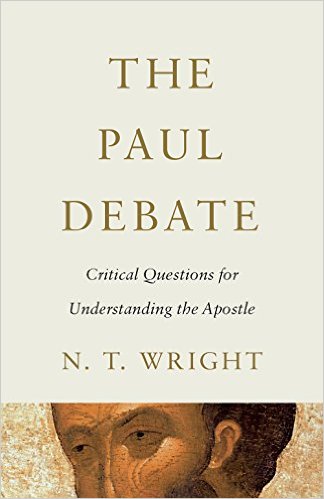 N. T. Wright, The Paul Debate: Critical Questions for Understanding the Apostle (Baylor University Press, 2015), 122 pages, ISBN 9781481304177.
Theologians and pastors alike have come to expect that, as each calendar year turns, Dr. Tom (N.T. Wright) will publish some new work. Such has happened just this week with the release of his most recent book now available, The Paul Debate: Critical Questions for Understanding the Apostle.
It’s not as if Wright hasn’t already written plenty on the topic – he has, perhaps, published more on Pauline studies than any other over the past three decades. Some of his greatest works include What Saint Paul Really Said: Was Paul of Tarsus the Real Founder of Christianity?, Paul: In Fresh Perspectives, and Justification: God’s Plan & Paul’s Vision. Even more, his massive 1700-page tome, Paul and the Faithfulness of God came out only two years ago. It was volume 4 of his Christian Origins and the Question of God. He has literally racked up thousand and thousands of published pages on the theme of Paul’s theology as found in the New Testament.
Most will know by now, but Wright steps to the plate as a champion for what has been titled the “new perspective on Paul” (NPP), which is in contradistinction to a normal evangelical reading of Paul’s letters, especially his letters to the churches in Galatia and Rome. Following in the vein of folk like E.P. Sanders and James Dunn, Wright argues that the NPP paradigm offers a better grounding in the first-century setting of Paul. The normal Protestant and evangelical readings of Scripture, NPP advocates charge, is to readily run through the lens of a perspective that came along later during the 16th century Reformation.
As expected, with the release of Paul and the Faithfulness of God, much scrutinization of the magnum opus followed, both criticism and praise. In an effort to briefly respond to the reviews (the book’s content weighs in at a mere 107 pages), and probably more the critical responses, Wright has offered this new Baylor Press publication, The Paul Debate. In all, the book serves as a succinct summary of his own insights into the new perspective on Paul.
In particular, the book is broken into five chapters of similar length that address particular criticisms. As he outlines in the Preface:
“The five chapters represent a response to the five most questioned elements in my book [Paul and the Faithfulness of God]… The first chapter thus takes up the question of Paul’s theological coherence, particularly the way in which his Jewish context, and the story about Israel he inherited, interacted with what he came to believe about Jesus, a christological story. Chapter 2 follows on by tackling the debate over the background, origin, and implications of Paul’s Christology. The third chapter addresses the questions of covenant and cosmos, narrative and apocalyptic. Chapter 4 focuses on the debate over Paul’s view of who constitutes the people of God; this chapter also addresses the question of whether justification belongs to Paul’s soteriology or to his ecclesiology, or somehow to both. The final chapter then traces debates about method, both Paul’s and ours, as well as questions of discovery and presentation, again, both Paul’s and ours.” (ix-x)
To read even this summary of the book’s themes easily reminds us that the present work is more suitable to seminarians than a popular audience. To break it down, consider these points being addressed in each chapter.
Chapter 1 – Was Paul simply a Jew who knew Jesus as Messiah or did he carry a more Hellenistic, Greek perspective with only very little Jewish thought remaining? Or, was Paul deeply rooted in his Jewish thinking, but was one who had had his paradigm renewed in the new framework of Jesus as God’s Messiah? Wright is convinced Paul was as Jewish as they come, yet, thinking like the Messiah meant “bringing a whole world of Jewish thinking into a new focus, a new frame, because the Messiah himself, so Paul believed, had brought the whole life of God’s ancient people into a new focus, a new frame.” (p11)
Chapter 2 – This chapter flows on from the first in that Wright gets into the nitty gritty of the Jewish framework on which Paul built his renewed theology. Whereas concepts such as the hypostatic union and Trinity were defined a few centuries later in church history, all in an effort to support the view of Jesus’ divinity, Paul had his own Jewish way of identifying Jesus, the Messiah, with the God of Israel. The divine identity lined up quite well with the way the Hebrew Scriptures particularly spoke about Yahweh and his activity.
Chapter 3 – Here Wright deals with a category that has come to describe the pictorial and prophetic genre within Scripture: apocalyptic. But, in doing so, he considers this category in connection with Israel’s long-standing covenant story. Wright sees the apocalyptic Scriptures addressing the socio-political situation of the Jewish people, which in Paul’s day would have entailed the Roman empire. However, as he reminds us, “The ‘political’ reference does not cancel out the reference to suprahuman powers,” but that “behind these human agents there stood dark power bent on destruction, especially for the little embattled people of God” (p50). Furthermore, when reading the apocalyptic texts, we cannot imagine Jews were asking Protestant questions about who’s going to “get saved”. Rather, they asked, “How, in the present crisis, will the one God keep his promises and bring his justice and mercy to Israel and the world” (p50)?
Chapter 4 – This chapter moves to address what might cause most problems for traditional Protestant-evangelical theology. It covers the topic of justification, as well as the term “righteousness of God.” N.T. Wright is convinced, from the first century perspective, justification does not deal with the idea of saved sinners who are justified by faith rather than works of the law. Instead, we’re looking at a story about God’s covenant faithfulness that has continued to Abraham and his family, ultimately in Jesus as Israel’s Messiah. And this faithfulness is played out in gathering both Jews and Gentiles into the Abraham family through that “sole defining characteristic … pistis, ‘faith’ or ‘faithfulness'” (p87). The people of the Abraham family are now declared in the right and, so, they are justified (dikaiosynē), or are “within the covenant” (p89).
Chapter 5 – The final section of the book considers the practical reality of Paul’s missional perspective and method. Was he intent on saving souls from an evil world and God’s wrath or was he more intent on transformation of the setting in which he lived? As would be expected, Wright champions that latter view above and beyond the former.
The book is not going to hit the best-selling list, nor does it rehearse much of anything new in regards to Wright’s new Pauline perspective. However, as mentioned earlier, it does come to the table as his briefest account on the topic at hand. Even more, it stands as another effort in his continued contributions to the databank of Pauline scholarship.
Publisher’s page: http://www.baylorpress.com/Book/464/The_Paul_Debate.html
Further reading:
Scot McKnight posted a 7-part series a few years back where he discussed the book, Justification: Five Views (Spectrum Multiview Books). This gives an introduction to five specific views on the topic of justification, including James Dunn’s support of the new perspective on Paul. Here are the articles: part 1, part 2, part 3, part 4, part 5, part 6, part 7.
Ben Witherington has posted a 93-part series assessing N.T. Wright’s tome, Paul and the Faithfulness of God. Here is part 1 to start off that series.
Elsewhere on PneumaReview.com:
Will the Real Paul Please Stand Up? A review essay by pastor, scholar Tony Richie about the new perspective on Paul.
Amos Yong reviews: Don Garlington, In Defense of the New Perspective on Paul
Tony Richie on Kingdom of Heaven and Justification Must Re-centralizing Jesus Mean Displacing the Spirit? A Review Essay of Scot McKnight’s “Jesus vs. Paul.”
Kevin Williams on Kingdom of Heaven and Justification Kingdom of Heaven, Justification: Is There a Conflict? Something Missing? In this review essay, Kevin Williams responds to Scot McKnight’s article “Jesus vs. Paul.”
Scot McKnight on Kingdom of Heaven and Justification Scot McKnight responds to the review essays by Kevin Williams and Tony Richie that appeared in the Summer 2011 issue of The Pneuma Review regarding his article, “Jesus vs. Paul.”