Paul Elbert: Pastoral Letter to Theo

Â
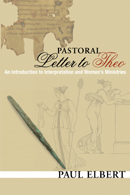
 Paul Elbert, Pastoral Letter to Theo: An Introduction to Interpretation and Women’s Ministries (Eugene, OR: Wipf & Stock, 2008), xxiv + 97 pages, ISBN 9781556355462.
Is it possible that basic hermeneutical principles are violated in an effort to be politically correct in modern society? Some women have felt betrayed or underutilized in the church due to the interpretation of some NT texts that seem to some to teach that their role is relatively minute in comparison to the role of men. Is it in response to women’s liberation that scholars now contend these verses are mere “cultural statements†and thus no longer apply to today’s society? Can one stay true to a historical-grammatical method of hermeneutics and still prove the validity of women in ministry through the very scriptures that some claim to be stating otherwise? Elbert, employing what he has called a narrative-rhetorical hermeneutical method that is charismatically sensitive and not indebted to the historic presuppositional filter of an “apostolic age,†carefully argues that women do have an equal role of ministry and spiritual gifts in the church. This is the essence of the exegesis set out in Pastoral Letter to Theo: An Introduction to Interpretation and Women’s Ministries.
Elbert opens the book stating the importance of good hermeneutical background and methodology. His intention here is to seek the original meaning and authorial intent on key passages in order to promote a more sustained understanding. He further contends that an interpretive method must respectfully account for the cohesive manner of scripture in its entirety. His purpose, therefore, is to prove that “the Spirit retarding claims, artificially devised epochs, and temporal chasm between original and later New Testament readers as a whole, which have been imposed by Protestant scholarship and formally incorporated within some Evangelical faith traditions since the mid-nineteenth century, are inappropriate and need to be considered for retirement†(xvii).
Elbert goes on to state that one of the major hindrances for an acceptable understanding of key passages is due to poor hermeneutics, particularly in “Bible Belt†zones. He contends that some Evangelical groups, in particular, tend to make “bold and textually untested and unconsidered claims based on proof-texting†(4). While Evangelicals themselves are fine people, some have continued for a long time to dogmatically repeat unreflective claims without giving due consideration to a critical contextual interpretation of the texts they repeatedly tout. The historical result has been to uphold an “apostolic-age†style of interpretation stemming from the male-dominated culture of the Protestant Reformation. In so doing, many of these well-intentioned ministers have focused on what is “doctrinally acceptable and thus keep the tradition of proof-texting alive†(5).
Elbert then moves from this potential misinterpretation in John regarding the heavenly Jesus’ ministry of baptism in the Holy Spirit to interpersonal spiritual gifts, as taught in 1 Corinthians. He begins this segment with 1 Corinthians 13:10 and contends that this verse has been venerated as a major proof-texting source by the modern dispensational/cessationistic mindset. After a brief discussion, Elbert closes by pointing out that since we do not see face-to-face Paul’s “that which is perfect†cannot refer either to the canon of scripture or to the later completion of a supposed imaginary epoch (24). As to the imposition of an intervening chasm between Paul’s original readers and later readers, one might draw attention to the apparent chasmal ridiculousness of God, through Paul, taking pains to explain details of interpersonal spiritual ministries that He was about to eliminate.
This argument then moves effortlessly to the role of women in the church and the sexist treatment they have received due to unexamined dictums and grossly distorted texts. Supporting this argument, Elbert again raises the classic case of the “apostolic–age†interpretive method employed by John Calvin at Acts 2:38–39, something that he has written about previously, where Calvin reverses his own contextual interpretation of the gift of the Holy Spirit (2:38). Here Calvin erases his own reading by imposing a cessationistic dictum. Elbert suggests that Calvin’s performance here was politically motivated (29).
— John 7:39 (NKJV)
After his discussion of 1 Corinthians, Elbert confronts the text of 1 Timothy 2:11–12. Once again, he insists that these two verses cannot be extracted from the entire NT context. He goes on to explain the cultural background of Ephesus and role of women in this city, pointing out that the context of 1 Timothy is concerned with the home, not public ministry. Timothy’s warning of a woman exercising authority over a man in referring to the woman’s own husband. Since her husband is the head of the home, she is not to exercise authority over him in particular. This argument is preceded and balanced by Elbert’s comments that wives can be right and calls attention to God telling Abraham to listen to his wife in Genesis 21:9-13. He also points out the distinct instruction of mutual submission in Ephesians 5. As Elbert continues with the specific reference to restrict women from teaching as extracted by some from 1 Timothy, he again reiterates the specific cultural and religious background of this Epistle. These women needed to learn from their husbands. They warranted correction for their religious and social status associated with worship in the Temple of Diana. Elbert firmly establishes this point on the use of the Greek verb epitrepÅ, which refers to a prohibition for a specified time and cannot mean a permanent ban. The textual implication explicitly correlates to the underlying cultural situation (48).
Finally, Elbert closes out the last two chapters of his book by addressing a few key passages in Acts and Romans. He first calls attention to the pouring out of the Holy Spirit on both men and women so that both may prophesy in fulfillment of Joel’s prophesy. Therefore, both sexes are equally equipped for ministry. He then points out Luke’s recognition of Philip’s daughters in their prophetic ministries in Acts 21:8-9 as well as the teaching ministry of Priscilla to Apollos in Acts 18:24-26. In Romans, Elbert brings attention to Phoebe and Paul’s admiration of her ministry as a deaconess in the church that is evidently stated in Romans 16:1-2. Elbert then revisits the ministry of Priscilla (mentioned as Prisca by Paul in Romans) along with her husband Aquila. He highlights Paul’s title of “agents of God†in their work as missionaries to this region (69) and then draws attention to the honorable mention of Junia in her ministry as being “outstanding among the apostles†in Romans 16:7. Elbert believes that Paul regards Phoebe, Prisca, and Junia, along with Tryphaina, Tryphosa, and Persis (Rom 16:12), as not only laborers in the Lord, but as “compatriots†in ministry. He feels that the text suggests these latter three women were also missionaries or local church leaders with whom Paul was personally acquainted.
— John 20:22 (NKJV)
Since the book, though rigorous and compact, has a slight pastoral flavor, Elbert keeps the footnotes to a minimum. However, he provides a thorough “Select Bibliography†(85–97) that affords background to scholarship underpinning this study and its conclusions.
The contribution of this small book is perhaps monumental with respect to its size, putting some of the pieces together that biblically support the role of women in ministry. Elbert eloquently shows the textual cohesion of the many uses and references to women in ministry. He deliberately addresses the problem passages that have been proof texted by those with historical agendas that may not have been as concerned with biblical accuracy as with other matters. Elbert is consistent in addressing these texts in showing their cultural and religious background and specific ministry contexts that have contributed to authors’ original intent. He rightly shows the continuity of scripture and specific references of women in ministry in both testaments. In addition, he shows the diverse roles of these women including administration, politics, teaching, preaching, prophecy, missions, and general leadership of the church. Through this book, Elbert is justified in his conclusion that it is incongruent with scripture to deliberately proof-text the few verses that seemingly limit the role of women in the church when there is an abundance of examples of the opposite application.
Reviewed by Adrian Hinkle
Publisher’s page: wipfandstock.com/store/Pastoral_Letter_to_Theo_An_Introduction_to_Interpretation_and_Womens_Ministries