The kindness that comes as a fruit of the Spirit is revealed in the life of Jesus in His darkest hour of trial. When Judas and the soldiers came to the garden to take Jesus, Peter used his sword to wound the ear of the servant of the High Priest. This man was an enemy of Jesus. But Jesus touched his ear and healed him. Most of us find it easy to be kind to our friends and loved ones, but Jesus was kind to His enemies. Think of Jesus at the table with Judas, knowing that Judas had betrayed Him for 30 pieces of silver. What might some of us have said to him? Something along the lines of “after all I’ve done for you …” But Jesus never uttered one word of reproach.
Kindness is usually associated with mercy. It is not possible to be kind without being merciful. And to be merciful is to be kind. It implies a deep concern for others.
Natural man sees kindness as protecting a weaker person from pain, pressure, and penalty. It often means overlooking the open sin or lawlessness of a fellow human being because it might be unkind to make an issue over something embarrassing. But this human tendency is not true kindness in the spiritual sense—it is simply human compassion.
God is kind, yet God allows man—Christian and non-Christian alike—to experience pain, penalty, and even death. But He shows His kindness during these sufferings even if He does not remove them. His greatest act of kindness was sending His Son so that we did not need to die as a consequence of our own sins. God shows “the surpassing riches of His grace in kindness toward us in Christ Jesus” (Eph. 2:7, MEV).
God’s kindness is much different from what we often call kindness.
God’s kindness, then, is a concern for our spiritual welfare as well as a concern for our physical well-being. The greatest kindness we can show our fellowmen is to bring them an opportunity to meet with their Creator and Savior, Jesus Christ.
Kindness may cost a great deal. It is more than pretending concern for others; it is in fact getting involved with the personal sorrows and pains of other lives to the point where it may cost us serious inconvenience.
Paul uses the word chrestotes 10 times in his epistles, but only in Galatians 5:22—regarding the fruit of the Spirit—is it translated gentleness. All other nine times it is translated kindness (2 Cor. 6:6, Eph. 2:7, Col. 3:12, Titus 3:4) or goodness (Rom. 2:4 and 3 times in Rom. 11:22), or good (Rom. 3:12). Yet Paul clearly intended something other than goodness in in Gal. 5:22, for the very next word listed as a fruit is agathosune which in each of its four New Testament appearances is translated goodness. The most common occurrence of the translation of Paul’s use of chrestotes is kindness.
Of all the fruit of the Spirit, kindness is perhaps the most familiar. This virtue is healing, compassionate, and merciful to others. Kindness is usually associated with mercy. It is not possible to be kind without being merciful. And to be merciful is to be kind. It implies a deep concern for others. Paul admonishes us to kindness in Eph. 4:32: “Be kind and compassionate to one another.”
Spirit-prompted kindness is the disposition to overlook and forgive personal injuries. Instead of vindicating ourselves or sticking up for our own rights, we are told “So embrace, as the elect of God, holy and beloved, a spirit of mercy, kindness, humbleness of mind, meekness, and longsuffering” (Col. 3:12, MEV). In doing so, we are following Jesus, who asked us to “learn from Me” (Matt. 11:29, MEV).
The truly kind people forget their own personal preferences in order to offer help to another person. The truly kind person tries to make the world a better and brighter place for those with pain.
Kindness may cost a great deal. It is more than pretending concern for others; it is in fact getting involved with the personal sorrows and pains of other lives to the point where it may cost us serious inconvenience. The truly kind people forget their own personal preferences in order to offer help to another person. The truly kind person tries to make the world a better and brighter place for those with pain. Our Father shows us this same kindness—His utterly merciful, compassionate, self-giving life is our example.
The fruit of the Spirit refers to a kindness beyond man’s greatest capacity on his own.
The command to be kind is not merely a general encouragement to treat our fellowman better. The world is in need of kindness, of course, but the fruit of the Spirit refers to a kindness beyond man’s greatest capacity on his own. Only with the work of the Holy Spirit can we produce this fruit. It is a kindness both unconscious and spontaneous. We won’t even have to think about it. When the Spirit dwells within us in His fullness, the children of God are moved by an impulsive kindness. As compassion is the opposite of self-pity, so true kindness is the opposite of self-love and pride.
James F. Linzey studied church growth under C. Pete Wagner and signs and wonders under John Wimber at Fuller Theological Seminary. He served on the large ministry team at the Anaheim Vineyard and is the chief editor of the Modern English Version Bible. He has a BA degree in Biblical Studies from Southern California College, and an MDiv degree from Fuller Theological Seminary. He is the author of numerous articles and books, speaker, and recording artist. MilitaryBibleAssociation.com. Wikipedia.org/wiki/James_F._Linzey.
John R. Levison, The Holy Spirit before Christianity (Baylor University Press, 2019) The book consists of Acknowledgments, five chapters, thirteen excurses, varied notes, selected bibliography, and detailed indexes of subjects, ancient names, modern authors and ancient sources. Chapter titles include: “The Emergence of the Spirit: Recasting Exodus”, “The Essence of the Spirit: Retelling Exodus”, “The…
In this guest editorial, Pastor Mur shares his memories of being filled with the Holy Spirit and how he was reminded of this blessing of God while reading Robert Graves’ article, “The Focus of the Charismatic Experience” that appeared in Summer 1999. Robert Graves’ excellent article on “The Focus of the Charismatic Experience” (Pneuma…
Amos Yong and Dale M. Coulter, The Holy Spirit and Higher Education: Renewing the Christian University (Waco, TX: Baylor University Press, 2023), 320 pages, ISBN 9781481318143. Amos Yong and Dale Coulter bring to bear a fruitful and constructive offering in The Holy Spirit and Higher Education whose primary audience are those engaged in work and…
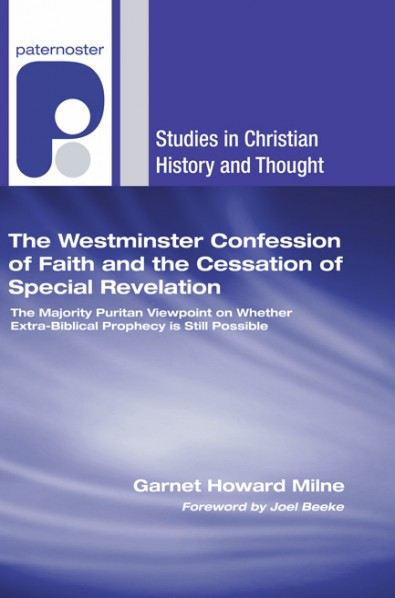
Garnet Howard Milne, The Westminster Confession of Faith and the Cessation of Special Revelation: The Majority Puritan Viewpoint on Whether Extra-biblical Prophecy is Still Possible (Studies in Christian History and Thought; Milton Keynes: Paternoster, 2007), 362 pages, ISBN 9781556358050. This book discusses the circumstances surrounding the Westminster Confession of Faith (the most influential confession in…
Justo L. González, Acts: The Gospel of the Spirit (Maryknoll, N.Y.: Orbis Books, 2001), 291 pages, ISBN 9781570753985. Acts: The Gospel of the Spirit is a translation and update of González’s Hechos in the Comentario Biblico Hispanoamericano (Miami, Fla.: Editorial Caribe, 1992). González‘s discussion for each section in Acts is divided into two parts distinguished…
To provide the best experiences, we use technologies like cookies to store and/or access device information. Consenting to these technologies will allow us to process data such as browsing behavior or unique IDs on this site. Not consenting or withdrawing consent, may adversely affect certain features and functions.
Functional
Always active
The technical storage or access is strictly necessary for the legitimate purpose of enabling the use of a specific service explicitly requested by the subscriber or user, or for the sole purpose of carrying out the transmission of a communication over an electronic communications network.
Preferences
The technical storage or access is necessary for the legitimate purpose of storing preferences that are not requested by the subscriber or user.
Statistics
The technical storage or access that is used exclusively for statistical purposes.The technical storage or access that is used exclusively for anonymous statistical purposes. Without a subpoena, voluntary compliance on the part of your Internet Service Provider, or additional records from a third party, information stored or retrieved for this purpose alone cannot usually be used to identify you.
Marketing
The technical storage or access is required to create user profiles to send advertising, or to track the user on a website or across several websites for similar marketing purposes.