
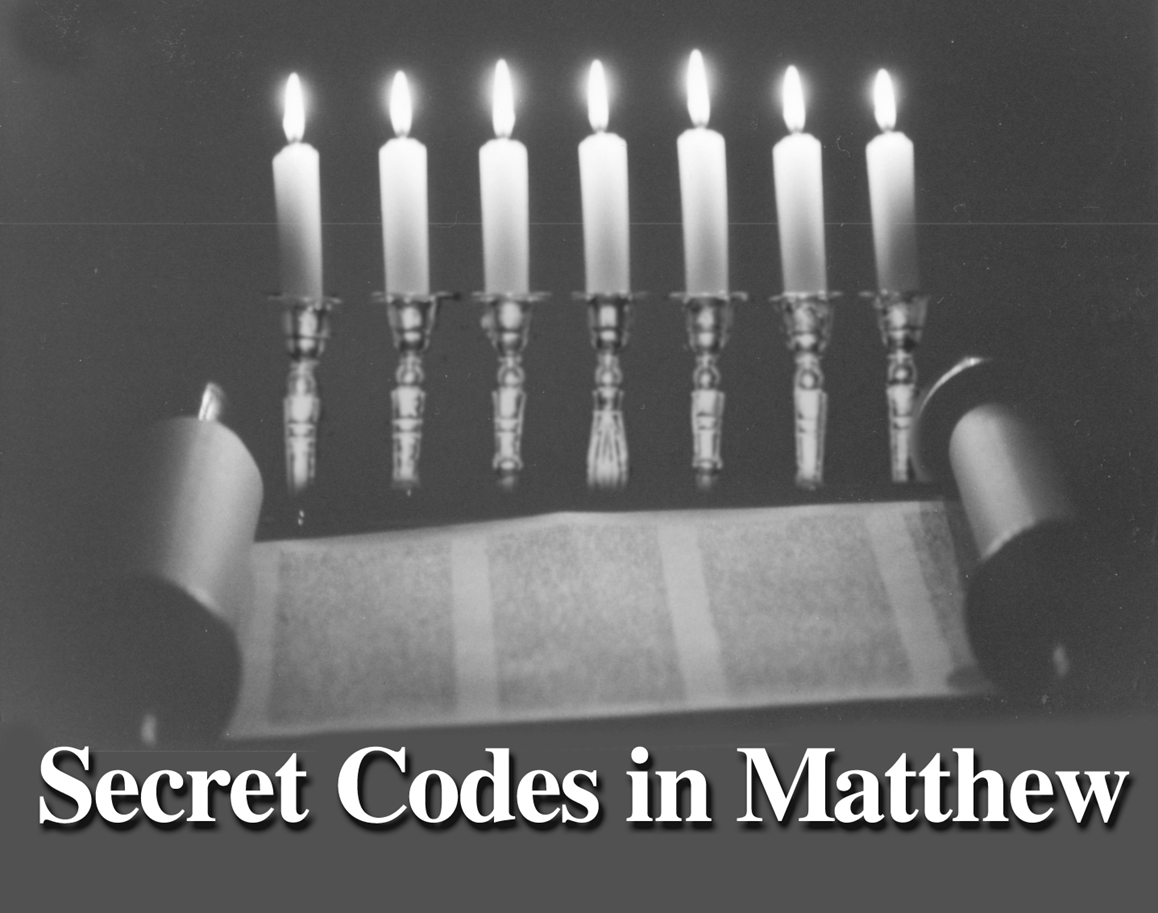
The Secret Codes in Matthew: Examining Israel’s Messiah, Part 2, by Kevin M. Williams

From Pneuma Review Summer 2001
Matthew 1:18-2:12
“Now the birth of Jesus Christ was as follows …†(Matt. 1:18).
We could likely spend a lot of time debating the season of the Messiah’s birth, but we are not going to. We will not even try.
Christian tradition holds to the 25th of December, a date that parallels the celebration of the pagan god Saturn and was indoctrinated sometime around 400 CE. Biblical scholar Alfred Edersheim1 agrees. Noted author John Lightfoot,2 on the other hand, espouses an autumn birth during the Feast of Tabernacles, while Dr. Arnold Fruchtenbaum3 teaches a nativity closer to Passover, in the spring. Each of these renowned scholars have well-founded arguments leaving us to investigate the matter on our own, reaching our own conclusions. The really important news is—the Messiah was born!
Other gospel accounts of the Messiah’s birth begin, “And it came to pass.†John’s words resonate “In the beginning was the Word†(John 1:1). Perhaps the apostle Paul says it best, “But when the fullness of the time came, God sent forth His Son, born of a woman†(Galatians 4:4).
The plan—God’s plan—unfolded right on schedule—in “the fullness of time.†The miracle occurred not a moment too soon, and by all accounts, not a moment too late. Everything was in order.
In part one, we examined that according to some Hebrew theologians, the time appointed for the earth is divided into four distinct ages.
1. Tohu—void (from creation to Abraham)                 2,000 yrs
2. Torah—instruction (Abraham to Messiah’s advent) 2,000 yrs
3. Moshiach—the Messianic Kingdom                         2,000 yrs
4. Shabbat—the Sabbath rest                                      1,000 yrs
                                                                       TOTAL   7,000 years The Soncino edition of the Talmud includes a footnote that the Messiah should have been born at the beginning of this third epoch. While they have no faith that this occurred, they do believe that he will still appear within this 2,000-year period.
This is, believe it or not, an important facet of the birth of Jesus as it relates to the 3rd and 4th epochs. In light of what Peter says, “that with the Lord one day is like a thousand years, and a thousand years like one day†(2 Peter 3:8), we have an important clue to our Matthew examination.
In Jewish life, there are six days to the week, and then the Sabbath. In fact, the Sabbath is the only day of the week with a name! All others are referred to by their number.
With the Shabbat falling on the 7th day, or last day of the week, the following two days (Sunday and Monday respectively) are days of “remembering the Sabbath.†However, by the 4th day, Thursday, one’s attitude is supposed to switch gears, and begin looking forward the next Sabbath. Thursday and Friday, therefore, become days of preparation for the coming day of rest.
This may tie directly into the Hebrew concept of the millennial epochs, and the birth of the Messiah. In the first two epochs—with each epoch lasting two thousand years, or for our purposes, the first four “days of the weekâ€â€”man remembered all that had been lost during the first Sabbatical: his life in the Garden of Eden. He remembered the “rest†that was lost and the subsequent striving to return to paradise.
By the third epoch, the account given here in Matthew, the Messiah was born. In this epoch, two thousand years correlating to the 5th and 6th days of the week, all mankind began looking forward to the 7th day of rest, the Sabbatical millennium, when the Messiah will reign and restore peace to the nations.4
Whether you are a “Sabbath-keeper†or not, and whether you are aware of it or not—if your faith rests in Jesus, then you are indeed among the multitudes looking forward to the 7th day Sabbath.
With “ . . . the birth of Jesus Christ†(Matt. 1:18), the season of preparation began. We eagerly anticipate the Messiah’s return, when He will inaugurate this 4th epoch and proclaim the Messianic Kingdom.
___
“Miriam had been betrothed to Joseph, before they came together she was found to be with child by the Holy Spirit†(Matthew 1:18).
Here we find that Miriam was betrothed to Joseph, but that she mysteriously (albeit miraculously) became pregnant. Yet verse 19 states that Joseph was her “husband.â€
In our modern, western society, this seems irreconcilable. Were they engaged or were they married?
The answer is “Yes.â€
In Israeli society, according to the laws and customs of Torah, a betrothed woman is as good as married. In other words, the betrothal is a legally binding covenant that sets the bride-to-be apart from all others.
In fact, one of the words for betrothed is kiddushin—separated. This young woman was now “off limits†to any other potential courtiers, and reserved only and solely for her bridegroom.
In a remarkable parallel, this contract was officially sealed with a cup of wine. The hopeful groom proposed to his potential bride with a covenant, called a ketubah. In the ketubah were all the promises to care for, love, and provide for his intended. If the young woman agreed to the stipulations of the ketubah, she drank from a cup of wine. From that moment on, she was kiddush—separate (but most frequently translated in the Scripture as “holyâ€.)
How like our own Bridegroom? When we first drank from the cup of communion, we affirmed His covenant promises to us, and we sealed our contract as His Bride. The betrothal was official and we were made kiddush—holy, separated from the world and reserved solely for our Bridegroom until the wedding day.
According to the custom of the day, once the ketubah had been confirmed by the bride and groom, a marriage would take place in approximately one year. The bridegroom went away to build a bridal chamber, a house in which the married couple would dwell. His parting words after the sharing of the cup were, “I go and prepare a place for you.â€
Sound familiar? Our Bridegroom, Jesus, mirrored these words to us in the gospel of John.
“I go to prepare a place for you. And if I go and prepare a place for you, I will come again and receive you to Myself; that where I am, there you may be also†(John 14:2-3)
So, there is no discrepancy between being betrothed and being married in Israel at that time. Rather, through the instructions of God’s Torah, and through this picture, we find a remarkable parallel to our own relationship with our anticipated Bridegroom!
Verse 19 reads, “[Joseph] being a righteous man and not wanting to disgrace her, planned to send her away secretly.â€
The penalty for breaking a betrothal covenant by adultery was death. Looking at outside circumstances, any thinking human being would come to one of two conclusions: either Miriam had been impregnated by another man or Joseph had not waited until the wedding day. In Israeli society, either option was scandalous.
Joseph knew the truth—at least part of the truth. He had no part in the pregnancy, which left him with one earthly conclusion. But his conclusion meant death for Miriam and the child within her.
According to Talmud, “A man who has intercourse with a betrothed girl is subject to the same penalty as one who has intercourse with his mother, namely, stoning.†(Sanhedrin 7:4).
Yet we see a glimpse of Joseph’s compassion, by virtue of the fact that he wished to send her way secretly. This syntax, “to send her away†is legal vocabulary insinuating divorce. It is the same syntax Pharaoh uses in Exodus 12:31 “Then he called for Moses and Aaron by night, and said, “Rise, go out from among my people, both you and the children of Israel. And go, serve the Lord as you have said.†This is the syntax used to give a letter of divorce. In doing so, the whole matter could be handled discretely, Joseph’s reputation might remain untainted and Miriam’s life—and the life of the child—would be spared.
Then comes another miracle:
But when he had considered this, behold, an angel of the Lord appeared to him in a dream, saying, “Joseph, son of David, do not be afraid to take Miriam as your wife; for the Child who has been conceived in her is of the Holy Spirit. “She will bear a Son; and you shall call His name Jesus, for He will save His people from their sins.” Now all this took place to fulfill what was spoken by the Lord through the prophet: “BEHOLD, THE VIRGIN SHALL BE WITH CHILD AND SHALL BEAR A SON, AND THEY SHALL CALL HIS NAME IMMANUEL,” which translated means, “GOD WITH US.” And Joseph awoke from his sleep and did as the angel of the Lord commanded him, and took Miriam as his wife, but kept her a virgin until she gave birth to a Son; and he called His name Jesus. (Matthew 1:20-25).
The angel does not address Joseph as “son of Jacob,†as our genealogy reads (v. 16). Rather he is addressed as “son of David.†The angel’s use of the royal lineage, instead of the patrimonial, is a strong message potentially meant to get Joseph’s spiritual attention. This angel does not see Joseph as merely a common man, but the one through whom the Messiah was promised. Joseph may have been struck with the noble weight with which he was regarded.
The angel then begins quoting prophecies from Isaiah 7:14; Isaiah 9:6, 7; and Isaiah 8:10. Unlike Miriam, who quizzed the angel about how this pregnancy could be (Luke 1:34), the angel’s assertions and use of Scripture fully satisfy Joseph. Could this imply that Joseph was a learned man, and not some simple carpenter from Nazareth? Was he familiar enough with the prophet (read regularly in the synagogues at that time), to comprehend the impact of the angel’s words? Miriam saw a literal manifestation, and still needed to be convinced (as does Zechariah in Luke 1). Joseph had a dream, and it was sufficient. It is this author’s opinion that Joseph was learned, and a man of immense, undoubting faith.
In Israeli society, an adopted child is considered to be as if from your own body. Through this betrothal—truly a match made in heaven—Joseph would claim this son as his own, and rear him with the Torah of Moses, in accord with the prophets.
There are some detractors who insist that Jesus held to a more liberal theological world-view, possibly molded by His earthly father, Joseph. Yet time and again, as we view the early days and years of Jesus’ life, it appears that Joseph is quite committed to his faith, both in Torah and temple observance, and in simple obedience to God’s angelic messenger. It would be inconsistent to have the “Word made flesh†born into a Hellenized, secular home.
Part of Joseph’s obligation was to name this child “Jesus.†Traditionally in Jewish homes, a child is named after an honored relative. In the gospel of Luke (1:67), we read that it caused some confusion for Zechariah and Elizabeth to name their son “John,†since no one else in the family had that name.
We have no clue that a relative of Joseph’s was named “Jesus,†but we have biblical precedent that this name was vital for the Messianic appellation.
It is worth noting that his literal name could not have been “Jesus.†There is no “jay†sound in Hebrew, Aramaic, or Greek. “J†is of Anglo-Saxon origin and unfamiliar in the Ancient Near Eastern tongues. Strong’s Concordance lists his name in the Greek as Iesous. Yet Strong’s also states that this word is of Hebrew origin—Yehoshua, literally meaning, “Jehovah is salvation.†Common to the period, this name, Yehoshua, was contracted into Yeshua.
Why is this name so crucial? Many Jewish opponents to Jesus as the Messiah use following argument: “If Jesus is the Messiah, why doesn’t his name appear in the Tanakh? Certainly God would have given us insight into his name!â€
This is a true statement, yet you will not find an Anglo-Saxon name in a Hebrew text written centuries before the Anglo-Saxons were a people. You will, however, find Hebrew names in the Hebrew text.
That might seem obvious, but for many Jewish and non-Jewish people, it is not. “Jesus†has become such an indoctrinated concept, that accepting any other name seems ludicrous. It is, in many ways, one subtle way that has separated the Church from its Hebraic roots and has driven a wedge between Jewish and Christian peoples. To insist on calling the name “Jesus,†after an Anglican tradition, is pure legalism and not based on an honest evaluation of the Bible.
For instance take a look at Isaiah 62:11 (italics mine), “Behold, the Lord has proclaimed to the end of the earth, Say to the daughter of Zion, “Lo, your salvation comes; Behold His reward is with Him, and His recompense before Him.â€
In this text, we find a grammatical error, unless the text says more that we see. “Salvation†is written as a proper noun, yet this is grammatically impossible unless “salvation†is a person. The Hebrew text is yesha (עשי), the root of Yeshua (עושי)—“YHWH is Salvation.†In Isaiah 62:11, the word is both a concept and a person, “and His reward is with Him, and His recompense before Him.†Grammatically, therefore, Isaiah is speaking of a person—a specific person.
The name was no accident. Neither was it Greek or Anglican in origin. It points to the character of the Jewish Messiah in ways both simple and profound.
Matthew dots the first chapter of his testimony with specific clues. Some obvious, some less so, and some hidden to the unfamiliar eye. To a learned Jewish man or woman, though, his clues point to only one conclusion—this Yeshua was the Son of God, the Messiah of Israel.
What do you think? Will he continue along this vein in the following chapters? Let’s find out.
___
Now after Jesus was born in Bethlehem of Judea in the days of Herod the king, magi from the east arrived in Jerusalem, saying, “Where is He who has been born King of the Jews? For we saw His star in the east and have come to worship Him.†When Herod the king heard this, he was troubled, and all Jerusalem with him. Gathering together all the chief priests and scribes of the people, he inquired of them where the Messiah was to be born. They said to him, “In Bethlehem of Judea; for this is what has been written by the prophet: ‘And you, Bethlehem, Land of Judah, are by no means least among the leaders of Judah; for out of you shall come forth a ruler who will shepherd My people Israel.’â€
Matthew follows the pattern in Chapter One quite consistently. Here we are not drawing attention to the magi, nor to Herod, but to Bethlehem and the Shepherd.
Regarding Bethlehem, The p’shat5 interpretation is clear—a geographical location evident on most maps. The remetz6 interpretation is also rather clear—the birthplace was prophesied hundreds of years earlier in Micah 5:2. What about the sod7 interpretation?
Bethlehem, Bayt-lechem (סחל תיב), is two words in the Hebrew and literally means, “house of bread.†Is it a coincidence that the One called the Bread of Heaven8 would be born out of the “house of bread?†Is it really a random event, that the Bread of Life9 that comes down out of heaven, that was broken for us10, would find its beginning in Bayt-lechem?
I tend to agree with a Messianic Jewish friend of mine who says, “There is no such thing as coincidences, only God-incidences!â€
Regarding the Shepherd, we have many allusions in the Tanakh of the Messiah as the Great Shepherd. One of the best is out of the book of Ezekiel (37:24), “My servant David will be king over them, and they will all have one shepherd; and they will walk in My ordinances and keep My statutes and observe them.â€
In John 10:1–18, Yeshua designates Himself as that “Good Shepherd†who would draw His sheep from His own flock (Israel) as well as sheep from another flock (the Gentiles) and form them into one flock. This seems to reflect the sentiment of Isaiah 56:8, “The Lord GOD, who gathers the dispersed of Israel, declares, ‘Yet others I will gather to them, to those already gathered.’â€
These priests and scribes Herod gathered together give a correct answer, geographically, politically, scripturally, and whether they were aware of it or not—deeply spiritually.
For those Jewish sages with eyes that see, as the Bible says, these nuances would not have been lost on them. Matthew was revealing treasures of biblical truth that have often been buried by those unfamiliar with Jewish heritage.
___
As to the magi (wise men in the King James translation), many traditions have become entrenched in the collective Christian memory. Rarely is the following considered, and yet it seems fully consistent with the Tanakh and is another potential landmark on our treasure map.
Of the magi Wesley says:
Wise men—The first fruits of the Gentiles. Probably they were Gentile philosophers, who, through the Divine assistance, had improved their knowledge of nature, as a means of leading to the knowledge of the one true God. Nor is it unreasonable to suppose, that God had favoured them with some extraordinary revelations of himself, as he did Melchisedec, Job, and several others, who were not of the family of Abraham; to which he never intended absolutely to confine his favours. The title given them in the original was anciently given to all philosophers, or men of learning; those particularly who were curious in examining the works of nature, and observing the motions of the heavenly bodies.
While I hold Wesley in the highest regard, and appreciate his scholarship, I humbly disagree. It appears that Dr. David H. Stern has an insight worth investigating.
Magi were not merely sorcerers or magicians, although the term “magician†comes from this word; nor where they simply astrologers, although they did observe the stars. They were sages, wise men, often in positions of responsibility but sometimes commanding respect because of their wisdom even when not holding office. These Magi came from the Medo-Persian Empire or Babylon.11
For me, the answer lies in the book of Daniel. In this Babylonian tome, we find the term “wise men†used 13 times. These chakkiym (מיבבח) were men of great influence in the Babylonian Empire. While time and space do not permit a complete investigation, one point is very important: in this institution of learning, the Jewish prophet Daniel was preeminent.
“Then the king promoted Daniel and gave him many great gifts, and he made him ruler over the whole province of Babylon and chief prefect over all the wise men of Babylon†(Daniel 2:48, emphasis mine).
This made Daniel not merely a magi, but chief magi. His words and his prophecies would have carried great weight throughout the Empire (incidentally, east of Israel.) In Daniel 9, we have a clear indication of the time of the Messiah’s coming. The Babylonian magi contemporary to Yeshua’s birth would, in all likelihood, been very familiar with the writings of their great prophet and had set out for Israel in anticipation of the Messiah’s birth.
“Where is He who has been born King of the Jews? For we saw His star in the east and have come to worship Him†(Matthew 2:2).
The question must be raised, why would pagan wise men come to worship a Hebrew king—not merely to witness, but to worship? It seems highly unlikely—let alone politically unsound—unless they had a unique insight, such as a sacred scroll left to them foretelling this great event by one of their greatest prophets, Daniel, chief prefect over all the wise men of Babylon.
It is also quite possible—though not authoritatively so—that these wise men were themselves, Jewish, coming to worship their own Messiah. We know that the majority of the Hebrew population carried off into Babylonian exile stayed behind. We also know that the authoritative Hebrew scholarship came not out of Israel, but out of Babylon, from whence we get the Babylonian Talmud. Even the great mishnaic scholar Hillel (president of the Temple Sanhedrin at the time of Yeshua’s birth) came from Babylon. While in the realm of speculation, it seems a point worth consideration.
___
In part three, we will look into Miriam and Joseph’s flight into Egypt, John the Baptist, and the birth of Yeshua’s three-year ministry.
Endnotes
1 Bishop John Lightfoot (1602-1675): English scholar partially responsible for formulating the Westminster Confession, and best known as the author of the Commentary of the New Testament from the Talmud and Hebraica.
2 Alfred Edersheim (1825-1889): Vicar of Lodera, Dorsetahire, Curate of the Abbey Church, Christchurch, Hants Oxford Lecturer, Select Preacher to the University, Grinfield Lecturer on the Septuagint. Himself a Jew, he is best known for the work The Life and Times of Jesus the Messiah.
3 Dr. Arnold Fruchtenbaum (1943-): Founder of Ariel Ministries, Tustin, California, was formerly editor of The Chosen People, associate director of The Christian Jew Foundation. The completion of his dissertation, Israelology: The Missing Link in Systematic Theology, was the culmination of 13 years of research for which he earned his Ph.D. at New York University in 1989. Dr. Fruchtenbaum has authored numerous published works and recorded many Biblical studies of keen interest to both Jews and Gentiles.
4 Isaiah 2:4, Micah 4:3
5 p’shat = literal or simple interpretation. For a more complete introduction to rabbinic interpretation see “The Secret Codes in Matthew: Examining Israel’s Messiah†Part 1 in Pneuma Review Spring 2001 (Vol 4, No 2).
6 remez = deeper figurative interpretation.
7 sod = deeper spiritual interpretation. Also written coq.
8 John 6:51
9 John 6:35
10 Mark 14:22
11 Jewish New Testament Commentary, 1992, Jewish New Testament Publications, Clarksville, MD, p. 9.
Â





In the penultimate paragraph, a curious claim is made. How is "salvation written as a proper noun" in this verse? I know of no way to distinguish proper from common nouns in the Hebrew writing system. There's nothing "grammatically impossible" about the word יִשְ×עֵךְ denoting a concept or state rather than a person. It's certainly possible to understand יִשְ×עֵךְ by metonymy as 'savior' rather than 'salvation' and then to interpret the suffixes on the ensuing nouns as referring back to the savior, but one could also take יהוה as their antecedent and understand יש××¢ as the abstract 'salvation'.
In the penultimate paragraph, a curious claim is made. How is "salvation written as a proper noun" in this verse? I know of no way to distinguish proper from common nouns in the Hebrew writing system. There's nothing "grammatically impossible" about the word יִשְ×עֵךְ denoting a concept or state rather than a person. It's certainly possible to understand יִשְ×עֵךְ by metonymy as 'savior' rather than 'salvation' and then to interpret the suffixes on the ensuing nouns as referring back to the savior, but one could also take יהוה as their antecedent and understand יש××¢ as the abstract 'salvation'.
@Timothy Mcmahon One exception is the case of Steven with "Ph" 🙂
@Timothy Mcmahon One exception is the case of Steven with "Ph" 🙂
In the penultimate paragraph, a curious claim is made. How is “salvation written as a proper noun” in this verse? I know of no way to distinguish proper from common nouns in the Hebrew writing system. There’s nothing “grammatically impossible” about the word יִשְ×עֵךְ denoting a concept or state rather than a person. It’s certainly possible to understand יִשְ×עֵךְ by metonymy as ‘savior’ rather than ‘salvation’ and then to interpret the suffixes on the ensuing nouns as referring back to the savior, but one could also take יהוה as their antecedent and understand יש××¢ as the abstract ‘salvation’.
@Timothy Mcmahon One exception is the case of Steven with “Ph” 🙂
In the penultimate paragraph, a curious claim is made. How is “salvation written as a proper noun” in this verse? I know of no way to distinguish proper from common nouns in the Hebrew writing system. There’s nothing “grammatically impossible” about the word יִשְ×עֵךְ denoting a concept or state rather than a person. It’s certainly possible to understand יִשְ×עֵךְ by metonymy as ‘savior’ rather than ‘salvation’ and then to interpret the suffixes on the ensuing nouns as referring back to the savior, but one could also take יהוה as their antecedent and understand יש××¢ as the abstract ‘salvation’.
@Timothy Mcmahon One exception is the case of Steven with “Ph” 🙂