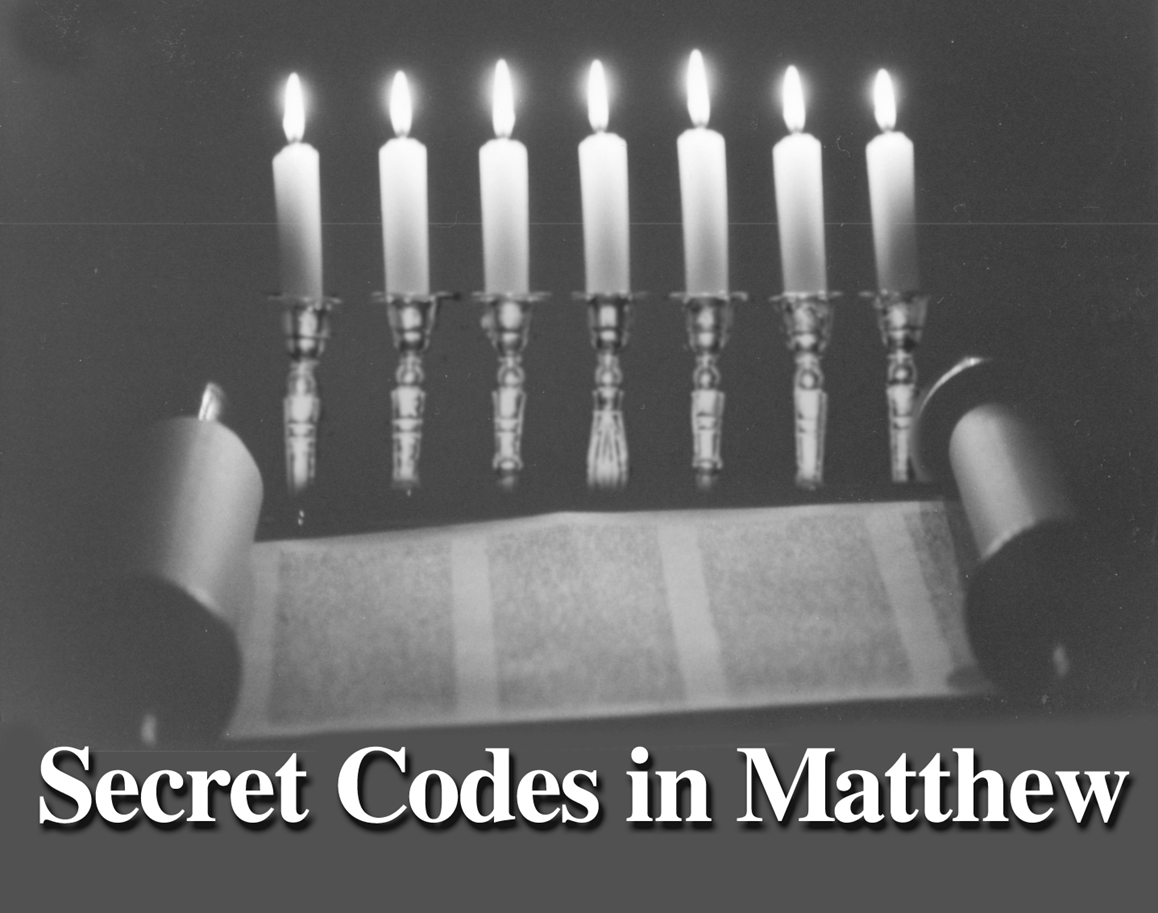
The Secret Codes in Matthew: Examining Israel’s Messiah, Part 20: Matthew 26:1-30, by Kevin M. Williams

Messiah celebrates his final Passover on earth, teaching us much about His own identity as the Paschal Lamb.

And it came about that when Jesus had finished all these words, He said to His disciples, “You know that after two days the Passover is coming …†(Matthew 26:1-2a).1
Passover: the overriding event in Israel at the time of Yeshua’s2 crucifixion receives scant attention in the gospel accounts. Hundreds of thousands of fathers and husbands, often with their 12-year-old sons, would travel to Jerusalem to make the Paschal sacrifice required in Exodus 12. But in the period when Matthew was written, among the Jewish people, little needed to be said. Matthew’s audience was well acquainted with the traditions, symbols, and significance of Passover and the weeklong observance of the Feast of Unleavened Bread. For such an audience, Pesach—as Passover is called in the Hebrew—required no exposition.
2,000 years removed from Israel and the temple, from young innocent lambs and the ritual slaughter, from the weeklong observances of matzah bread and the inherently Hebraic perspective, our modern understanding and therefore, appreciation of events in Israel may be lacking.
In this section of The Secret Codes in Matthew: Examining Israel’s Messiah, we return to the root and core—the very foundation if you will—upon which the entire structure of redemption was built. This foundation—yesod in the Hebrew—is rich with imagery, and a testimony to the awesome foresight and design of its Great Architect, the Almighty Father, who built so firm a foundation. “Therefore thus says the Lord God, ‘Behold, I am laying in Zion a stone, a tested stone, A costly cornerstone for the foundation, firmly placed. He who believes in it will not be disturbed’†(Isaiah 28:16).
Every year, in Jewish homes around the globe, it is expected to not merely participate in the Seder, the order of service for Passover, but to engage in the observance as if actually participating in the events. May this be true for us as well, as we step into the culture and history of biblical Israel.
___
“You know that after two days the Passover is coming, and the Son of Man is to be delivered up for crucifixion†(Matthew 26:2).
Yeshua’s execution was a foregone conclusion. Not only had Yeshua told them on more than one occasion, 1 Peter 1:20 reminds us, “He was foreknown before the foundation of the world.†The plan of salvation had been set in motion long before Matthew, Moses, or Adam.
Yet with every perfect work of God, the Adversary of our souls contrives counterfeits to distract and derail men and women of otherwise good conscience. Out of this divine promise that “the Son of Man is to be delivered up for crucifixion†came the fabricated lie of the Jews as “Christ Killers,†a bitter root in Church history that has defiled too many for too long. This deceit became a rationalization for the Church to persecute the Jewish people and remains a blot on our religious history that should not be overlooked or forgotten.
As Jewish men, women, and children were marched into Nazi concentration camps, they read signs that said, “You killed our God, now we kill you.†Even today, some still live who read those signs in their lifetime and have endured “Christian†hatred.
Of course, no one can truly be considered a Christian and hate the Jewish people, or any people. No one who follows the Messiah of Israel as an honest disciple can hold anyone more accountable for Yeshua’s crucifixion than him or her self, acknowledging that the Messiah gave his life as an atonement for all who believe. This is key.
Knowing as He did that He was to be “delivered up for crucifixion,†Yeshua willingly participated. Knowing the anguish he was to endure, He faithfully fulfilled that for which He had been sent. Like those Passover lambs being herded into Jerusalem, Yeshua was “like a lamb that is led to slaughter,†(Isaiah 53:7), and He did so with love in His heart for all mankind.
As we shall see, as our story unfolds, there were certainly Jewish men who aided in this process, but we shall examine their motives and their actions to find that “Jews†did not kill the Savior who would not stay dead. Rather, they were His witnesses that the world may know.
“Then the chief priests and the elders of the people were gathered together in the court of the high priest, named Caiaphas; and they plotted together to seize Jesus by stealth, and kill Him. But they were saying, ‘Not during the festival, lest a riot occur among the people’†(Matthew 16:3-5).
In Isaiah 53:2 of the King James Version we read of the Messiah that, “he hath no form nor comeliness.†Note the contrast then that Caiaphas means “comely†in Aramaic. The true Judge and the false; no comeliness and comely; the One who plans redemption and life, and the other who plots stealth and death.
But we also find credibility to the previous assertion. First: only a few mislead leaders participated in the Messiah’s execution. The text clearly says as much. Second, these very same leaders feared an uprising from the populace. Why? As discussed in part 17 (Pneuma Review Winter 2005), there were myriads—untold thousands—who had welcomed Yeshua to Israel because they believed he was the long-awaited Messiah. The city was filled with followers, not accusers.
One the other hand, in what can only be described as the spirit of anti-Christ, Caiaphas the comely high priest, premeditated murder; the very antithesis of all he represented as Cohen Gadol, the High Priest and enforcer of God’s holy Torah on earth.
___
“Now when Jesus was in Bethany, at the home of Simon the leper, a woman came to Him with an alabaster vial of very costly perfume, and she poured it upon His head as He reclined at the table. But the disciples were indignant when they saw this, and said, ‘Why this waste? For this perfume might have been sold for a high price and the money given to the poor.’ But Jesus, aware of this, said to them, ‘Why do you bother the woman? For she has done a good deed to Me. For the poor you have with you always; but you do not always have Me. For when she poured this perfume upon My body, she did it to prepare Me for burial. Truly I say to you, wherever this gospel is preached in the whole world, what this woman has done shall also be spoken of in memory of her’†(Matthew 26:6-13).
Our Passover narrative is interrupted briefly with Yeshua’s visit to the house of Simon the leper. Some postulate, based on Luke7:36-4 that Simon was in fact, a Pharisee. This conclusion satisfies this author who has previously pointed out that not all Pharisees were opposed to Yeshua’s message or messiahship.
However, not all theologians agree on this matter, let alone the gospels themselves. John’s gospel, written decades after Matthew, records, “Jesus, therefore, six days before the Passover, came to Bethany where Lazarus was, whom Jesus had raised from the dead. So they made Him a supper there†(John 12:1-8).
I cannot speak to the incongruity. That Yeshua may have dined in more than one persons’ home is not outside the realm of possibility. However, that his feet would be anointed so ceremonially on two separate occasions in the same week with the same outcome seems unlikely. For those who wish to debate such technical inconsistencies while ignoring spiritual uniformity—may they soon come to understand the futility of their work.
I can however, speak to the religious spirit that asked “Why this waste?†First of all, the text is careful to point out, “But Jesus, aware of this, said to them …†implies that the disciples were gossiping in secret, and trying to sound pious (at least to one another). One of the first signs of a religious spirit is to complain out of earshot of those with the authority. This religious spirit divides congregations, destroys unity, betrays, and operates to bring down honest, righteous leadership.
That a betrayal was indeed going on is evident in verses 14-15: “Then one of the twelve, named Judas Iscariot, went to the chief priests, and said, ‘What are you willing to give me to deliver Him up to you?’ And they weighed out to him thirty pieces of silver. And from then on he began looking for a good opportunity to betray Him.†Certainly Judas Iscariot was not operating in a messianic spirit.
“Truly I say to you, wherever this gospel is preached in the whole world, what this woman has done shall also be spoken of in memory of her†(Matthew 26:13) is worth repeating. Strong’s Concordance defines “gospel†as the “gospel of the kingdom of Heaven,†which has also been discussed previously. Yeshua was not speaking of the texts of the gospels; Matthew, Mark, Luke, and John, but rather, the witness of the message of the kingdom of God as a whole.
What this woman did, presumably Mary (though which Mary is not absolutely clear), the outpouring not only of a costly oil, but the outpouring of herself and her earthly wealth to glorify the Messiah, is lifted by Yeshua to a very high standard of excellence, that it would be “spoken of in memory of her,†wherever the gospel was preached in the entire world. Those are high accolades indeed, and a deed worth emulating in our own lives.
___
“Now on the first day of Unleavened Bread the disciples came to Jesus, saying, ‘Where do You want us to prepare for You to eat the Passover?’†(Matthew 26:17).
This becomes a stumbling stone for many critics of the Bible. Was Yeshua sacrificed on Passover or the Feast of Unleavened Bread? Was he sacrificed on Nisan 14 or 15 in the Jewish calendar? This verse would seem to indicate that they did not sit down to eat until the 15th and therefore, missed the actual Passover. Some also indicate that Yeshua was already breaking with the commandments of the Torah in favor of a more liberated theology, in which the Law had been fulfilled and was no longer binding.
However, within Israel—and even to this day—Passover and the Feast of Unleavened bread are synonymous with one another. To the Jewish mind, Passover is an eight-day observance, including the Feast of Unleavened bread and vice-versa. The disciples were not being incongruent. They were being very Jewish.
And He said, “Go into the city to a certain man, and say to him, ‘The Teacher says, “My time is at hand; I am to keep the Passover at your house with My disciples.â€â€™â€ And the disciples did as Jesus had directed them; and they prepared the Passover (Matthew 26:18-19).
The other gospel accounts give us an even deeper look into the Messiah’s powerfully prophetic gifts and another proof of His Messianic claim.
But this verse is the first that brings us to a logistic quagmire into which some become mired. To prepare for the Passover Seder meant, in part, to go to the Temple, sacrifice the required lamb, bring it home and eat it with the rest of the ritual meal. If this is the case, then Yeshua could not have been crucified on the Passover—Nisan 14. The very next verse reads, “Now when evening had come, He was reclining at the table with the twelve disciples†(Matthew 26:20).
In the Jewish calendar, almost every holy day (Rosh Hoshanna, Yom Kippur, Sukkot, etc…) begins on sundown of the previous day—according to our western calendars. Ergo, if your calendar shows Yom Kippur on a Friday, it actually begins at sundown on Thursday.
The only holy day that follows a different practice is Passover—setting it apart from all other feast day observances. The Paschal lamb was sacrificed on the 14th of Nisan—and there were hundreds of thousands of lambs slaughtered, making it an all day affair—so that it would be eaten after sundown, the beginning of the 15th. Exodus 12:5-6 reads, “Your lamb shall be an unblemished male a year old; you may take it from the sheep or from the goats. And you shall keep it until the fourteenth day of the same month, then the whole assembly of the congregation of Israel is to kill it at twilight.â€
The Hebrew word “twilight†is erev, whereas the word for “night†is lila. Erev occurred between 3:00 p.m. (the 9th hour) and 6:00 p.m. The lamb in Exodus 12:6 is to offered up at erev—twilight. The Hebrew is quite specific.
So too is the Greek. In Matthew 26:20 it says that “when evening had come.†The Greek word is opsios, or twilight, the period between 3:00 p.m. and 6:00 p.m. Nisan 14 is in fact Passover, but only inasmuch as this is the day when the Paschal lamb was slaughtered. But by the instruction of the Torah, it was consumed in one’s home after sunset, making it the beginning of the next day, the 15th of Nisan.
For some this raises the question, “How then can Yeshua be our Paschal sacrifice?â€
The answer resides in the Jewish tradition and helps us see why understanding the New Testament from a Hebraic perspective is so useful in absorbing the entirety of the message of the Bible.
The Nisan 14 sacrifice was known as the first Chagigah (pronounced ha-gee-gah). But there was a second Chagigah as well on Nisan 15 at the 9th hour. In Orthodox Jewish homes to this day, the Passover meal is a two-night observance, known as the 1st and 2nd Chagigah, and the Seders are identical.
For many, because of the separation of the Jewish and Christian traditions, that Yeshua may have been sacrificed on the 15th and not the 14th flies in the face of all they have been taught.
Yes, it does.
But as already noted, Passover and the Feast of Unleavened bread are synonymous in Hebraic theology and practice. Even further, there is strong biblical parallel for Yeshua to have been offered up as the 2nd Chagigah. Numbers 33:3 reads, “And [the people of Israel] journeyed from Rameses in the first month, on the fifteenth day of the first month; on the next day after the Passover the sons of Israel started out boldly in the sight of all the Egyptiansâ€3 (brackets mine).
The day of Israel’s liberation from bondage did not take place on the 14th, but on the 15th of the month. This is part of the historical foundation of the overall picture. If we accept that Yeshua’s life is a portrait of redemption, patterned after the reality of the entirety of the Passover season, when death was made to pass over the faithful on the 14th, and liberty came on the 15th of Nisan, we find a more perfect representation of spiritual truth in the sacrifice of Yeshua as the 2nd Chagigah.
And as they were eating, He said, “Truly I say to you that one of you will betray Me.†And being deeply grieved, they each one began to say to Him, “Surely not I, Lord?— And He answered and said, “He who dipped his hand with Me in the bowl is the one who will betray Me†(Matthew 26:21-23).
Again our story is involved in the Passover narrative. Dipping in the bowl was not unusual. In fact, the tradition calls for a bowl of salt water into which the karpas, or greens are dipped. Interestingly and poignant to the story of Judas’ betrayal is the fact that the salt water represent “the tears of life.†Yeshua and Judas together, dipped into the tears of life. “The Son of Man is to go, just as it is written of Him; but woe to that man by whom the Son of Man is betrayed! It would have been good for that man if he had not been born†(Matthew 26:24). Tears indeed.
And while they were eating, Jesus took some bread, and after a blessing, He broke it and gave it to the disciples, and said, “Take, eat; this is My body†(Matthew 26:26).
The bread, or in this case matzah bread, was the only bread eaten during the eight days of the Feast, and the blessing—assuming they held to the religious tradition then as well as today—was, “Blessed art Thou, O Lord our God, King of the universe, who causes bread to come from the earth.†In Hebrew tradition, the blessing over a meal is a blessing to God coupled with thanksgiving. In that regard, Christian prayers that ask God to “bless this meal†are alien to the Jewish culture.
The breaking of the matzah during the Seder is likewise a traditional observance. Generally, the head of the house—the grandfather or father of the family—would lead the meal and would break and distribute pieces of the bread. In the relationship of a rabbi and his talmadim (disciples), the rabbi functioned as the head.
However, something deeper and potentially more prophetic and profound happened here as well. Next to the Paschal lamb, the matzah bread plays one of the most significant roles in the eight days of Passover. After the temple was destroyed by the Romans in 70 of the Common Era, the surviving Pharisees convened an emergency session called the Council of Yavneh. The Sadducees and Scribes had largely been casualties of the temple’s razing, and if Judaism was to survive, those assembled in Yavneh would have to pave the way. In that regard, much of today’s Orthodox Jewish practice traces its roots to the Pharisees of Yavneh. It was here that the religious observance and authority of priest and temple transitioned to the synagogue.
At the Council of Yavneh, one of the issues was “without the temple, how shall we partake of the Paschal lamb?†It was decided that until the temple was restored, lamb would not be served at any Seder meal. Instead, the matzah bread would symbolically become one with the Passover lamb. Anyone eating the Passover matzah would—from the Jewish perspective—also partake of the Passover lamb.
Yeshua—the Passover Lamb—said prophetically to His disciples during the Last Supper, “Take, eat; this is My body.†The Lamb of God and the Bread of Affliction, as matzah was known during the Feast, became one and the same, and for those of us who participate in communion, we share a common link, though with two symbolic meanings.
And when He had taken a cup and given thanks, He gave it to them, saying, “Drink from it, all of you; for this is My blood of the covenant, which is poured out for many for forgiveness of sins†(Matthew 26:27-28).
In the Tanakh—the Hebrew Scriptures—blood is the common ratification of a covenant. This was true with Noah, with Abraham, with Moses, and with David. Only one promised covenant had not been ratified: the New Covenant of Jeremiah 31:31—“‘Behold, days are coming,’ declares the Lord, ‘when I will make a new covenant with the house of Israel and with the house of Judah.’â€4
That which had not been confirmed had not been forgotten. Through the cup of the Messiah’s Passover, already known in the Seder as the “Cup of Redemption,†came the ratification the people of Israel had so long awaited.
The New Covenant carries with it certain promises which, when contrasted with the Abrahamic, Mosaic, and Davidic covenants have amazing similarities. “‘But this is the covenant which I will make with the house of Israel after those days,’ declares the Lord, ‘I will put My law within them, and on their heart I will write it; and I will be their God, and they shall be My people’†(Jeremiah 31:33). These bear a striking resemblance to promises in the Abrahamic, Mosaic, and Davidic covenants. In fact, a closer look into those three previously ratified covenants will show a progressive expansion of each covenant, reiterating many of the terms and requiring the pre-existence and continuance of each previous covenant to uphold and substantiate the next.
It should come as no surprise then, that the term “New Covenant,†or B’rit Chadashah, in Jeremiah shares the same root with the Hebrew word “renewed.†We find the same word chadash, in two other places in Scripture; Isaiah 61:4 and Lamentations 5:21. The first is translated as “repair,†and the second as “renew.â€
For some, the “New Covenant†of Jeremiah 31:31 is in fact the “Repaired Covenant,†or “Renewed Covenant,†and not entirely new at all, but a spiritual renewal incorporating some of the previous covenant’s promises in a demonstration of divine continuity and progressive revelation.
But I say to you, I will not drink of this fruit of the vine from now on until that day when I drink it new with you in My Father’s kingdom (Matthew 26:29).
Some have suggested that in this verse Yeshua binds himself to a Nazarite vow. This may be so. The conditions of a Nazarite vow are that the man must abstain from grape products or wine and that he not cut his hair.
We seem to find some continuity in that Yeshua promises not to drink from the fruit of vine again, and we know that the Wedding Feast of the Lamb awaits us, where heavenly wine will certainly be served in the “Father’s kingdom†after the Messiah’s vow is fulfilled.
The only inconsistency remains the cutting of hair, and this we can neither deny nor confirm. The only latter description we have of Yeshua comes to us from the apostle John: “And His head and His hair were white like white wool, like snow (Revelation 1:14). This does not give us a hint as to whether Yeshua’s hair was uncut or not.
And after singing a hymn, they went out to the Mount of Olives (Matthew 26:30).
And still the Passover celebration finds its way into our narrative. At the conclusion of the Seder meal, it has been a long held joy to sing the Hallel—praises—or more specifically, Psalms 113-118.
At this point in the Paschal observance, it is Nisan 15, the first day of the Feast of Unleavened Bread, a High Holy Sabbath (see Leviticus 23:7), and an important point of reference in the events that follow Yeshua’s betrayal.
___ In Next Issue
In Part 21 of our examination of Matthew, we shall look at Yeshua’s trial and the travesties committed by the Sanhedrin. It was a High Holy Sabbath, and according to oral law, many things that were sanctioned that night by Israel’s leaders had previously been forbidden by Israel’s leaders.
Notes
1 Unless otherwise noted, the New American Standard Bible is used with permission.
2 The Hebrew name for the anglicized “Jesus†and so used throughout.
3 Brackets mine. At this time, the Hebrew calendar began with Nisan as the 1st month. The transformation to the month of Tishrei and Rosh Hoshannah as the 1st of the civil calendar began during the Babylonian exile.
4 It is interesting to note that this covenant is for the house of Israel and Judah. There is no mention of Gentiles or the “world-at-large†in this promise.
Â