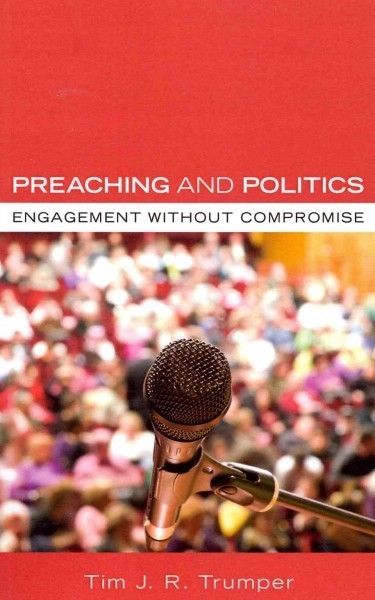
Tim J. R. Trumper, Preaching and Politics

 Tim J. R. Trumper, Preaching and Politics: Engagement without Compromise (Eugene, OR: Wipf & Stock, 2009), 97 pages, ISBN 9781606080085.
How do you avoid extremes in the pulpit on controversial affairs of state?
As a Reformed Calvinist pastor, Trumper writes for conservative and Reformed evangelicals. He advocates for a middle position between not preaching on politics at all and making preaching altogether political. He calls his position ‘the biblical-political approach.’ His research incorporates both liberal and conservative writers on the subjects of politics and the Bible. In following his father’s advice, he wishes to follow Christ more than any party or personality. Since he is both a citizen of Great Britain and a resident of the United States, he covers the political spectrum in both countries.
According to Trumper, expository preaching best allows preachers to address the strengths and weaknesses of both political parties in the light of Scripture. In the three chapters of his short book, he maintains the biblical-political approach is a middle way, a spiritual way, and a practical way. He rightly maintains some preachers over-engage politics in the pulpit, while others never engage political issues at all. His contention that the Fox television channel does not speak adequately for the church might rile some conservative readers. Its owners, in his view, also tend to worry more about ratings than objectivity. He sounds the alarm against the dangers of generalizations of either party. He argues correctly, in the opinion of this reviewer, that avoidance of political preaching altogether is irresponsible and unbiblical. The Old Testament prophets certainly addressed political issues.
Why does expository preaching, in particular, serve as the most effective approach in the pulpit? For the following reasons: it comprises the most comprehensive approach, best covers the biblical world view, keeps the preacher away from hobby horses, and broadens the possibilities of application (pp. 22-4). The biblical–political preacher will encourage examination of both the issues and methods of debate (p. 51).
Trumper wisely reminds his readers that equally sound and committed Christian thinkers take different sides on the same issues. He discusses how various preachers deal with congregants who disagree with their approach. Often, unfortunately, they are subtly encouraged to leave, despite the fact that Scripture never endorses any political party. In a thorough fashion, the writer evaluates the pros and cons of the three current approaches taken and concludes that the middle way of expository preaching has the best chance to make converts and save the culture.
The research done for this volume was thorough. The footnotes and bibliography refer the reader to a wealth of resources from the left and the right, politically and theologically. In this way, the author serves as an excellent example of the stance he advocates. The biblical-political approach demands more exacting scholarship out of the preacher in terms of both the study of Scripture and society than either of the other two approaches (pp. 56-7). Of course, preachers who follow the likes of James Kennedy, the former pastor of Coral Ridge Presbyterian Church, will disagree with this author’s middle of the road stance, as will supporters of the likes of Jerry Falwell, former founder of the Moral Majority. Both of these evangelical preachers tended to address political issues in the pulpit more often than most of their peers and tended to side with only the Republican Party.
The middle way is destined to please and displease all involved. Naturally, advocates from the partisan and apolitical sides will find fault with much said in this book. The person in the middle is always attacked from both sides. This reviewer does agree with the author; however, he maintains this approach is easier said than done. More examples, maybe even a few from his own actual sermons, might have clarified some of the concepts discussed and served as useful models for readers to follow.
The final major chapter suggests useful ways of carrying out the biblical-political approach. The book concludes with a helpful and clear summary of the points made throughout its pages. The very prospect of preaching depends to a certain extent upon the morals of a culture and the freedom it permits for interaction within its confines. Preachers, as well as believers in general, are taught to pray, “Thy will be done on earth as it is in heaven,’ and to work to see it done.
Overall, the author is fair in his assessments, clear in his examples, orderly in his organization, and balanced in his approach. His analysis should encourage the apolitical to speak up occasionally and the party-political to tone it down a note.
This reviewer especially appreciates the author’s attitude, illustrated by the following quote: “Enlisting under Christ’s banner, the biblical-political preacher understands that it matters not only what battles we choose, but how we fight, and what forces we engage†(p. 50). Discussion questions are provided at the end of each chapter and a useful bibliography on the subject from a wide variety of sources is included in the back. The author has done preachers of the gospel everywhere a genuine service. His recommended approach is worthy of emulation because it is both spiritual and impartial, biblically and politically.
Reviewed by Steve D. Eutsler
Publisher page:Â wipfandstock.com/store/Preaching_and_Politics_Engagement_without_Compromise