To Everyone an Answer: A Case for the Christian Worldview

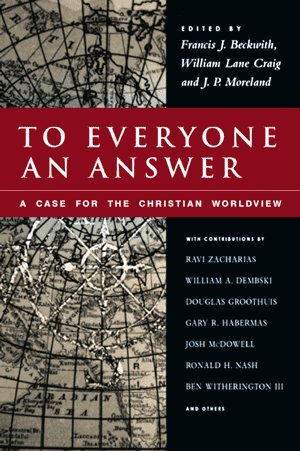
 Francis J. Beckwith, William Lane Craig, and J. P. Moreland, eds., To Everyone an Answer: A Case for the Christian Worldview (Downer’s Grove: InterVarsity Press, 2004), 396 pages, ISBN 9780830827350.
These essays are presented in honor of Norman L. Geisler, a popular Evangelical theological apologist who has significantly influenced the editors and contributors of this volume. As the title, drawing from 1 Peter 3:15, indicates and as Josh McDowell (Foreword) and Beckwith (Introduction) further explain, To Everyone an Answer is a book about and of apologetics. Christian apologetics of course attempts to provide thoughtful people with a rationally defensible basis for faith. This book will well serve that purpose. In particular, this volume, though affirming the biblical basis of the Christian perspective on reality, appeals primarily to general revelation in an attempt to provide rational arguments understandable to those who do not (yet) share Christian faith.
To Everyone an Answer is organized in five parts with contributions from scholars in their respective areas of expertise. Foundational to the project, “Part 1: Faith, Reason, and the Necessity of Apologetics” is essentially an apology for apologetics. In other words, it defines apologetics and defends the rationale for doing apologetics. Here, for instance, Thomas A. Howe and Richard G. Howe carefully and skillfully detail the definitions and relations of faith and reason. “Part 2: God’s Existence” gets right at “new and improved versions” of classical arguments for theism. For example, Paul Copan presents a moral argument somewhat in the tradition of C. S. Lewis to trace the origin and existence of objective morality to a moral Creator and God. “Part 3: Christ and Miracles” demonstrates the rationality of belief in biblical miracles, including and especially Christ’s resurrection. An example is Ben Witherington III revisiting Christology in light of academia’s quest for the historical Jesus. “Part 4: Philosophical and Cultural Challenges” addresses issues like evolution, theodicy, and postmodernism. In one selection, Ronald Nash gives a clear, cogent Christian presentation of the problem of evil that ends by reminding that no one, including no philosophy or no religion, has explained evil in a universally satisfactory manner but that Christian theism is most credible. “Part 5: Religious Challenges to Christian Faith” looks at the reality of religious pluralism of world religions from a staunchly Christian perspective. In this section Ravi Zacharias writes a stimulating and challenging chapter on Indian culture and philosophy in the context of the gospel.
As is so often the case with such projects, To Everyone an Answer is excellent in many ways but often uneven as well. For example, most Bible-believers will probably take delight in the defense of the miracles of Christ but many Charismatic Christians will be disappointed that the present reality or continuing validity of belief in miracles appears generally dismissed or avoided. Understandably, in convincing non-Christians, the place to start is with establishing the credibility of biblical miracles. However, that does not mean contemporary relevance is dismissible. Quite the contrary, once establishing biblical miracles, adequately explaining why a miracle working God would suddenly cease working miracles could be a rational obstacle. Furthermore, hope that God can and will directly intervene in life today can be a strong inducement to trusting faith. Moreover, on the one hand, Moreland gives a striking defense of “the immaterial nature of consciousness and the soul” that suggests a body-soul “dualism” of human nature based on the teachings of Jesus. His is an excellent argument against mere “physicality” or pure “materialism.” Yet on the other hand, Douglas Groothius effectively attacks “secular postmodernism” but then mistakenly assumes he has successfully defeated Christian postmodern spirituality thereby. In fact, he did not even address Christian postmodernism or even any generic postmodern spirituality. In his defense, this oversight seems to be a supposition of the entire book as taken from introductory and concluding remarks (as well as scattered references throughout) on the subject. Yet it disappoints still.
David K. Clark gives an interesting and insightful discussion of “Religious Pluralism and Christian Exclusivism.” This is so in spite of the fact that he dismisses out of hand the more mediating position of inclusivism and focuses only on pluralism and exclusivism. Oddly enough, however, he eventually collapses important elements of traditional inclusivism, such as optimistic speculation on the fate of the unevangelized, into a kind of nontraditional exclusivism. Thus, he ends by strongly affirming authentic interreligious dialogue. To some extent perhaps, Clark personifies the fact that the now common categories of exclusivism (only explicit faith in Christ, usually through the direct proclamation ministry of the Church, saves), pluralism (more or less all religions connect/unite devotees to God/Ultimate Reality), and inclusivism (only Jesus Christ saves but Christ is not limited to human effort or institutions) are not entirely satisfactory classifications. Nevertheless, Clark strongly debunks the ideology of pluralism (i.e., all roads lead to God) and defends Christian exclusivism (i.e., only Christ saves). Furthermore, Abdul Saleeb (pseudonym) engagingly argues that more fundamental than focusing on interfaith violence for resolving conflict between Christianity and Islam is an understanding of and dialogue on theology, or on the belief systems that underpin justifications and motivations for such actions. As a convert from Islam to Christianity, Saleeb’s point seems well taken. Does it not make sense that Christians and Muslims talking is better than them fighting, and that it might eventually accomplish a more peaceful co-existence than attempts at mutual extermination? Of course, we might grant that conversation requires partners, and where some have become adamantly entrenched in ideologies of hate and hostility dialogue will not be as effective. Yet surely this dismal description is only indicative of a minority of extremists rather than the majority of adherents.
A brief observation may be in order about To Everyone an Answer. This is a good book that addresses a legitimate need in contemporary society. However, it has something of a defensive, perhaps at times, regressive tone regarding today’s society and culture. It might conceivably benefit from a bit more dynamic interaction with contemporary culture in view of the gospel’s ageless reality and verity. However, worth remembering is that much was predetermined by the nature of apologetics as conceived by its editors and contributors.
To Everyone an Answer is intentionally an accessible and readable book for the most part. Its thorough name, subject, and Scripture indexes are helpful study aids. Clergy and students will likely benefit most from this book. Doubtless, informed laity, and of course, curious non-Christians will find it informative as well.
Reviewed by Tony Richie
Preview this book: http://books.google.com/books?id=geiXYY-B_RYC